
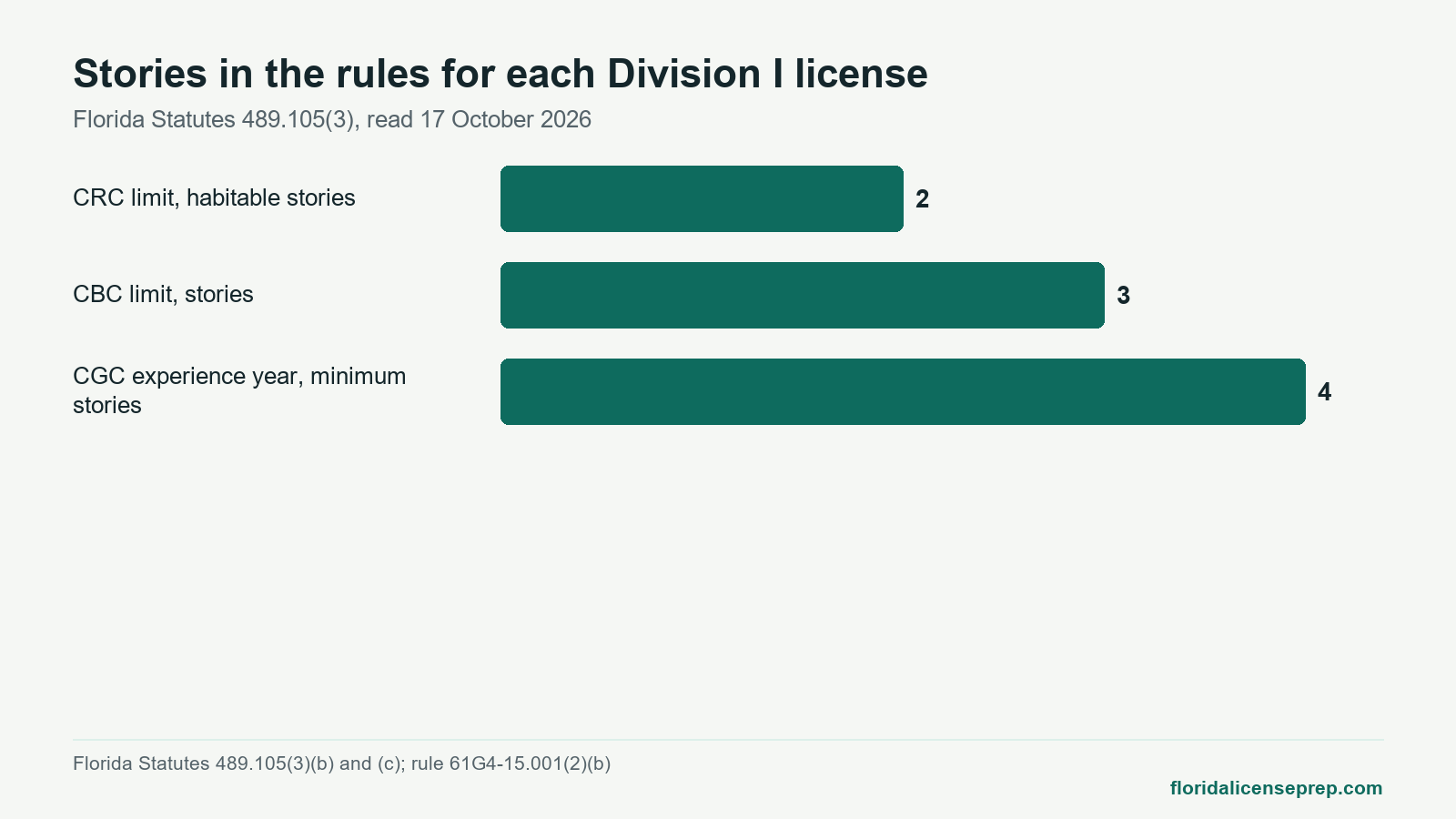
The CBC license Florida issues, the certified building contractor, covers commercial and residential buildings of up to three stories, plus nonstructural remodeling of any size building, under section 489.105(3)(b). The board wants four years of commercial experience in four of six structural areas, but not the general contractor’s year on a four story building.
Listen to this article, about 20 minutes. A synthetic voice reads the article and announces each section title as it begins; tables are read row by row and the questions at the end are left out.
Recorded 21 November 2026 from the article as published that day. Press a chapter to jump there; the highlighted line is what is playing. A play button sits beside every section heading, and once you scroll past this player a bar at the bottom of the screen keeps the controls in reach. Tap or click any sentence to hear the reading start from there.
On this page: section 489.105(3)(b) quoted in full, the six commercial experience areas from rule 61G4-15.001 and the four story year it does not ask of building applicants, every CBC fee from rule 61G4-12.009, three applicant threads, and seven prep page claims checked against the rule text.
Think you already know this? Five questions, one minute.
Every answer is on this page. Answer from what you know now; the page fills in the rest.
-
1. Under section 489.105(3)(b), may a building contractor do a nonstructural remodel inside a ten story building?
The definition includes remodeling, repair or improvement of any size building if the services do not affect the structural members. Florida Statutes 489.105 Read the section
-
2. Where may a certified building contractor do clearing, grading and other site work?
Section 489.113(3)(a) gives general contractors site work on any project, and building and residential contractors only on the lot of the specific building. Florida Statutes 489.113 Read the section
-
3. Rule 61G4-15.001(2)(b) requires a year on structures not less than four stories. Which applicants does it name?
Paragraph (2)(b) names applicants for certification in the general contractor classification; building applicants need the four of six areas only. Rule 61G4-15.001 Read the section
-
4. How does rule 61G4-12.009 treat the Contract Administration and Project Management tests for fees?
The rule says the two tests are considered one test for fee assessment: $135, $80 per test and $40 after passing, $335 in all. Rule 61G4-12.009 Read the section
-
5. How many years of proven experience does section 489.111(2)(c)4.a. ask of a certified residential contractor moving up to building?
An active certified residential contractor needs at least 3 years of proven experience in that classification and a pass in the building contractors’ exam. Florida Statutes 489.111 Read the section
The building license is the middle child of Florida contracting, and most guides describe it as a general license with a height cap. That is roughly right and specifically wrong in two places that matter. Every rule below is quoted, linked and was read on 17 October 2026 unless another date is given; the fees and the application form were read again on 13 November 2026. Nothing here rules on your application; the board does that.
What does a CBC license let you build in Florida?
Everything starts with one paragraph, section 489.105(3)(b) of the 2026 Florida Statutes. A building contractor is limited to “construction of commercial buildings and single-dwelling or multiple-dwelling residential buildings, which do not exceed three stories in height, and accessory use structures in connection therewith”. The same paragraph adds a second, separate power: “remodeling, repair, or improvement of any size building if the services do not affect the structural members of the building.”
So there are two tests. For new building and structural work, the limit is three stories, with no cap on units. For nonstructural work, height does not matter: a tenant buildout on the eleventh floor of an office tower is building contractor work; replacing a column in a four story building is not. The statute does not define structural members, though it calls a structural component “any vertical or horizontal load-bearing member of a structure.”
Two limits sit in section 489.113(3). Electrical, mechanical, plumbing, roofing, sheet metal, swimming pool and air conditioning work goes to a contractor certified or registered in that trade. For wiring, that means an electrical contractor licensed by a separate board, whose certified, registered and specialty routes are set out in the guide to which electrician license Florida issues and who issues it. And a certified building contractor may do clearing, grading and other site work only “on the lot on which a specific building is located”, while a general contractor may do it on any project. The one roofing carve out, shingles on a new building of your own construction, is set out on the page on who may roof what under the statute.
Does the building contractor definition reach this job?
Pick the job closest to yours. The answer quotes what sections 489.105(3)(b) and 489.113(3) say about it. It does not rule on your project or your eligibility; the building official and the board decide those.
A local board may still limit permits after fraud or a willful code violation (section 489.113(4)(b)).
How does the CBC compare with the CGC and the CRC?
The three Division I licenses are nested, and the table puts the CBC in the middle column. Every row comes from a primary source read on 17 October 2026, except the exam row, which is from DBPR’s booklet as read on 16 October 2026.
| Question | Residential (CRC) | Building (CBC) | General (CGC) | Source |
|---|---|---|---|---|
| New construction | One, two or three family homes, two habitable stories over at most one uninhabitable story | Commercial and residential buildings up to three stories | Unlimited | 489.105(3)(a) to (c) |
| Nonstructural remodel of a taller building | No | Yes, any size building | Yes | 489.105(3)(b) |
| Site work | Only on the lot of the specific building | Only on the lot of the specific building | Any project | 489.113(3)(a) |
| Experience areas | 3 of 5 residential areas | 4 of 6 commercial areas | 4 of 6 commercial areas, plus 1 year on a structure of at least 4 stories | 61G4-15.001 |
| Liability and property damage insurance | $100,000 and $25,000 | $300,000 and $50,000 | $300,000 and $50,000 | 61G4-15.003 |
| Contract Administration and Project Management | 45 scored questions each | 50 scored questions each | 60 scored questions each | DBPR booklet |
Read the experience row twice. The building and general licenses ask for exactly the same four of six commercial areas. The only experience difference is the four story year, which is why some applicants pass the general contractor exams and still apply for the building license. If every job you plan is a house, the residential contractor license and its two story limit asks for less. If anything above three stories is coming, the general contractor license requirements are the ones to read.
What experience does the board accept for a CBC?
The routes themselves are in section 489.111(2)(c): a relevant bachelor’s degree plus one year of experience, four years of active experience with at least one as a foreman, or a mix of foreman years and college credits. A year means “a minimum of 2,000 person-hours”. The board’s rule 61G4-15.001, last amended 16 May 2024, then says what that experience must be for the general and building categories: “commercial construction experience involving construction, erection, alteration, or modification of buildings and structures”, in four or more of these areas:
- Foundations or slabs in excess of 20,000 square feet
- Masonry walls
- Steel erection
- Elevated slabs
- Column erection
- Formwork for structural reinforced concrete
Notice what is missing. Paragraph (2)(b), the year on “structures not less than four stories in height”, names only an applicant “for certification in the general contractor classification”. The building applicant is not mentioned in it. Notice too what is excluded: the rule’s definition leaves out “storage, utility, and miscellaneous structures of an accessory character”, listing barns, carports, garages, sheds, silos, tanks and towers, and any work done under an exemption in section 489.103. The rule says buildings “with any use and occupancy classification” otherwise qualify, so a three story apartment building is not ruled out by being residential. Painting, drywall or trim work is not in the list of six areas at all.
Two conditions in subsection (1) catch people. The experience must be “lawfully acquired” under a contractor who was properly licensed in the category, or in one that covers its full scope. And experience from another state counts if it fits the 489.105 definitions. A building contractor already licensed elsewhere may not have to sit the Florida trade papers at all, and the four Florida endorsement routes, NASCLA among them, are set out with their forms and fees. Degrees accepted for the building classification are civil engineering, building construction and architecture, per subsection (4)(a).
Before you fill in the experience pages of the building application
Gather these for every employer and project. Each line comes from rule 61G4-15.001, section 489.111 or the adopted July 2024 edition of form DBPR CILB 5-B; ticking them all does not mean your experience qualifies.
The adopted form has no supervisor signature line, but DBPR may contact the supervisor to verify experience, so tell them you listed them.
What does a CBC cost, and which money tests apply?
| Item | Amount | Source |
|---|---|---|
| Application and examination fee, first attempt | $335, nonrefundable | 61G4-12.009(1)(a) |
| Of which, paid when scheduling | $135 plus $80 per test | 61G4-12.009(1)(a) |
| Of which, paid after passing | $40 | 61G4-12.009(1)(a) |
| Retake | $135 plus $80 per test | 61G4-12.009(1)(b) |
| Biennial renewal, active | $200 | 61G4-12.009(3)(a) |
| Public liability and property damage cover | $300,000 and $50,000 | 61G4-15.003 |
| Credit test | FICO 660 or higher, or a 14 hour board approved course | 61G4-15.006(2) |
The $335 works because the rule says the contract administration and project management tests “are considered one test for fee assessment”: $135, then $80 for Business and Finance, $80 for the pair, and $40 at the end. On credit, rule 61G4-15.006, amended 5 May 2024, also requires a credit report showing no unsatisfied judgments or liens against you or against a business you qualified. Its text offers no bond alternative. The insurance is attested by affidavit and must be kept for the life of the certificate.
One thing the table hides: the $335 is neither what the testing vendor charges nor the whole bill. A first attempt at all three papers costs $295 in exam charges, which is $135 to register plus the fee sheet’s $80, $40 and $40, or the rule’s $135 plus $80 plus $80, the same number either way. The rule’s last $40 is processing, and it travels with the license application. The adopted building form, DBPR CILB 5-B, read on 13 November 2026, asks for “$245” when you apply between “May 1st of an EVEN year through August 31st of an ODD year” and “$145” from September 1 of an odd year to April 30 of an even year. That $245 is the $40 processing, the $200 initial certification fee in rule 61G4-12.009(4)(a) and the $5 unlicensed activity fee in section 455.2281; the $145 swaps in the rule’s $100 second year fee. So a building applicant who passes everything first time and applies today pays $540 in state charges, or $440 for an application filed from 1 September 2027. Fingerprints, the credit report, insurance and any course come on top. The rule’s page on flrules still shows 30 October 2017 as its last amendment, so none of these figures has moved since the page was written.
Which exams does a building contractor applicant sit?
Three tests, as for every Division I license. According to DBPR’s Candidate Information Booklet, as read on 16 October 2026, Business and Finance carries 120 scored questions in 6.5 hours and is shared with every trade. The building contractor’s own Contract Administration and Project Management papers carry 50 scored questions each, 4.5 hours each. Each part needs 70 percent, with no rounding, so 35 of 50. All three are open book and multiple choice, may include unscored pilot questions, and you retake only a part you failed.
The booklet lists the building papers separately from the general contractor’s. The general contractor exam page covers books and timing, and the Business and Finance exam has its own page.
Can you move up from CRC to CBC, or from CBC to CGC?
Yes, both ways are written into section 489.111(2)(c)4. An active certified residential contractor qualifies for the building license with “at least 3 years of proven experience” in the residential classification, after passing the building contractors’ exam. A certified building contractor qualifies for the general license with at least 4 years in the building classification, after passing the general contractors’ exam. Rule 61G4-15.001(2)(b) exempts the contractors in 4.b. and c. from the four story year, so a building contractor moving up does not need it.
DBPR’s building application is form DBPR CILB 5-B, and the edition the board adopted by rule 61-35.010, footed “Eff. Date: July 2024”, was read in full on 13 November 2026. It says a certified residential contractor “holding an active current license for a minimum of 3 yrs in the classification” is “exempted from the Employment History section of this application”, and must still give a license number for verification. Take the form from the rule, not an old download: DBPR’s own site has served older editions of these applications after the rule adopted new ones.
The same page lists three routes for military veterans: three years of service plus one year as a foreman, two years of service plus a year as a foreman and a year as a worker or foreman, or one year of service plus a year as a foreman and two years as a worker or foreman, all “applicable to the category for which you are applying.” Section 489.111, read the same day, does not mention military service, so this page could not trace the rule behind those routes; ask DBPR how it applies them before relying on one.
What do CBC applicants report about the application?
Three public threads from December 2025 to June 2026, with about 25 replies between them, were read on 17 October 2026. They are what people report, not rules, and they disagree with each other on one point that matters.
- In a May 2026 r/GeneralContractor thread, an applicant who had passed all three general contractor exams applied for the building license because their experience fit only that. They were quoted $800 to $1,500 by application services, paid one, and posted in June 2026 that the state approved the application in about three weeks, first time.
- A reply in the same thread, also May 2026, said they filed alone, that their general contractor did not have to sign off on their experience, and that DBPR asked for a letter explaining why they sat the general exams but applied for the building license.
- Another reply in that thread said the opposite: that the qualifying contractor must sign an affidavit confirming the applicant’s supervisory roles, and that vague wording gets rejected.
- In an April 2026 r/Construction thread, a company owner with painting, HVAC, drywall and framing experience asked who could verify it. One reply said the past supervisor signs; another said Florida no longer requires a contractor’s affidavit.
- In a December 2025 r/GeneralContractor thread, two replies said a house built as an owner builder does not count, which matches the rule’s exclusion of exempt work.
Where they agree with the rule text: exempt owner builder work does not count, and the experience must be documented and tied to a licensed supervisor. Where they split, on whether someone must sign, the adopted form settles what it asks for. Its employment pages want the “Name of qualifying contractor for employer” and that contractor’s license number for every employer, its instructions say “DBPR may contact the supervisor to verify experience”, and the only signature anywhere in it is the applicant’s own written declaration. There is no supervisor affidavit in the July 2024 edition. That does not stop DBPR asking for more, as the letter in the May thread shows. And the painting and drywall experience in the April thread is not in the rule’s six areas, which no reply raised.
Where do the ranking pages disagree with the rule text?
This is where the building license gets muddled most. Each claim below was read on 17 October 2026 beside the rule text it contradicts. Prep company pages are evidence of what is claimed, not of what is true.
| The page says | The rule text says | Source |
|---|---|---|
| passflexam.com, in its FAQ: a CBC “can exceed three stories in height” | New construction “which do not exceed three stories in height”; only nonstructural work on taller buildings | 489.105(3)(b) |
| passflexam.com: CBC applicants qualify “through experience with smaller commercial or residential projects” | Commercial experience in four or more of six structural areas | 61G4-15.001(2)(a) |
| passflexam.com: a CGC needs experience “with buildings over four stories” | “Structures not less than four stories in height”, so four counts | 61G4-15.001(2)(b) |
| passflexam.com: “CBC applicants tackle 60” questions per trade exam | 50 scored questions each, per DBPR’s booklet as read 16 October 2026 | DBPR booklet |
| passflexam.com: moving up needs four years “without any citations or violations” | 4 years of proven experience in the classification; no violation test in that sentence | 489.111(2)(c)4.c. |
| licensetopass.com: for CRC and CBC “the experience and character bar is identical” | CRC: 3 of 5 residential areas. CBC: 4 of 6 commercial areas | 61G4-15.001(2), (3) |
| licensetopass.com: “Do not chase a specific credit score” | FICO 660 or higher, or a 14 hour approved course | 61G4-15.006(2) |
On violations, the board can deny on grounds in other sections, so a clean record still matters; the upgrade sentence just does not say it. For how the CBC sits among the trade licenses, see which Florida contractor license covers which work, and the full rule by rule list of Florida contractor license requirements.
Frequently asked questions
Does CBC stand for anything official?
It is the prefix on certified building contractor license numbers. The statute’s own term, in section 489.105(3)(b), is building contractor.
Can a CBC build a four story apartment building?
No. Section 489.105(3)(b) limits new residential and commercial buildings to those that “do not exceed three stories in height”. Four stories needs a general contractor.
Can a CBC do a nonstructural renovation in a high rise?
Yes. The same paragraph covers “remodeling, repair, or improvement of any size building if the services do not affect the structural members of the building.”
Does a CBC license work in every Florida county?
It is statewide. Section 489.113(4)(a) says a certificate holder only shows the certificate and pays local fees, though a local board may restrict permits after fraud or willful code violations.
Can a CBC do its own plumbing or electrical work?
Not without that trade’s license. Section 489.113(3) requires subcontracting electrical, mechanical, plumbing, roofing, sheet metal, pool and air conditioning work.
How long does the board take to approve a CBC application?
No processing time is set in the rules read for this page. One applicant reported about three weeks in June 2026; treat that as one account, not a standard.
Finished the page? The same five questions from the top, to see what stuck.
Rules and fees change without notice. This page was checked against the sources linked above on the date shown. If you find something different, tell us in the comments.
Leave a Reply