
The residential contractor license Florida issues covers constructing, remodeling and repairing one, two and three family homes of up to two habitable stories over at most one uninhabitable story, under section 489.105(3)(c). It usually takes four years of experience, one as a foreman, in three of five structural areas, plus three state exams.
Listen to this article, about 25 minutes. A synthetic voice reads the article and announces each section title as it begins; tables are read row by row and the questions at the end are left out.
Recorded 13 November 2026 from the article as published that day. Press a chapter to jump there; the highlighted line is what is playing. A play button sits beside every section heading, and once you scroll past this player a bar at the bottom of the screen keeps the controls in reach. Tap or click any sentence to hear the reading start from there.
On this page: the residential, building and general contractor definitions quoted side by side from section 489.105 in one cited table, the board’s three of five experience areas, the 45 question residential exams from DBPR’s own booklet, the $335 and $245 fees, what three months of board minutes and four forum accounts show, and where a ranking guide contradicts the statute.
Think you already know this? Five questions, one minute.
Every answer is on this page. Answer from what you know now; the page fills in the rest.
-
1. Under section 489.105(3)(c), which home is inside the residential contractor’s scope?
The definition covers one, two and three family residences not exceeding two habitable stories above no more than one uninhabitable story. Florida Statutes 489.105 Read the section
-
2. Which license does the statute give remodeling of any size building, if the work does not affect structural members?
Section 489.105(3)(b) includes remodeling, repair or improvement of any size building if the services do not affect the structural members. Florida Statutes 489.105 Read the section
-
3. Under section 489.113(3)(b), what roofing may a residential contractor do without subcontracting?
Paragraph (b) names those materials, installation or warranty repair, on a new building of the contractor’s own construction; other roofing is subcontracted. Florida Statutes 489.113 Read the section
-
4. How many of the five residential experience areas in rule 61G4-15.001(3) must the experience cover?
The rule says experience must be in three or more of the listed areas, from foundations and slabs to column erection. Rule 61G4-15.001 Read the section
-
5. According to DBPR’s construction booklet, which exams must a residential contractor applicant pass?
The booklet, effective July 2024, says Division I contractors, residential included, must pass all three examinations. DBPR Candidate Information Booklet Read the section
Search the phrase and the first screen offers a contractor license in a weekend, followed by guides that agree with each other more closely than with the statute. This page goes the slow way. Every rule below is quoted from Chapter 489 of the Florida Statutes or the board’s own rules, linked to its section, and was read on 13 October 2026 unless another date is given. The definition, the owner builder rules and every fee source were reread in the 2026 statutes and the adopted application form on 9 November 2026. Nothing here rules on your own application; the board does that.
What can a Florida residential contractor build?
Section 489.105(3)(c) is one sentence long. A residential contractor is “a contractor whose services are limited to construction, remodeling, repair, or improvement of one-family, two-family, or three-family residences not exceeding two habitable stories above no more than one uninhabitable story and accessory use structures in connection therewith.”
That sentence sets three limits. The building type: a house, a duplex or a triplex, and nothing with four units, however short it is. The height: two floors people live on, sitting on no more than one floor they do not, which is the shape of a home raised over a ground level garage or storage floor. And the extras: garages, sheds and other accessory structures that go with the home. Whether a particular ground floor counts as uninhabitable is a question for the building official reading the plans, not for a forum thread.
The certified license works statewide. Section 489.113(4)(a) says a certificate holder shall be required “only to exhibit to the local building official, tax collector, or other person in charge of the issuance of licenses and building permits in the area evidence of holding a current certificate and to pay the fee for the occupational license and building permit required of other persons.” Paragraph (b) still lets a local board limit permit authority, so the certificate is a key, not immunity.
How does the residential license compare with building and general?
Florida’s three Division I building licenses are nested. Paragraph (b) limits a building contractor to “construction of commercial buildings and single-dwelling or multiple-dwelling residential buildings, which do not exceed three stories in height”, plus “remodeling, repair, or improvement of any size building if the services do not affect the structural members of the building.” Paragraph (a) gives the general contractor services “unlimited as to the type of work”. The table sets the three side by side, every row from a primary source.
| Question | Residential (CRC) | Building (CBC) | General (CGC) | Source |
|---|---|---|---|---|
| Homes | One, two or three family, two habitable stories over at most one uninhabitable story | Single or multiple dwelling, up to three stories | Any | 489.105(3)(a) to (c) |
| A fourplex or small apartment building | No | Yes, up to three stories | Yes | 489.105(3)(b), (c) |
| Commercial buildings | No | Yes, up to three stories | Yes, any height | 489.105(3)(a), (b) |
| Nonstructural remodel inside a taller building | No | Yes, any size building | Yes | 489.105(3)(b) |
| Experience areas the board wants | 3 of 5 residential areas | 4 of 6 commercial areas | 4 of 6 commercial areas, plus 1 year on a structure of 4 or more stories | 61G4-15.001 |
| Contract Administration and Project Management exams | 45 scored questions each | 50 scored questions each | 60 scored questions each | DBPR booklet, July 2024 |
| Public liability and property damage minimums | $100,000 and $25,000 | $300,000 and $50,000 | $300,000 and $50,000 | 61G4-15.003 |
If every job you plan is a house, the residential license fits. If a fourplex is on the horizon, it does not, and the certified building contractor license, with its three story limit and six commercial experience areas, is the next step up. The general contractor license page covers the top of the ladder, and the map of which Florida contractor license covers which work places all three among the trade licenses.
Which Division I license does the statute’s wording name for this building?
Pick the building closest to the job. The answer names the narrowest license whose definition in section 489.105(3) covers it. It does not rule on your eligibility or your project; the building official and the board decide those.
Electrical, plumbing, mechanical, roofing, pool and air conditioning work is subcontracted to those trades whatever the building (section 489.113(3)).
Which work must a residential contractor still subcontract?
Section 489.113(3) opens with the rule every builder runs into: “A contractor shall subcontract all electrical, mechanical, plumbing, roofing, sheet metal, swimming pool, and air-conditioning work, unless such contractor holds a state certificate or registration in the respective trade category”. A residential license does not cover wiring the house it frames. Nor the pool behind it: the structural pool exception in paragraph (c) names only the general contractor, so a residential contractor hands the pool to one of the three Florida pool contractor licenses. The plumbing in that list is a separate state certificate with its own paper exam, and what a Florida plumbing contractor license covers and costs sets out how far that scope runs. For the air conditioning share of that list, which HVAC contractor class the subcontractor needs depends on the size of the system, because Class B stops at 25 tons.
Paragraph (a) gives the other direction. A general, building or residential contractor “shall be responsible for any construction or alteration of a structural component of a building or structure”, and a certified residential contractor “may perform clearing and grubbing, grading, excavation, and other site work for any construction project in this state, limited to the lot on which any specific building is located.” The lot, not the road outside it.
Roofing has one narrow carve out. Paragraph (b) says these contractors are not required to subcontract “the installation, or repair made under warranty, of wood shingles, wood shakes, or asphalt or fiberglass shingle roofing materials on a new building of his or her own construction.” Tile and metal are not on the list. Paragraph (g) then bars any general, building or residential contractor certified after 1973 from advertising as a roofing contractor without a roofing license; the roofing license page follows that line in detail.
What experience does the board accept for the residential license?
Section 489.111(2) asks that the applicant “Is 18 years of age”, “Is of good moral character”, and meets one route in paragraph (c). The application form lists them as five boxes, plus three more for veterans:
- A bachelor’s degree “in the appropriate field of engineering, architecture, or building construction” plus 1 year of proven experience, counted at “a minimum of 2,000 person-hours” a year.
- “A total of at least 4 years of active experience” as a skilled worker or foreman, “provided, however, that at least 1 year of active experience shall be as a foreman.”
- 1 year as a foreman and at least 3 years of college credits.
- 1 year as a worker, 1 year as a foreman and 2 years of college credits.
- 2 years as a worker, 1 year as a foreman and 1 year of college credits.
The veteran routes on form DBPR CILB 5-C, the July 2024 edition the board adopted under rule 61-35.010, trade military service for worker years, and every one still includes a year as a foreman.
What counts as experience is in the board’s rule 61G4-15.001(3): “construction experience involving construction, alteration, enlargement, or repair of detached one- and two-family dwellings and townhouses not more than three stories above grade plane in height with a separate means of egress.” It must be “in three or more” of five areas: foundation, slabs and structural formwork; masonry walls; structural demolition; structural wood framing, “including trusses and excluding platform framing”; and column erection. The degree route accepts civil engineering, building construction or architecture.
Notice the two rulers. The license scope speaks of three family homes and habitable stories; the experience rule speaks of one and two family homes and townhouses up to three stories above grade. So time spent framing a three story townhouse can count toward a license that would not let you build it.
Two more lines in the rule decide many applications before anyone counts years. Experience must be “gained under the supervision of a contractor, who, at the time was properly licensed” in the category or one that covers it, and experience gained under the exemptions in section 489.103 “will not be accepted.” The full requirement set, credit and fingerprints included, is in Florida contractor license requirements, rule by rule.

Before you fill in the experience pages of the residential application
Gather these for every employer and project you list. Each item is a field on the archived form CILB 5-C or a line in rule 61G4-15.001; the list does not judge whether your experience qualifies.
Ticks are saved on this device only. Nothing here promises approval; the board decides each application.
Which exams and fees come with the residential route?
DBPR’s Candidate Information Booklet for construction examinations, effective July 2024 and read through an archive capture on 13 October 2026, says “Division I contractors (General, Building, and Residential) must pass three examinations: Business & Finance, Contract Administration, and Project Management.” For the residential license that means Business and Finance at 120 scored questions over 6.5 hours, and residential versions of Contract Administration and Project Management at 45 scored questions and 4.5 hours each. Professional Testing, Inc. registers candidates; Pearson VUE schedules and delivers the computer based tests. The business paper is the same one every applicant sits, and its 2026 reference list, tab rules and retake fees are quoted in what DBPR allows on the Business and Finance exam.
Unscored pilot questions may be added, with extra time. The exams are open book: permanent tabs and highlighting are allowed, written notes are not. Courses that sell the open book exam as a near impossible ordeal are selling the cure along with the fear.

Fees are set by rule 61G4-12.009: “The application and examination fee for an applicant for certification shall be three hundred thirty-five dollars ($335.00)”, nonrefundable. It is paid as $135 when you schedule, $80 for each test administered and $40 after you pass, and “The contract administration and project management tests are considered one test for fee assessment”. A failed test is rescheduled at $135 plus $80 per test. The rule sets the initial certification fee at $200, or $100 in the second year of a biennium, and biennial renewal at $200.
The application form prints its own figure. The adopted form DBPR CILB 5-C, effective July 2024 and reread on 9 November 2026, asks for $245 when you apply for initial certification “between May 1st of an EVEN year through August 31st of an ODD year”, and $145 from 1 September of an odd year to 30 April of an even year. That $245 is three fees in one envelope: the rule’s $40 processing fee, its $200 initial certification fee, and the $5 that section 455.2281 adds “upon initial licensure and each subsequent renewal” to fund the fight against unlicensed activity. So the $335 and the $245 overlap by $40, and the state’s share of a first residential license is $540: $295 in exam charges ($135, plus $80 for Business and Finance, plus $80 for Contract Administration and Project Management counted as one test) and $245 on the form. File on or after 1 September 2027 and the form asks $145, for a total of $440. Retakes are extra. Before the license issues you also need $100,000 of public liability and $25,000 of property damage cover, the minimums the form prints for “All other categories” and the figures in rule 61G4-15.003, and workers’ compensation or an exemption under section 489.114.
How long the department takes is set by a general statute, not a contractor one. Section 120.60(1), read on 9 November 2026, gives it 30 days after receipt to “notify the applicant of any apparent errors or omissions”, and says a complete application “must be approved or denied within 90 days”. If that window passes, the license is treated as approved by default, but only after the applicant notifies “the agency clerk of the licensing agency, in writing”. Silence alone issues nothing. The board minutes quoted further down show it reviewing Division I applications at its meetings, so a file sent to the board also waits for the next meeting.
Can a residential contractor move up to building or general later?
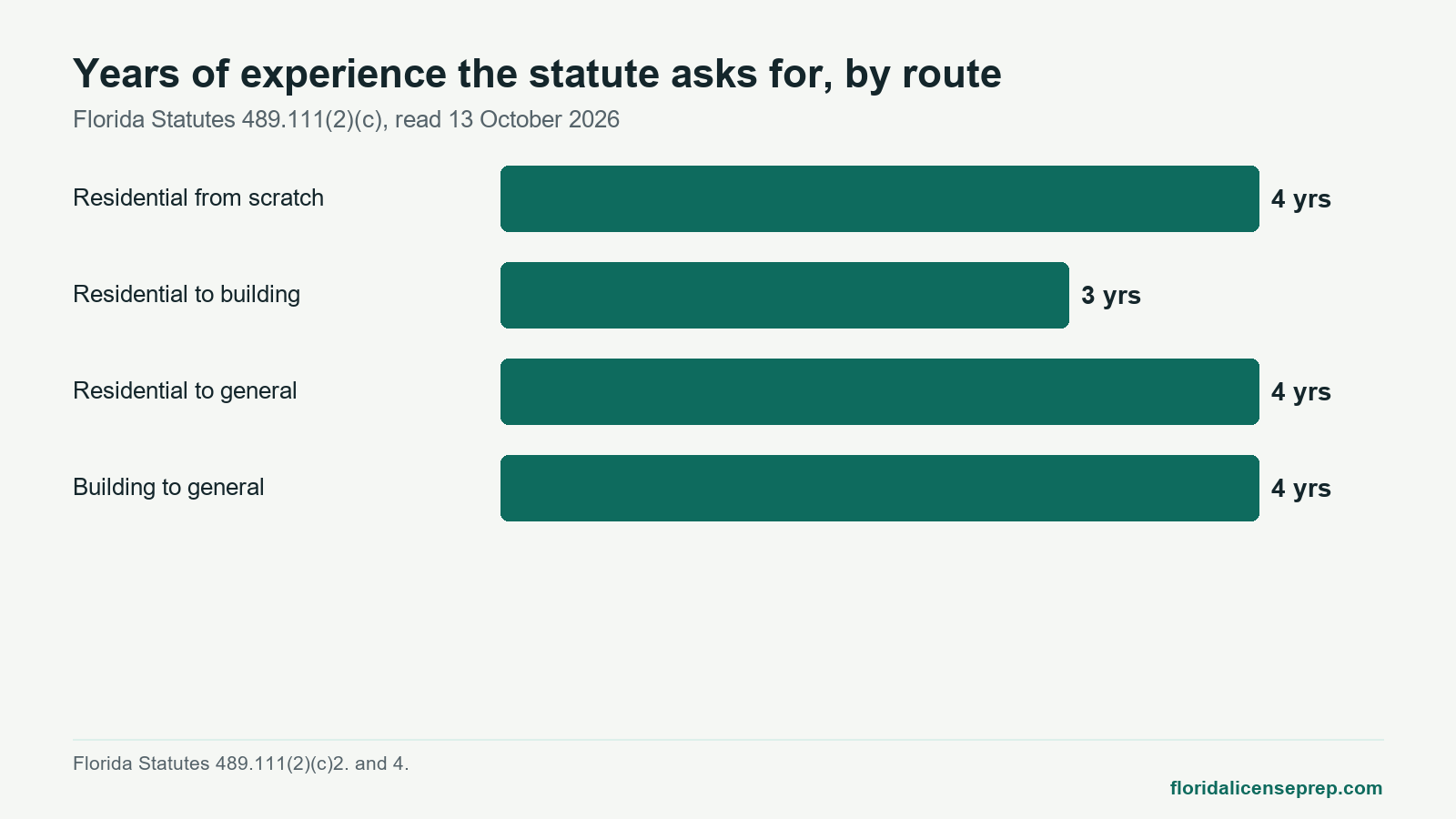
Section 489.111(2)(c)4. builds the ladder. “An active certified residential contractor is eligible to receive a certified building contractor license after passing or having previously passed the building contractors’ examination if he or she possesses a minimum of 3 years of proven experience in the classification in which he or she is certified.” For the general license the same sentence says “a minimum of 4 years”. What the adopted building form then asks of a residential contractor making that move, including the exemption from its employment history pages, is quoted on the page on moving up from a residential to a building license.
There is a quiet bonus in the board’s rule. The general contractor’s extra requirement, a year on a structure of four or more stories, applies to applicants “other than those contractors designated in sections 489.111(2)(c)4.b. and c.”, which are the residential and building upgraders. A residential contractor who has never worked above the second floor can still reach the general license, through four years of residential work and the general exams.
Can a homeowner build their own house without a residential license?
Yes, inside a fence the statute draws carefully. Section 489.103(7)(a)1, read in the 2026 statutes on 9 November 2026, exempts “Owners of property when acting as their own contractor and providing direct, onsite supervision themselves of all work not performed by licensed contractors” when building or improving “one-family or two-family residences on such property for the occupancy or use of such owners and not offered for sale or lease”. Set that beside section 489.105(3)(c) and one word is missing. The residential license covers three family homes; the owner builder exemption stops at two.
The exemption is generous about the house and stingy about the helpers. Paragraph (b) says it “does not exempt any person who is employed by or has a contract with such owner and who acts in the capacity of a contractor”, and the owner “may not delegate the owner’s responsibility to directly supervise all work” to anyone who is not registered or certified for that work. Paragraph (c) makes the owner “personally appear and sign the building permit application” and sign a disclosure statement. The friend who builds houses but never got around to the license cannot run the job for you.
Selling is where owner builds most often go wrong. The same subparagraph says that a sale or lease, or an offer of either, “within 1 year after completion of same creates a presumption that the construction was undertaken for purposes of sale or lease.” The disclosure statement an owner signs puts it more bluntly: a sale inside that year means the law will presume the house was built for sale, “which violates the exemption.” There is one newer door. Subparagraph 4 lets an owner finish a one or two family home whose listed contractor “substantially completed the project”, with the local permitting agency’s approval first, and that owner “is not required to occupy the dwelling or unit for at least 1 year”.
Two smaller numbers get mixed up with the license. Section 489.103(9) exempts work of “a casual, minor, or inconsequential nature” under $2,500 in total, unless it is part of a larger operation, split into small contracts to dodge the law, or done by someone who “advertises that he or she is a contractor”. Section 553.79(1)(g) tells local governments to exempt a single family owner from a building permit for “any work valued at less than $7,500”, but not in a flood hazard area and not for “electrical, plumbing, structural, mechanical, or gas work”. That is a permit rule, not a license rule: it says nothing about who may do the work. The handyman license page follows the $2,500 line job by job, and the penalties for unlicensed contracting in Florida show what happens when an owner build turns out to be a business.
| Situation | What the 2026 text says | Source |
|---|---|---|
| Owner builds a one or two family home to live in | Exempt, with direct onsite supervision and the permit signed in person | 489.103(7)(a)1, (c) |
| Owner builds a triplex | Not in subparagraph 1, which names one-family or two-family residences only | 489.103(7)(a)1 |
| Owner sells or leases within a year of completion | Presumed built for sale or lease | 489.103(7)(a)1 |
| Owner hires an unlicensed builder to run the job | That person is not exempt; supervision cannot pass to an unlicensed person | 489.103(7)(b) |
| Owner finishes a job the listed contractor substantially completed | Exempt with the local agency’s approval, no one year occupancy rule | 489.103(7)(a)4 |
| Anyone does a small repair under $2,500 | Exempt unless part of a larger job, split, or advertised as contracting | 489.103(9) |
What do applicants and the board’s own records report?
Public records first, because they are the most reliable account of what happens. The board’s July 2025 minutes record its Division I application review: of 28 applications on the agenda, 11 were approved, 1 approved contingent, 4 continued, 4 pulled, 3 withdrawn and 5 denied. One approval is noted as a “downgrade to CRC”, an applicant for a higher license approved for the residential one instead. The minutes record outcomes, not reasons.
Across the July, August and September 2025 minutes there are about 115 disciplinary case entries, and 10 of them involve a CRC license. Outcomes ranged widely. Case 2024046339 ended in revocation of license CRC1332741, a $20,500 fine and restitution through the Florida Homeowners’ Construction Recovery Fund. Case 2025014738 revoked CRC1326847 with a $17,500 fine, and case 2024045850 revoked CRC1332328 with $10,000. At the mild end, case 2025004295 put CRC1326729 on two years of probation with a $5,000 fine and seven extra hours of continuing education. Three months is a small sample: examples, not rates.
Forums show where applicants stall, and it is almost always the experience form. In an April 2023 contractortalk thread an owner operator moving to Florida, whose work was mostly kitchen and bath remodels, said two DBPR staff had told them by phone that their experience would count. A reply walked them through the form and the three of five areas and doubted that bath remodels fit; the poster answered that they had some framing, slab and structural demolition work inside larger remodels, and could find nothing saying how much of each is enough. The rule text read today sets no quantity either.
In a December 2025 Reddit thread a civil engineer asked whether building their own house as an owner builder could count. Two replies the same month said no, one adding that the experience has to be under a licensed qualifier; another warned that the board sends applications back over small gaps. In May 2026 someone filling in the residential experience form asked for a completed example; the only answer pointed to paid services. Four forum accounts in all, a small and self selected set.
Where they meet the rule: the owner builder answer matches it exactly. Where they part: the 2023 phone advice was the most optimistic voice of the lot, and it was not the board deciding.
Where do the ranking pages disagree with the rule text?
One prep company guide that ranks for the phrase, dated 15 November 2024 and not linked here because it sells a course, says the license covers “single-family homes, duplexes, and multifamily homes up to three stories high.” The statute says one, two or three family residences “not exceeding two habitable stories above no more than one uninhabitable story”. A fourplex is multifamily, and it is outside the residential license.
The same guide describes a “two-part exam” of Business and Finance and Trade Knowledge. That is the Division II format. DBPR’s booklet puts residential in Division I with three exams. It also says you need “at least four years of experience in residential construction” and stops there, leaving out the statute’s foreman year and the rule’s three of five areas, which are what the form actually tests. Where it is right, credit it: the form itself calls a four year construction degree “equivalent to three years experience”.
Frequently asked questions
Can a certified residential contractor in Florida build a fourplex?
No. Section 489.105(3)(c) limits the license to one, two and three family residences. A fourplex needs at least a building contractor license, which covers multiple dwelling residential buildings up to three stories.
Can a residential contractor build a house with three floors?
Only if one of them is uninhabitable. The statute allows two habitable stories above no more than one uninhabitable story, so two living floors over a garage or storage level fit the wording, and three living floors do not.
Does owner builder work on my own house count as experience?
Rule 61G4-15.001 accepts experience gained under the supervision of a properly licensed contractor and says experience gained under the exemptions in section 489.103 will not be accepted. Owner builder work is one of those exemptions.
Do I need a county license as well as the state certificate?
Section 489.113(4)(a) says a certificate holder need only show the local building official evidence of a current certificate and pay the occupational license and permit fees others pay. Local boards keep some power over permits under paragraph (b).
How long do the residential Contract Administration and Project Management exams take?
DBPR’s construction booklet, effective July 2024, lists 45 scored questions and 4.5 hours for each, alongside the 120 question, 6.5 hour Business and Finance exam.
Can a residential contractor put shingles on a house they built?
Yes. Section 489.113(3)(b) excuses general, building and residential contractors from subcontracting wood shingles, wood shakes, or asphalt or fiberglass shingles on a new building of their own construction. Other roofing goes to a roofing contractor.
Finished the page? The same five questions from the top, to see what stuck.
Rules and fees change without notice. This page was checked against the sources linked above on the date shown. If you find something different, tell us in the comments.
Leave a Reply