
There is no single electrician license Florida hands to every worker. The state licenses electrical contractors: certified (EC) to work statewide, or registered (ER) for the counties where they hold a local certificate. Journeyman cards are local. Counties may issue them under section 489.5335, and the state does not.
Listen to this article, about 19 minutes. A synthetic voice reads the article and announces each section title as it begins; tables are read row by row and the questions at the end are left out.
Recorded 22 November 2026 from the article as published that day. Press a chapter to jump there; the highlighted line is what is playing. A play button sits beside every section heading, and once you scroll past this player a bar at the bottom of the screen keeps the controls in reach. Tap or click any sentence to hear the reading start from there.
On this page: a table of every Florida electrical credential with the statute or rule that creates it, the six specialties in rule 61G6-7.001, the 40 percent 3 phase experience rule most guides skip, the state fee schedule worked into a total, and what the board’s own minutes record about approvals and denials.
Think you already know this? Five questions, one minute.
Every answer is on this page. Answer from what you know now; the page fills in the rest.
-
1. Under section 489.505, where may a registered electrical contractor contract?
Section 489.505(16) says a registered electrical contractor may contract only in the jurisdiction for which the registration is issued. Florida Statutes 489.505 Read the section
-
2. What service limit does rule 61G6-7.001 set for the residential electrical specialty?
The residential specialty covers 1 to 4 family residences up to 2 stories, with service limited to single phase, 400 ampere single service. Rule 61G6-7.001 Read the section
-
3. What share of an electrical contractor applicant’s experience must be 3 phase service under rule 61G6-5.003?
Each experience route in the rule must include, for an electrical contractor, at least 40% of work that is 3-phase service. Rule 61G6-5.003 Read the section
-
4. What does section 489.5335 say counties must do about a journeyman licensed by another Florida county?
Subsection (2) says counties and municipalities must recognize a person as a journeyman if another Florida county or city issued the license. Florida Statutes 489.5335 Read the section
-
5. In the September 2025 minutes, what reasons did the board give for its one electrical denial?
The minutes record the denial as due to lack of experience in the trade including 3-phase experience, failure to demonstrate financial responsibility and possible ULA. ECLB minutes, September 2025 Read the section
That split trips up nearly everyone who searches for an electrician license in Florida, because the phrase means two different things. To an employer it means the person holding the screwdriver. To the statute it means the business taking the money. Florida regulates the second one at state level and leaves the first one, mostly, to the counties.
Electrical work also sits outside the board most Florida contractor guides talk about. It lives in Part II of Chapter 489 and answers to the Electrical Contractors’ Licensing Board, not the Construction Industry Licensing Board. If you are still sorting out which board your trade belongs to, the overview of which Florida contractor license covers which kind of work is the place to start. Every rule quoted below was read on 8 October 2026, and the fee, net worth and timing rules were read again on 4 November 2026.
Who issues an electrician license in Florida, the state or the county?
The definitions in section 489.505 of the Florida Statutes do most of the work. A “certificate” is “a geographically unlimited certificate of competency issued by the department”. A registered electrical contractor is one who registered with the department after meeting “the competency requirements in the jurisdiction for which the registration is issued”, and who “may contract only in the jurisdiction for which his or her registration is issued.”
The Department of Business and Professional Regulation says the same thing in plainer words on its Electrical Contractors’ Licensing Board FAQ: “Certified licensees can work anywhere within the State of Florida”, while “Registered licensees can only work in the counties or municipalities where they hold a local license.” On journeymen it is blunter still: the department “does not license or regulate the journeyman’s license.”
Here is every electrical credential in one place, with the rule that creates each one.
| Credential | Who issues it | Where it is valid | Can you contract with it? | Rule text |
|---|---|---|---|---|
| Certified Electrical Contractor (EC) | DBPR, on approval of the electrical board | Statewide | Yes, all electrical and alarm work | 489.505(4) and (8) |
| Registered Electrical Contractor (ER) | DBPR registers a county or city certificate | Only the jurisdictions on the registration | Yes, there only; no alarm work | 489.513(3) and (5) |
| Certified Electrical Specialty (ES) | DBPR | Statewide, inside one specialty | Yes, inside the specialty | 61G6-7.001 |
| Registered Electrical Specialty (ET) | DBPR registers a local certificate | Local, inside one specialty | Yes, there and inside the specialty | Know Your Scope chart |
| Local master or contractor certificate of competency | County or city board | That county or city | Only after state registration | 489.537(5)(b) |
| Journeyman license | County or city, if it chooses to | Every Florida county must recognize it | No; you work for a licensed contractor | 489.5335 |
One line in section 489.537(3)(a) protects certified contractors from local add ons: a certified electrical contractor “is not subject to any additional certification or licensure requirements that are not required by this part.” Counties can still charge permit fees, business tax receipts and a bond of up to $5,000. They cannot make an EC sit a second competency exam. The business tax side is smaller than it sounds, as the Miami-Dade contractor business tax rates and the rule on out of county jobs show.
What can an EC, an ER and a specialty license holder do?
The unlimited license is defined in section 489.505(12) as covering anyone who can “install, repair, alter, add to, or design” electrical wiring and equipment “which generates, transmits, transforms, or utilizes electrical energy in any form”. The department’s FAQ adds that the EC “covers all types of electrical and alarm work.” The ER does not: “Alarm contracting is not within the scope of work for the ER license.”
Below those sit the specialties. Rule 61G6-7.001, last amended on 25 September 2024, lists six of them.

| Specialty | What the rule allows | Where it stops |
|---|---|---|
| Residential electrical | All wiring in a 1, 2, 3 or 4 family residence not over 2 stories | Single phase, 400 ampere single service |
| Limited energy systems | Wiring, fixtures and fiber optics | 98 volts (RMS); no alarm system wiring |
| Lighting maintenance | Installing, repairing or replacing lighting fixtures | The last supplying source, outlet or disconnect |
| Sign | Electrical and non electrical signs, outline lighting, foundations | Remote signs up to 25 kilowatts at 250 volts |
| Utility line | Transmission, distribution and substation work for utilities and co-ops | Point of origin to point of delivery |
| Two way radio communications enhancement | Antennae, amplifiers and wiring in any structure | 98 volts (RMS); no connection to a fire alarm panel |
The low voltage row is the one forum threads argue about. Running data cable or speaker wire inside a building still needs a license, according to the board’s FAQ: “if you are installing wiring within a structure for any reason including the items listed a license is required.” The exemptions in section 489.503 mostly cover utilities and their own employees. One that does help homeowners is subsection (24): installing low voltage landscape lighting that comes with a factory fitted cord and plug needs no license at all. There is no small job exemption in Part II. The construction side has one, in section 489.103(9), for work where “the aggregate contract price for labor, materials, and all other items is less than $2,500”, but it sits in Part I and does not reach electrical work. That gap is why Florida handymen hit a wall at electrical work even on jobs well under $2,500.
Which electrical credential does the rule text describe?
Pick the description closest to the work you want to do. The answer names the credential whose definition matches, with its source. It is not a ruling on your eligibility.
Definitions from Chapter 489 Part II and rule 61G6-7.001, read 8 October 2026. General information only; the board decides every application.
What does the state want before it certifies an electrical contractor?
Section 489.511 sets the bar. You must be at least 18, of good moral character, pass the certification exam and meet one experience route. The common ones are 3 years of management experience within the last 6, 4 years as a supervisor or contractor within the last 8, or 6 years of training, technical education or supervisory experience within the last 12. A Florida electrical engineer licensed for 3 years also qualifies.
The detail most summaries skip is in the board’s own rule 61G6-5.003. Each route must include, “For an electrical contractor, at least 40% of work that is 3-phase service”. Years spent wiring houses on single phase service can be honest, skilled work and still fall short. The FAQ adds a second trap: experience “as an electrician or supervising electrician for a facility is not considered by the board to be electrical contracting experience.” Maintenance electricians at a hospital or a plant are not working for an electrical contractor, and that is where the board draws the line.
The paperwork is heavier than the exam. The rule wants a credit report dated within 12 months that covers liens, judgments, suits and bankruptcy, W-2 forms, and statements of your work history written by someone other than you. The FAQ asks for job lists of “5 jobs per year for each year of experience you are claiming.” Then the full board reviews the file at a scheduled meeting.
Money is checked as well as experience. Rule 61G6-5.004, last amended with effect from 6 November 2023, says the business’s financial statement “must indicate a minimum net worth” of $10,000 for an unlimited electrical and alarm contractor and $5,000 for a specialty contractor. It sets no credit score. The $5,000 figure is the same one that turns up as a cash condition on a specialty approval in the April 2024 minutes further down.
How long the review takes is capped by general Florida law, not by the electrical board’s own rules. Section 120.60(1) gives the department 30 days to “notify the applicant of any apparent errors or omissions”, and says an application “must be approved or denied within 90 days after receipt of a completed application.” The 90 days run from a completed file, so a missing W-2 or job list holds the clock until it arrives.
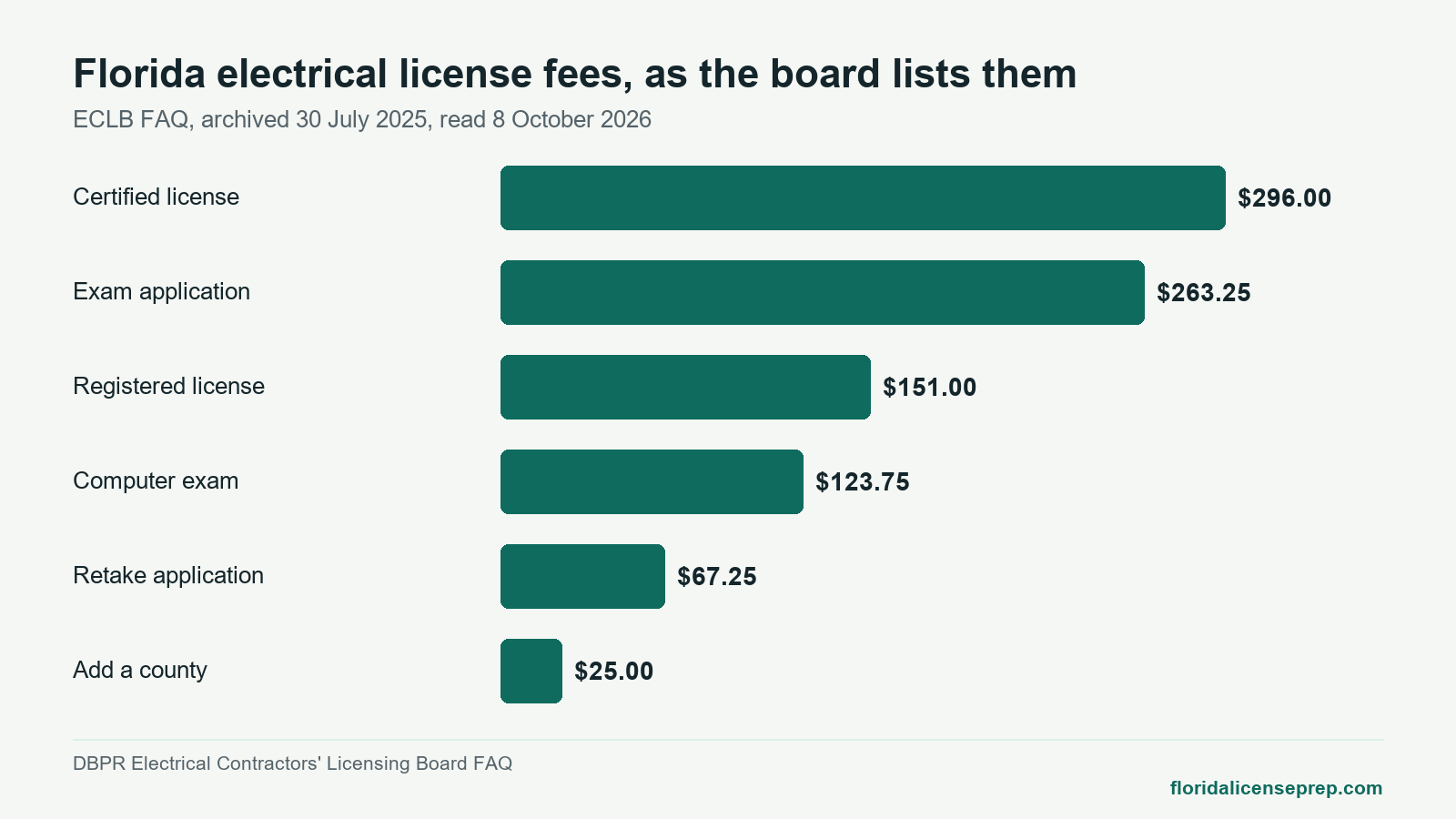
These are the state fees as the board’s FAQ lists them, read through an archived copy from 30 July 2025. On 4 November 2026 they were checked against the fee rule itself, rule 61G6-8.001, last amended with effect from 28 August 2022, with no change proposed since. The rule’s own figures add up to the FAQ’s. The $263.25 application is the $196.00 application fee in subsection (1) plus the $67.25 initial exam fee. The $296.00 license is the $291.00 certification fee in subsection (3) plus the $5.00 unlicensed activity fee in subsection (14). The $151.00 registered license is the $146.00 fee in subsection (6) plus the same $5.00, and the $492.00 endorsement total is the $196.00 application, the $291.00 license and the $5.00 together. The one figure the rule does not set is the $123.75 exam charge: subsection (1) sends test administration fees straight to the testing vendor, so that number is the FAQ’s, and the vendor quotes the current price when you book.
| Item | Fee | Paid to |
|---|---|---|
| Certified examination application | $263.25 | DBPR |
| Computer based exam | $123.75 | Testing vendor, after approval |
| Retake examination application | $67.25 | DBPR |
| Initial certified license, active | $296.00 | DBPR |
| Initial registered license, active | $151.00 | DBPR |
| Add a county to a registered license | $25.00 | DBPR |
| Endorsement application | $492.00 | DBPR |
Worked through for a first time pass on the certified route, that is $263.25 plus $123.75 plus $296.00, or $683.00 in state and vendor fees, before the credit report, any exam books, and the county’s own permit and business tax charges. The application fees are non refundable.
How does a journeyman license work if the state does not issue one?
Section 489.5335 says counties and cities “are authorized to issue journeyman licenses”, not that they must. To get one under the statute, a person has to score at least 75 percent on a proctored journeyman exam approved by the board, complete a registered apprenticeship “or has at least 12,000 hours of on-the-job training” in the trade, and finish Florida Building Commission coursework. Subsection (2) is the useful part for anyone who moves: counties “must recognize a person as a journeyman” licensed by another Florida county or city. What that one sentence does and does not cover, and how two county boards handle the cards, is set out in the walk through of who issues the electrical journeyman license in Florida.
Two county pages show how differently this plays out. Hillsborough County’s journeyman page opens with “There is no State of Florida requirement for anyone to hold a Journeyman Certificate of Competency” and says the holder “must always work under the supervision of a properly licensed Electrical/Plumbing Contractor.” Its fees are $50 to start, $100 on acceptance and a $70 one time registration fee. Miami-Dade’s personal certification application charges $240, lists 3 years of experience for a journeyman electrician, and prints in capitals that a journeyman “IS NOT A CONTRACTORS LICENSE.” Plumbers get their journeyman cards under a parallel statute, section 489.1455, which the account of how Florida licenses plumbing contractors and journeyman plumbers works through.

Three years in Miami-Dade and 12,000 hours in the statute do not obviously match: at a 40 hour week 12,000 hours is closer to six years. We could not reconcile the two from the published documents, so ask the county board which standard it applies before you count your hours.
Why hold one at all if the state does not demand it? Partly because employers ask for it, and partly because of section 489.537(3)(f): a county may require one licensed journeyman on an industrial or commercial new build of 50,000 gross square feet or more whenever electrical work over 77 volts is under way. The other route to working legally without your own license is the employee exemption in section 489.503(1), which covers people working for a licensed contractor, inside that license, with the licensee’s permission.
What do the board’s minutes show about electrical applications?
Every certified application ends at a public board meeting, and the minutes say what happened. We read two sets through the board’s published PDFs and refer to applicants by application number only.
At the September 2025 application review, about 64 electrical and alarm files were recorded as approved, 34 of them on the consent agenda without discussion. Six of those approvals came with probation, most of them until collections were paid, five files were withdrawn on the record, and one was denied: application 180066, a certified electrical file, for “lack of experience in the trade including 3-phase experience, failure to demonstrate financial responsibility and possible ULA”, the board’s shorthand for unlicensed activity.
The April 2024 minutes show the same pattern with a twist. Application 153488 was denied for failing to show 3 phase experience, and the board offered a downgrade to the utility line specialty if the applicant accepted within 15 days. Application 153341 was approved only as a utility line specialty, with proof of $5,000 cash in the bank. Application 154559 was denied on 3 phase experience outright. An endorsement file from North Carolina was refused because its limited exam was “not similar to FL EC unlimited exam” and was offered the residential specialty instead.
So most files pass, and the ones that fail tend to fail on the same two things: the 40 percent 3 phase share and the credit file. These are records of what the board decided on particular days, not a prediction for any one application, and files the department approves without a referral never appear in the minutes. For how the construction board treats its own referred files, see the rule by rule account of Florida contractor license requirements.
Where do popular guides blur the electrical license rules?
The ranking pages are not wrong so much as blurry, and the blur lands on the details that cost applicants time. The weekend licensing adverts deserve their own eye roll: no rule above can be satisfied in a weekend, because the shortest experience route is three years.
- Hours for a registered license. ServiceTitan’s Florida electrician page says “Most cities/counties require 8,000 hours (about four years) of documented electrical experience”. The only hour figure in Part II of Chapter 489 is the journeyman’s 12,000 hours in section 489.5335, and Miami-Dade’s form asks for years, not hours.
- Two kinds of license. The same page says Florida “offers two certified and two registered licenses”. The department’s own list runs to nine codes once the alarm licenses (EF, EG, EY, EZ, EJ) are counted, and an electrician bidding a job with a fire alarm in it needs to know that.
- No reciprocity at all. Pages that say Florida has no reciprocity are right about other states, which go through endorsement under section 489.511(5). Inside Florida, journeyman licenses do travel: section 489.5335(2) makes every county recognize another county’s card.
If your work is framing and finishing rather than wiring, the general contractor license rules are a different board and a different set of tests.
Frequently asked questions
Do I need a license to do electrical work on my own house in Florida?
Chapter 489 Part II regulates contracting, meaning work done for compensation. Owners working on their own property usually deal with the local building department and its permit rules, so ask that office before you start.
Can a registered electrical contractor work in another county?
Only after adding it. Section 489.513(5) says a registrant must meet the new area’s local requirements and then file with the department to have the registration endorsed for that area. The FAQ lists a $25 fee.
Who gives the Florida certified electrical contractor exam?
The board’s FAQ says the certified electrical exam is computer based and taken through the testing vendor, Pearson VUE, once the department has processed the application. Both parts must be passed.
Is solar panel installation electrical work in Florida?
The board’s FAQ says a license is required to install photovoltaic systems and that solar electric work is within the scope of certified and registered electrical contractors. Solar water heating falls under the construction board instead.
Can I hold an electrical license from another state and work in Florida?
Not directly. Section 489.511(5) offers certification by endorsement for holders of a substantially equivalent license or exam, or of a license held for at least 10 years, plus a 2 hour Florida Building Code course.
How old do I have to be to sit the Florida electrical contractor exam?
Section 489.511(1)(a) says any person who is at least 18 years of age may take the certification examination.
Finished the page? The same five questions from the top, to see what stuck.
Rules and fees change without notice. This page was checked against the sources linked above on the date shown. If you find something different, tell us in the comments.
Leave a Reply