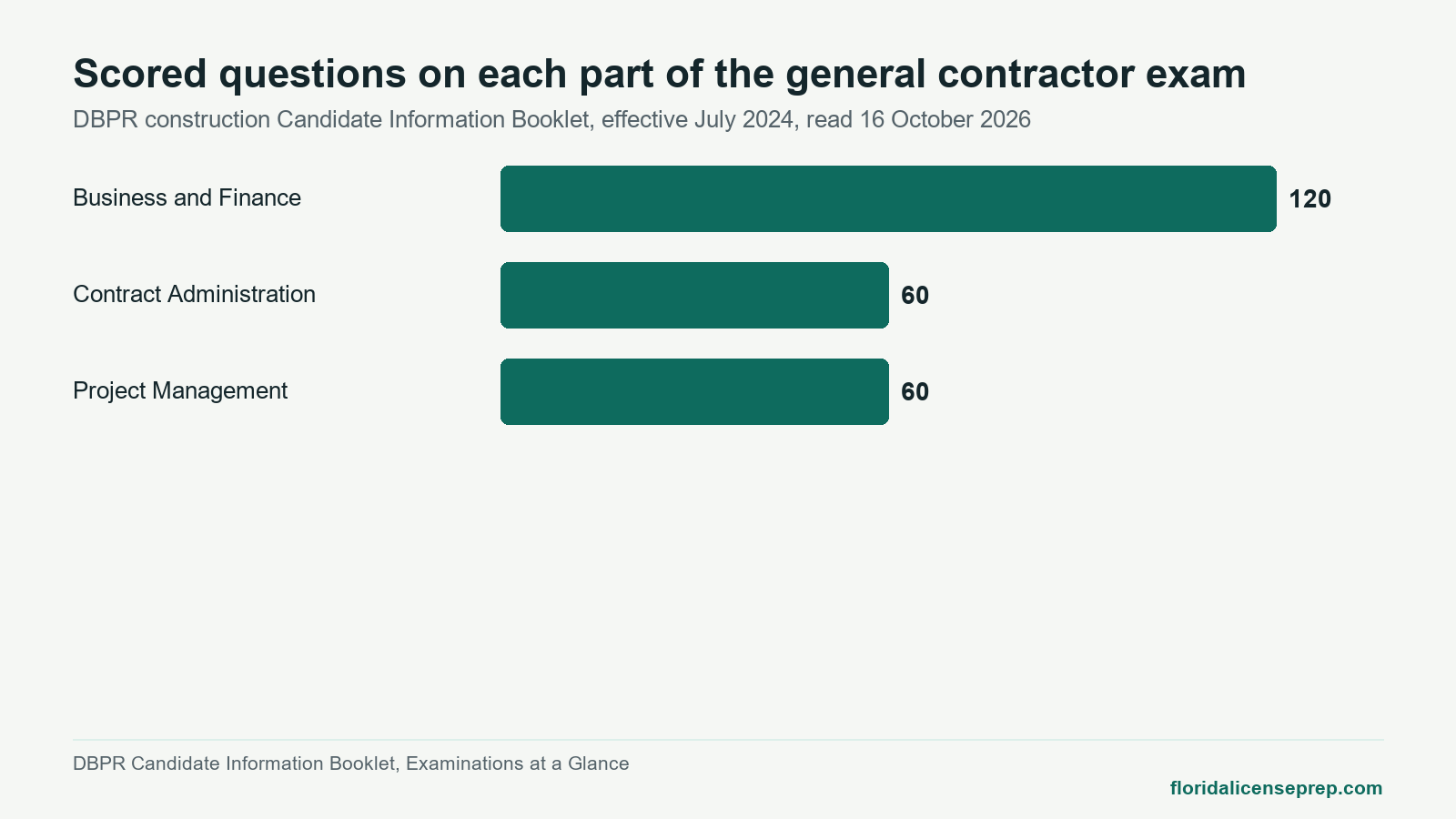
The Florida general contractor exam is three open book, multiple choice tests on a computer: Business and Finance (120 scored questions, 6.5 hours), Contract Administration (60, 4.5 hours) and Project Management (60, 4.5 hours). Each needs 70 percent with no rounding, and you retake only the parts you fail.
Listen to this article, about 22 minutes. A synthetic voice reads the article and announces each section title as it begins; tables are read row by row and the questions at the end are left out.
Recorded 12 November 2026 from the article as published that day. Press a chapter to jump there; the highlighted line is what is playing. A play button sits beside every section heading, and once you scroll past this player a bar at the bottom of the screen keeps the controls in reach. Tap or click any sentence to hear the reading start from there.
On this page: every part of the exam with its scored questions, time and pass line from DBPR’s booklet, the rule’s content weights turned into question counts, the 13 books on the 2026 list, the $335 fee worked line by line from rule 61G4-12.009, and three prep page claims checked against the rule text.
Think you already know this? Five questions, one minute.
Every answer is on this page. Answer from what you know now; the page fills in the rest.
-
1. How many tests must a Florida certified general contractor candidate pass?
DBPR’s Candidate Information Booklet says Division I contractors, general, building and residential, must pass three examinations; Division II trades sit two. Read the section
-
2. How many scored questions does the booklet list for GC Contract Administration?
The Examinations at a Glance table in the DBPR booklet lists GC Contract Administration at 60 scored questions and 4.5 hours; 120 in 6.5 hours is Business and Finance. Read the section
-
3. Which content area carries the most weight on the GC Project Management test?
Rule 61G4-16.001(1)(c) weights construction methods, materials, tools and equipment at 63 percent, safety at 20 and plans and specifications at 17. Read the section
-
4. What does the 2026 GC, BC and RC reference list say about Post-it flags?
The 2026 reference list says moveable tabs such as Post-it flags are not allowed, and handwritten or typed notes are not allowed either. Read the section
-
5. Under rule 61G4-16.009, what must a candidate who fails one part retake?
Rule 61G4-16.009 requires a retake of only the failed tests, all passed within four years of the first attempt, and sets no waiting period. Read the section
Ask a prep course how hard this exam is and the answer tends to arrive with a price tag attached. The state offers a fifteen page booklet, a reference list and three rules, which are drier but are what you are actually tested under. This page is built from those, read on 16 October 2026, with the fees and the license application step rechecked against the rule and the adopted form on 12 November 2026. DBPR’s site refuses automated readers, so its documents were read through Internet Archive captures; every link below goes to the live DBPR copy.
What are the three parts of the Florida general contractor exam?
DBPR’s Candidate Information Booklet for construction exams, effective July 2024, puts it in one sentence: “Division I contractors (General, Building, and Residential) must pass three examinations: Business & Finance, Contract Administration, and Project Management.” The board’s rule 61G4-16.001 says the same for general contractors in its own words: test two is “contract administration including managing and operating the day to day activities of a contracting firm”, and test three is “project management including managing, controlling and conducting a specific project”.
The first test is shared. A roofer, a pool builder and a general contractor all sit the same Business and Finance paper, and it gets its own page on the books, tabs and weights. The other two are written for your license. The booklet lists separate GC, BC and RC versions of Contract Administration and Project Management, so a building contractor does not sit the general contractor’s papers. A candidate who passed NASCLA’s national trade test can skip those two papers only through an endorsement application, on the conditions set out in how Florida treats the NASCLA exam. Passing all three does not issue a license on its own: section 489.111 of the Florida Statutes sets the experience, age and character tests as well, which the general contractor license requirements page quotes rule by rule.
How many questions are on each part, and what score passes?
The booklet’s Examinations at a Glance table is the only official source for the lengths, and here is what it says for the general contractor, set beside the two neighboring licenses so the difference is visible.
| Exam part | Scored questions | Time | Correct answers to pass | Source |
|---|---|---|---|---|
| Business and Finance (all trades) | 120 | 6.5 hours | 84 | CIB, Examinations at a Glance |
| GC Contract Administration | 60 | 4.5 hours | 42 | CIB, Examinations at a Glance |
| GC Project Management | 60 | 4.5 hours | 42 | CIB, Examinations at a Glance |
| BC Contract Administration or Project Management | 50 each | 4.5 hours each | 35 | CIB, Examinations at a Glance |
| RC Contract Administration or Project Management | 45 each | 4.5 hours each | 31.5, so 32 | CIB, Examinations at a Glance |
The scoring rules are short and strict. “All questions will be multiple-choice with four (4) alternative answers and will be equally weighted.” “The minimum percentage score needed to pass has been set at seventy percent (70%).” And “Scores on the construction exams are NOT rounded to the nearest percent.” So 41 out of 60 is 68.3 percent and a fail, and nobody is going to round it up for you.
The papers may also carry extra questions that do not count. The booklet says the exam “may contain a small number of experimental or ‘pilot test’ questions”, that they “will NOT be counted”, that “Additional time will be given”, and that “Pilot questions are NOT identified.” It does not print how many. You get the result before you leave the building, on an “official photo-bearing exam result report”.
What do the Contract Administration and Project Management tests cover?
Rule 61G4-16.001(1), last amended 16 December 2024, sets the content weights for both trade tests. The rule calls them “approximate”. The question counts in the last column apply those shares to 60 and round them, so they are this page’s estimate, not DBPR’s.
| Test | Content area in the rule | Weight | About this many of 60 |
|---|---|---|---|
| Contract Administration | Preconstruction Activities | 27 percent | 16 |
| Contract Administration | Project Contracts | 40 percent | 24 |
| Contract Administration | Obtaining Licenses, Permits and Approvals | 20 percent | 12 |
| Contract Administration | Construction Procedures and Operations | 13 percent | 8 |
| Project Management | Construction Methods, Materials, Tools, and Equipment | 63 percent | 38 |
| Project Management | Safety | 20 percent | 12 |
| Project Management | Reading Plans and Specifications | 17 percent | 10 |
Two things jump out. Contracts are the biggest single slice of Contract Administration, which is why three AIA contract documents sit on the reference list. And nearly two thirds of Project Management is methods, materials, tools and equipment, which is where the code books and the concrete and truss references earn their weight in your bag. The booklet adds that “knowledge of basic mathematics is required for each part of the examination”, and the reference list warns that “Some of the questions will also be based on field experience and knowledge of trade practices”, so not every answer is sitting on a page waiting to be found.
Which books may you bring into the general contractor exam?
Only the books on the current list. The GC, BC and RC reference list valid from January to December 2026 covers both trade tests and names thirteen references. DBPR posts each year’s list on its reference lists page. The list says “Editions earlier or later than those listed below can be brought to the examination but AT YOUR OWN RISK”, and “only one copy of each reference will be allowed”.
- AIA A201 General Conditions of the Contract for Construction, 2017; A401 contractor and subcontractor agreement, 2017; A701 Instructions to Bidders, 2018
- OSHA, 29 CFR Part 1926, July 1, 2025
- Contractors Manual, 2021, with a note that “Beginning July 1, 2026, the 2025, Edition will be used”
- Principles and Practices of Commercial Construction, 11th edition, 2024
- Energy Efficient Building Construction in Florida, 2024
- BCSI truss handling and bracing guide, 2020, with the same July 1, 2026 switch to the 2025 edition
- Florida Building Code 2023: Building, Accessibility, Residential, Existing Building and Energy Conservation
Read the two dated notes carefully. From 1 July 2026 the questions follow the 2025 editions of the Contractors Manual and the BCSI guide, so anyone testing now with the older copies is carrying the “at your own risk” edition. The list’s last page also names five “suggested study” books, including the Building Estimator’s Reference Book and Placing Reinforcing Bars, and says they “MAY NOT be brought into the testing room”. Buying them is fine. Packing them is not.
Booking a date in 2027? DBPR posts next year’s lists in the autumn, and the Business and Finance list for 2027 is already out, with a switch to the 2026 edition of Chapter 455 from 1 March 2027, set out on the page about what changes on the 2027 Business and Finance list. The 2027 version of this trade list could not be read for this page: on 12 November 2026 DBPR’s site answered with a bot check instead of the reference lists page. Until it can be checked, treat the 13 books above as the 2026 list and confirm the edition for your exam year before you buy anything.
Marking rules come from the same list: “References containing underlining with pen or highlighter may be used. Hand-written and typewritten notes are NOT allowed.” Existing notes “must be blackened out or removed completely”, “Moveable tabs (e.g., Post-it Flags) are NOT allowed”, and “You will not be permitted to make any marks in your references during the examination.” Books must be bound, and PDF copies must be in rings, brads, snap binders, spiral binding or screw posts, “but not with staples.” The booklet allows a calculator that is “silent, hand-held, battery-operated, nonprinting, and without an alphabetic keypad”.

What does the exam cost, and how do retakes work?
Rule 61G4-12.009(1)(a) sets the first attempt at $335, nonrefundable: $135 to the department or its exam development vendor, $80 “for each test administered”, and $40 for processing “after they have successfully passed the examination.” Then the sentence most guides skip: “The contract administration and project management tests are considered one test for fee assessment pursuant to this rule.” So a general contractor pays for two tests, not three: $135 plus $80 plus $80 plus $40 is $335.
Pearson VUE’s administration fee sheet, effective 3 January 2023, prices the same thing per paper: Construction Business and Finance $80, Construction Contract Administration $40, Construction Project Management $40. The two trade papers add up to the rule’s single $80, and the totals agree.
| What you are paying for | Amount | Source |
|---|---|---|
| Registration with the exam vendor, each attempt | $135 | 61G4-12.009(1)(a) and (b) |
| Business and Finance administration | $80 | CBT fee sheet, 2023 |
| Contract Administration administration | $40 | CBT fee sheet, 2023 |
| Project Management administration | $40 | CBT fee sheet, 2023 |
| Processing after you pass | $40 | 61G4-12.009(1)(a) |
| First attempt at all three, in total | $335 | 61G4-12.009(1)(a) |
One thing the table hides: the $335 is not what you hand over before the exam. The vendor’s charges for a first attempt at all three papers come to $295, which is $135 to register plus the fee sheet’s $80, $40 and $40, or the rule’s $135 plus $80 plus $80, the same number either way. The rule’s last $40 is processing, and it travels with the license application, not the exam booking. The adopted application form, DBPR CILB 5-A, read on 12 November 2026, asks for “$245” when you apply between “May 1st of an EVEN year through August 31st of an ODD year” and “$145” from September 1 of an odd year to April 30 of an even year. That $245 is the $40 processing, the $200 initial certification fee in rule 61G4-12.009(4)(a) and the $5 unlicensed activity fee in section 455.2281; the $145 swaps in the rule’s $100 second year fee. So someone who passes everything first time and applies today pays $540 in state charges, or $440 for an application filed from 1 September 2027.
Fail a part and rule 61G4-16.009 says “A candidate shall be required to retake only the tests on which he or she failed to achieve a passing score”. The reexamination fee in 61G4-12.009(1)(b) is $135 plus $80 for each test administered. On the vendor’s per paper prices, retaking Project Management alone comes to $135 plus $40, which is $175. The rule’s own wording, $80 per test, would make it $215, and the rule does not repeat the one test sentence for retakes, so check the amount Professional Testing quotes before paying.
Two limits matter more than the money. The retake application must reach the vendor “no less than thirty (30) days prior to the administration of the examination the candidate wishes to take”. And “a candidate must pass all tests within four years of the first attempt; after which time all past test scores of the candidate shall be considered invalid”. A pass in Business and Finance from 2023 does not wait forever for its two siblings.
Exam fee calculator, from rule 61G4-12.009 and the vendor fee sheet
Tick the parts you still need and say whether this is your first attempt or a retake. It adds up the published fees and nothing else: it says nothing about whether you will pass or be approved.
Figures: $135 registration each attempt and $40 processing after passing, from rule 61G4-12.009; $80 Business and Finance, $40 Contract Administration and $40 Project Management, from the Pearson VUE fee sheet effective 3 January 2023. Read 16 October 2026. Worked in your browser, nothing is stored or sent. Confirm the amount Professional Testing quotes before paying.
How do you register, and where do you sit it?
You apply to Professional Testing, Inc., which the booklet says DBPR contracted “to register candidates, develop, and score professional examinations”. Once approved, you book a seat with Pearson VUE, where every construction exam except plumbing is listed as “Daily CBT”. The booklet strongly recommends calling “at least five (5) business days before the examination date desired”.
On the day, arrive 30 minutes early with two forms of signature identification, one government issued. A photo is taken at check in. The tutorial can take up to 15 minutes and “will NOT reduce the time allotted”. Cancel at least two days ahead or you may forfeit the fee. Drinks are allowed in spill proof containers; food is not. If the trade papers are your last step, the licensing board’s role after the exams explains what happens to the application next.

What happens after you pass all three parts?
Nothing, on its own. Three pass reports are a ticket to apply, not a license, and the state does not send a card because you passed. The next step is the adopted application form, DBPR CILB 5-A, the July 2024 edition incorporated by rule 61-35.010 and read on 12 November 2026. It is fourteen pages, and the exam is only one of the things it checks. It asks for electronic fingerprints, which go to the Florida Department of Law Enforcement and the FBI. For an active license it wants a “credit report containing a credit score (FICO derived)” from a national agency, with a public records statement. And Section VI makes you pick one method of qualification and back it with an employment history, the experience rules that the general contractor license requirements page walks through.
| Step | What the form or statute says | Source |
|---|---|---|
| Application | Form DBPR CILB 5-A, Application for Certified General Contractor as an Individual, Eff. July 2024 | CILB 5-A |
| Fee | $245 from May 1 of an even year to August 31 of an odd year; $145 otherwise | CILB 5-A, rule 61G4-12.009(4)(a) |
| Background | Electronic fingerprints, sent to FDLE and the FBI | CILB 5-A, Section 1(b) of the instructions |
| Financial | For an active license, a credit report with a FICO derived score and a public records statement | CILB 5-A, Section 2(h) |
| Experience | One qualification method chosen in Section VI, backed by an employment history | CILB 5-A, Section VI |
| Missing items | Department must flag errors or omissions within 30 days | s. 120.60(1) |
| Decision | Approved or denied within 90 days after the application is complete | s. 120.60(1) |
The form also answers a question residential and building contractors ask about moving up a grade. It says “An active certified residential contractor is eligible to take the general contractors’ examination if he or she possesses a minimum of 4 years of proven experience in the classification in which he or she is certified”, and gives building contractors a parallel route. That is eligibility to sit these papers, not a pass on them; the three tests above still have to be taken.
Timing is set by section 120.60(1) of the Florida Statutes, read in the 2026 edition on 12 November 2026. The department must, “within 30 days after such receipt, notify the applicant of any apparent errors or omissions”, and “An application for a license must be approved or denied within 90 days after receipt of a completed application”. The 90 days count from a complete file, so a missing credit report holds the decision back until it arrives. Keep the four year limit in mind too: the scores expire four years after the first attempt, so a pass is worth applying on rather than filing away. Once a license issues, it shows on the Florida contractor license lookup, which is the quickest way to confirm it is real. Whether a particular application is approved is the board’s decision; this page does not rule on anyone’s eligibility.
Where do the prep pages and the rule text disagree?
This is the part that justifies a page like this one. Prep pages are evidence of what is claimed, not of what the rules say, and three claims read on 16 October 2026 did not match the text.
| The claim | Where | What the official text says |
|---|---|---|
| Contract Administration at “65 questions and 4.75 hours long”, the same for Project Management, and Business and Finance at “125 questions” | contractorsexamprep.com | 60 scored questions and 4.5 hours for each GC trade test, 120 and 6.5 hours for Business and Finance, per the booklet. Pilot questions exist but their number is not printed. |
| “you must wait at least 30 days before retaking it” | passflexam.com, December 2025 | Rule 61G4-16.009 sets no waiting period. The retake application must reach the vendor 30 days before the exam you want, which is a deadline, not a cooling off period. |
| A retake means paying “the full exam fee” | passflexam.com, December 2025 | Rule 61G4-12.009(1)(b) sets $135 plus the per test administration fee, and you retake only the parts you failed. |
The 65 question figure is most likely 60 scored plus five pilots, a count DBPR never publishes. It matters less than it looks, because the pass line is worked out on the scored questions only. The waiting period claim matters more: someone who believes it might sit idle for a month that the rule never asked for. One honest caveat cuts the other way. The pass rates that circulate for these papers could not be traced to any DBPR publication, so this page does not repeat them.
Frequently asked questions
Is the Florida general contractor exam open book?
Yes, all three tests are. You may bring only the references on DBPR’s current reference list for each test, one copy of each, highlighted or underlined but without handwritten or typed notes.
Can I take Contract Administration and Project Management on the same day?
DBPR’s booklet lists both as daily computer based tests booked through Pearson VUE, so scheduling is by seat availability. Each runs 4.5 hours, so two in one day makes a long day.
Does a NASCLA exam replace the Florida trade tests?
Florida’s CILB is listed by NASCLA as accepting its commercial exam, and DBPR’s construction FAQ ties that to licensure by endorsement, which also needs Florida’s Business and Finance and building code exams. Check the endorsement form before relying on it.
Which Florida Building Code edition is on the 2026 list?
The 2023 editions of the Building, Accessibility, Residential, Existing Building and Energy Conservation volumes, per DBPR’s GC, BC and RC reference list valid January to December 2026.
Is the building contractor exam the same as the general contractor exam?
Only Business and Finance is shared. DBPR’s booklet lists separate building contractor Contract Administration and Project Management tests at 50 scored questions each, against 60 for the general contractor.
Can I challenge a question I think was wrong?
Yes, during a review session. The booklet says challenges must be written on the computer during the review, are assessed by a psychometrician and subject matter experts, and come back as credit or no credit, usually in about 21 days.
Finished the page? The same five questions from the top, to see what stuck.
Rules and fees change without notice. This page was checked against the sources linked above on the date shown. If you find something different, tell us in the comments.
Leave a Reply