
The roofing license Florida issues is the roofing contractor license in section 489.105(3)(e): certified to work statewide after two exams, or registered where a county card is held. It covers roofing, waterproofing, coatings, skylights and sheathing repair. A general contractor may only shingle a new building of their own construction, and may never advertise as a roofer.
Listen to this article, about 29 minutes. A synthetic voice reads the article and announces each section title as it begins; tables are read row by row and the questions at the end are left out.
Recorded 16 November 2026 from the article as published that day. Press a chapter to jump there; the highlighted line is what is playing. A play button sits beside every section heading, and once you scroll past this player a bar at the bottom of the screen keeps the controls in reach. Tap or click any sentence to hear the reading start from there.
On this page: the roofing contractor definition and the general contractor’s shingle exception quoted from sections 489.105 and 489.113, a rule cited table of who may roof what, the homeowner and handyman exemptions in section 489.103, the $295 exam charges and $245 application that make $540, the experience boxes on form DBPR CILB 5-I, six forum accounts from 2026, and where ranking pages contradict the rule text.
Think you already know this? Five questions, one minute.
Every answer is on this page. Answer from what you know now; the page fills in the rest.
-
1. Which of these does section 489.105(3)(e) put inside the roofing contractor’s scope of work?
The definition lists skylights, required roof deck attachments, and any repair or replacement of wood roof sheathing or fascia as needed during roof repair or replacement; structural components belong to the Division I licenses under section 489.113(3)(a). Florida Statutes 489.105 Read the section
-
2. Under section 489.113(3)(b), which roofing job may a general contractor do without subcontracting it?
Paragraph (b) excuses only the installation, or repair made under warranty, of wood shingles, wood shakes, or asphalt or fiberglass shingle roofing materials on a new building of the contractor’s own construction, and paragraph (g) bars advertising as a roofing contractor. Florida Statutes 489.113 Read the section
-
3. What does rule 61G4-15.001 say about experience gained while working under a section 489.103 exemption?
The rule accepts lawfully acquired experience gained under the supervision of a properly licensed contractor and says experience from exempt work will not be accepted. Rule 61G4-15.001 Read the section
-
4. How many scored questions does DBPR’s Examinations at a Glance sheet list for the Roofing exam?
The sheet, updated June 2024, lists Roofing at 80 questions over 5 hours; the 120 question, 6.5 hour figure is Business and Finance, which every Division II applicant also sits. DBPR Examinations at a Glance Read the section
-
5. What is the maximum fine section 489.147 sets for each prohibited property insurance practice?
Section 489.147(3) says a contractor who violates the section is subject to discipline under section 489.129 and may receive up to a $10,000 fine for each violation. Florida Statutes 489.147 Read the section
Type the phrase into a search engine and the first page is adverts promising a roofing license in a weekend, followed by guides that agree with each other and disagree with the statute. This page does the slower thing. Every rule below is quoted from Chapter 489 or the board’s own rules, linked to its section, and was read on 12 October 2026 unless a different date is given.
What does the Florida statute say a roofing contractor is?
Section 489.105(3)(e) defines a roofing contractor as “a contractor whose services are unlimited in the roofing trade” with the skill to “install, maintain, repair, alter, extend, or design” and to use the materials for “all kinds of roofing, waterproofing, and coating, except when coating is not represented to protect, repair, waterproof, stop leaks, or extend the life of the roof.” Then it adds the parts people forget are roofing: “skylights; required roof-deck attachments; any repair or replacement of wood roof sheathing or fascia as needed during roof repair or replacement”, and “the evaluation and enhancement of roof-to-wall connections for structures with wood roof decking as described in Section 706 of the Florida Building Code-Existing Building”, when done with a roof covering replacement or repair.
That one license comes in two forms. Subsection (8) says a certified contractor holds “a certificate of competency issued by the department” and may work in any jurisdiction in the state. Subsection (10) says a registered contractor has registered with the department after meeting local competency requirements. Section 489.117(1) fills that in: a contractor “must be registered before engaging in business as a contractor in this state, unless he or she is certified”, registration lets you work “only in the counties, municipalities, or development districts” where you met the local rules, and “An examination is not required for registration.” The county’s exam is the exam. Pinellas County, for one, asks roofing applicants for four years as a foreman or field supervisor and a pass of 70 percent on both a trade exam and a business and law exam, as the Pinellas County certificate requirements set out.
Roofing is a Division II trade, so it sits with the same board as the general, plumbing and air conditioning licenses. If you are still working out whether a roofing license is the one your work needs, the map of which Florida contractor license covers which work routes every trade in Chapter 489.
Can a general contractor do roofing in Florida without a roofing license?
Sometimes, and the sometimes is narrow. Section 489.113(3) opens with the rule: “A contractor shall subcontract all electrical, mechanical, plumbing, roofing, sheet metal, swimming pool, and air-conditioning work, unless such contractor holds a state certificate or registration in the respective trade category”. Paragraph (b) then carves out one exception. A general, building or residential contractor “shall not be required to subcontract the installation, or repair made under warranty, of wood shingles, wood shakes, or asphalt or fiberglass shingle roofing materials on a new building of his or her own construction.” Read each limit: shingles and shakes, not tile or metal or a flat membrane; a new building; their own construction.
Paragraph (g) closes the back door that forum certainty keeps propping open: “No general, building, or residential contractor certified after 1973 shall act as, hold himself or herself out to be, or advertise himself or herself to be a roofing contractor unless he or she is certified or registered as a roofing contractor.” So a general contractor may shingle the house they built, and may not put “roofing” on the truck. The traffic runs the other way too. Paragraph (a) makes the general, building and residential contractors “responsible for any construction or alteration of a structural component of a building or structure”. A roofing contractor may replace rotten sheathing while reroofing; the rafters under it belong to someone else, which is exactly the situation one roofer described in the accounts further down.

| Work | Roofing contractor | General, building or residential | Source |
|---|---|---|---|
| Reroofing an existing building, any material | Yes | No, must be subcontracted | 489.113(3); 489.105(3)(e) |
| Shingles or shakes on a new building of their own construction | Yes | Yes, installation and warranty repair only | 489.113(3)(b) |
| Tile, metal, modified bitumen or single ply on a new building of their own construction | Yes | No, must be subcontracted | 489.113(3)(b) |
| Waterproofing and roof coatings sold to stop leaks or extend roof life | Yes | No | 489.105(3)(e) |
| Skylights, roof deck attachments, sheathing or fascia repair during a reroof | Yes | No | 489.105(3)(e) |
| Roof to wall connection enhancement with a roof replacement | Yes | No | 489.105(3)(e) |
| Rafters, trusses, ridge and other structural components | No | Yes | 489.113(3)(a) |
| Advertising as a roofing contractor | Yes | No, if certified after 1973 | 489.113(3)(g) |
| Minor roofing work on a residential solar installation | Yes | No; a solar contractor may, within board rule | 489.113(3)(f) |
Can a homeowner or handyman do roofing work without a license?
Two exemptions in section 489.103 decide it, both read in the 2026 edition on 8 November 2026. Neither uses the word roof, which has not stopped forum threads from quoting both of them with total confidence and opposite conclusions.
The first is the owner builder exemption in paragraph (7)(a). Property owners may act as their own contractor and personally supervise work on a one or two family home for their own use that is not offered for sale or lease. Roofing gets a clause of its own, subparagraph 2: an owner may be “repairing or replacing wood shakes or asphalt or fiberglass shingles” on a one, two or three family home that they or their tenant occupy, when the damage came “from an event recognized as an emergency situation” by a Governor’s executive order, and the home is “not offered for sale within 1 year after completion of the work”. Paragraph (b) is the catch. The exemption does not cover anyone the owner hires who acts as a contractor, and the owner “may not delegate the owner’s responsibility to directly supervise all work to any other person” unless that person is licensed for the work. For a whole house rather than a roof, how the owner builder exemption compares with the residential contractor license sets the two side by side, including the triplex the exemption leaves out.
The second is the minor work exemption in subsection (9): casual, minor or inconsequential work where “the aggregate contract price for labor, materials, and all other items is less than $2,500.” Subsection (9) names no trades it excludes, so on paper a small shingle patch can sit inside it. It stops applying when the job is part of a larger operation, when one job is split into contracts under $2,500, and to anyone who advertises as a contractor. The department reads it more narrowly again. Its fact sheet on Emergency Order 2022-03, dated 3 October 2022, says “Typically, jobs that require permitting are not exempt, regardless of the amount of the contract.” That is DBPR’s reading, not statute text, and the handyman license in Florida page walks through the same limits dollar by dollar.
Permits moved this year. Since 1 July 2026, section 553.79(1)(g), read on 8 November 2026, says a local government “shall exempt an owner of a single-family dwelling or the owner’s contractor” from a building permit for “any work valued at less than $7,500”. Roofing is not on its list of exclusions, but “structural” work is, and so is any property “partially or entirely located in a flood hazard area” as the Florida Building Code defines it. The exemption is not automatic: the owner or contractor must submit a written request with the contract or other papers showing the nature and value of the work. And a permit exemption is not a license exemption. The owner’s contractor still needs the roofing license unless one of the section 489.103 exemptions above applies.
| Situation | Roofing license needed? | Source |
|---|---|---|
| Owner reroofing their own one or two family home, not offered for sale or lease | No; the owner may do the work or supervise it in person | 489.103(7)(a) |
| Owner repairing storm damaged shingles or shakes on a one to three family home they or a tenant occupy, after a declared state of emergency | No, if the home is not offered for sale within 1 year of the work | 489.103(7)(a)2 |
| A worker or company the owner pays to do the roof | Yes, unless the whole job falls inside the minor work exemption | 489.103(7)(b) |
| Small shingle repair, whole job under $2,500, not part of a larger job | Not by statute; DBPR says permitted jobs are typically not exempt | 489.103(9) |
| Anyone advertising roofing work | Yes, at any price | 489.103(9)(b) |
What experience does the board require for a certified roofing license?
The eligibility test is section 489.111(2): “Is 18 years of age”, “Is of good moral character”, and one of the routes in paragraph (c). The common one is “a total of at least 4 years of active experience” as a skilled worker or foreman, “provided, however, that at least 1 year of active experience shall be as a foreman.” The degree route needs a bachelor’s “in the appropriate field of engineering, architecture, or building construction” plus one year of proven experience, and the statute fixes “a minimum of 2,000 person-hours” as a full time year.
The board’s rule 61G4-15.001, last amended 16 May 2024, accepts “lawfully acquired experience gained under the supervision of a contractor” who was properly licensed in the category applied for, and says experience from work done under a section 489.103 exemption “will not be accepted”. One quiet detail: the rule’s table of which degree counts for which license names civil engineering, building construction or architecture for the Division I licenses, mechanical engineering for air conditioning and sheet metal, and lists no field at all for roofing. A roofing applicant on the degree route is therefore relying on the statute’s general wording and the board’s reading of it, not on a named field. The adopted roofing application, form DBPR CILB 5-I, read on 8 November 2026, words it more plainly: its first method of qualification is a “Four year construction-related degree from an accredited college (equivalent to three years experience)” plus one year of proven experience in the category. The same form lists three mixes of college credits and experience, and three routes for military veterans. The whole requirement set, trade by trade, is in Florida contractor license requirements, rule by rule.
Two more items come from the statute rather than the rule. Section 489.115(9) requires “a complete set of fingerprints” with the application and says “The cost for the fingerprint processing shall be borne by the person subject to the background screening.” And rule 61G4-15.003, unchanged since 15 November 2007 and read on 7 October 2026, sets $100,000 of public liability and $25,000 of property damage insurance for roofing, a third of what a general contractor carries; the application form prints the same two figures.
Which exams and fees does the certified roofing route involve?
DBPR’s Examinations at a Glance sheet, updated June 2024 and read through the Internet Archive capture of 4 October 2026, says Division II contractors “must pass two examinations: Business and Finance and General Trade Knowledge.” Business and Finance is 120 scored questions over 6.5 hours. Roofing is 80 questions over 5 hours, computer based and offered daily. The roofing examination content information sheet, marked revised September 14 with no fuller date, confirms “80 equally weighted questions” and gives the weights below, each of which “may vary by as much as plus or minus three (3) percent.”
| Content area | Share of questions |
|---|---|
| Built-up roofs | 15 percent |
| Shingles and shakes | 15 percent |
| Single ply systems | 15 percent |
| Modified roofing systems | 15 percent |
| Architectural metal roofs | 10 percent |
| Concrete and clay tile roofs | 10 percent |
| Equipment and safety | 10 percent |
| Membrane waterproofing | 5 percent |
| Drains and gutters | 5 percent |
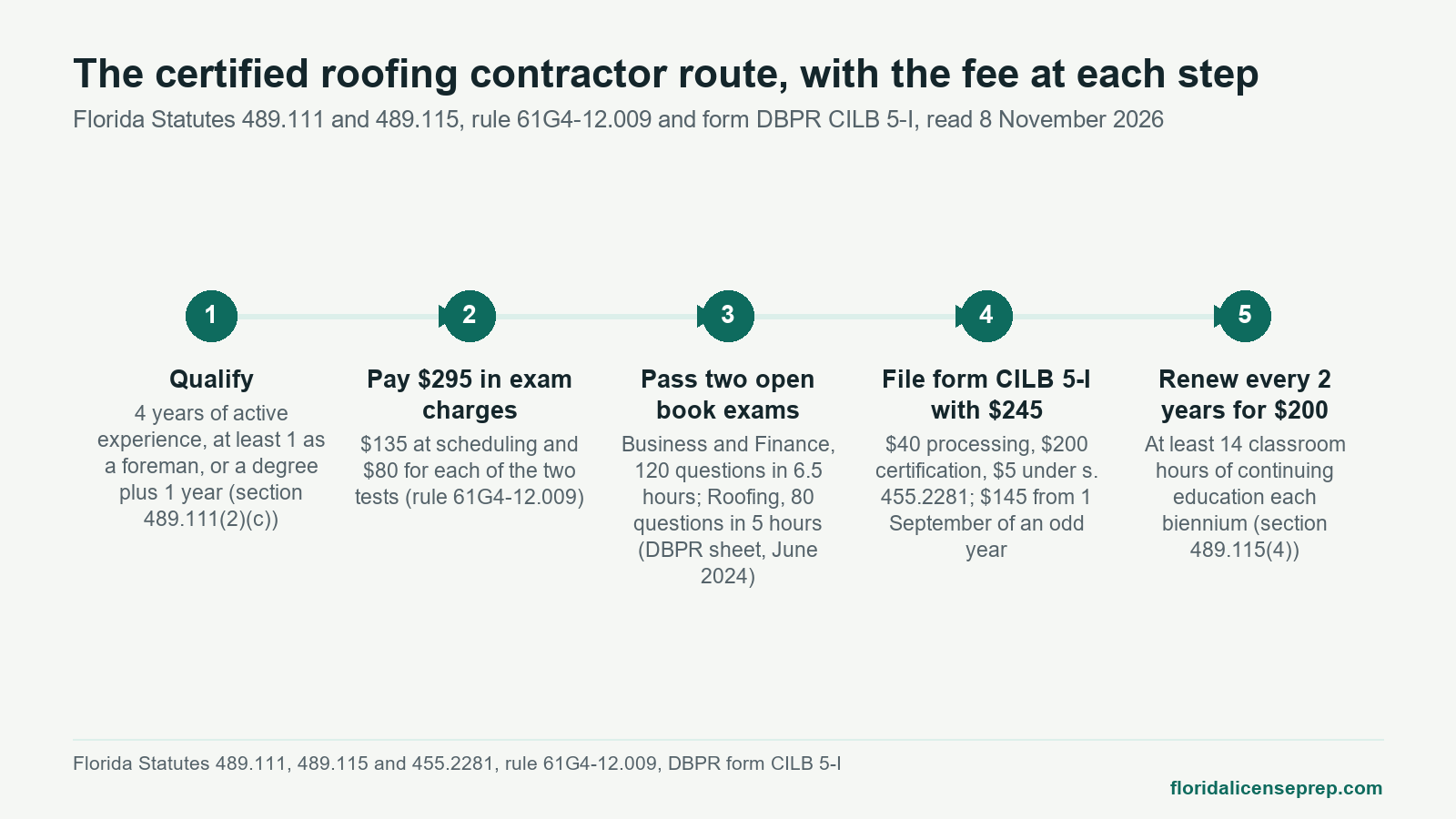
The exam fee is set by rule 61G4-12.009, last amended 30 October 2017: “The application and examination fee for an applicant for certification shall be three hundred thirty-five dollars ($335.00)”, nonrefundable, paid in pieces: $135 to the exam vendor when you schedule, $80 per test, and $40 of processing after you pass. For the two Division II exams that is $135 plus $80 twice, so $295 is paid before a first time pass, and the last $40 is application processing, collected with the license fee below. The vendor is Professional Testing, Inc. A failed part is retaken on its own at $135 plus $80 for that test. The exams are open book; permanent tabs and highlighting are allowed, written notes are not.
That $335 is not the whole bill, and it should not be added to the next figure either. The adopted roofing application, form DBPR CILB 5-I, marked “Eff. Date: July 2024” and incorporated by rule 61-35.010 (last amended 28 June 2026), prints one fee: $245 for “initial certification between May 1st of an EVEN year through August 31st of an ODD year”, or $145 from 1 September of an odd year to 30 April of an even year. That $245 is the $40 processing charge from the exam rule, the $200 “initial certification or registration fee” in the same rule ($100 in the second year of a biennium), and the “special fee of $5 per licensee” that section 455.2281 adds “upon initial licensure and each subsequent renewal”. So a roofing applicant who passes both exams first time and applies today pays $540 to the state and its exam vendor, dropping to $440 for applications made from 1 September 2027. The form was read on 8 November 2026; rule 61G4-12.009 was last amended on 30 October 2017. Renewal is $200 every two years under the same rule. Fingerprints, the credit report, the insurance premium and the reference books all come on top. Workers’ compensation under chapter 440, or an exemption, is required by section 489.114.
What does the roofing application form actually ask for?
The adopted roofing application is form DBPR CILB 5-I, “Application for Certified Roofing Contractor as an Individual”, Eff. July 2024, downloaded from flrules.org and read on 8 November 2026. DBPR’s own download page has served older editions of these forms, so this page quotes the copy the rule adopts. Its checklist is short and every line maps to a sentence quoted above: the fee, “Electronic fingerprints”, “Proof of satisfaction of liens, judgments, and discharge of bankruptcy, if applicable”, supporting legal documentation where needed, and for active applicants a credit report with a FICO derived score, plus a 14 hour financial responsibility course if the score is below 660.

The form itself runs nine sections: application type, personal information, background questions, two explanation sections for those questions, qualifications for the certified license with a project by project experience list, insurance coverage for active applicants, financial responsibility, and an affirmation by written declaration. Section VII asks two yes or no questions: whether you hold public liability and property damage insurance in the board’s amounts, and whether you hold workers’ compensation or an exemption, or “attest that you will obtain an exemption within 30 days after your license is issued”. The experience list is where applications stall, and where one forum reply below says the board picks up the phone.
Section VI is the part to read twice. For each employer it asks for the employer’s license number and a contact name, then a box list headed Part A. A roofing applicant ticks experience in “THREE OR MORE elements” of shingles, metal, tile, concrete and solar tile, and in “ALL of the following elements”: single ply systems, underlayment, insulation (tapered, flat, foam), roof penetrations, parapet walls, flashings, and sheathing and framing repairs. Four years of shingle work and nothing else does not tick enough boxes. The form says experience that falls short “may still be satisfactory” but that “the Construction Industry Licensing Board will have to review your application”, which means waiting for a board meeting rather than a staff approval. One oddity: the last element says framing repairs, while section 489.113(3)(a) leaves structural components to the Division I licenses, so the box most likely means the incidental repairs a reroof uncovers. That is this page’s reading; the form does not define it.
Roofing application checklist, item by item from the form and the rules
Tick each item as you assemble it. The list is drawn from the adopted form DBPR CILB 5-I and the statute and rules quoted on this page; it is not a ruling on eligibility and does not replace the current form from DBPR.
Ticks are saved on this device only. Nothing here promises approval; the board decides each application.
Which rules apply to roofing contractors once they are licensed?
Roofing carries one statute of its own. Section 489.147 makes a “prohibited advertisement” of any communication that encourages a consumer to make “an insurance claim for roof damage” unless it states, “in a font size of at least 12 points”, that the consumer pays the deductible and that waiving a deductible or filing a false claim is insurance fraud “punishable as a felony of the third degree”. Door hangers, magnets and emails are named. A contractor may not offer “a rebate, gift, gift card, cash, coupon, waiver of any insurance deductible, or any other thing of value” for a roof inspection or a claim, may not interpret a policy without a public adjuster license, and “may receive up to a $10,000 fine for each violation”.
Renewal is section 489.115(4): every two years, with “at least 14 classroom hours of at least 50 minutes each” of continuing education, a portion of which must cover workers’ compensation, business practices, workplace safety and, “for applicable licensure categories, wind mitigation methodologies”. Subsection (3), the endorsement route for contractors licensed in another state, adds that “Division I contractors and roofing contractors must complete a 2-hour course on the Florida Building Code which includes information on wind mitigation techniques.” Wind is the reason Florida treats roofing as its own license, and the statute keeps saying so.
What do people going through the Florida roofing license report?
Six Reddit threads from January to October 2026, read on 12 October 2026 and paraphrased. They are what people report, not evidence of what the board does.
- In r/Roofing, June 2026, a candidate studying six to eight hours a week with a prep school course and a full set of tabbed books felt they were making no progress and wondered whether the video modules taught anything. The one substantive reply said the exam is about finding the answer in the book quickly and knowing which questions to skip. In October 2026 another candidate bumped the thread looking for a highlighting guide.
- In r/Roofing, September 2026, an applicant with an economics degree and almost two years helping a friend’s roofing company asked whether the degree could stand in for three of the four years. The reply said a degree outside construction would likely not count, and that the board does call the employer named on the experience list.
- In r/Contractor, August 2026, a roofing contractor on a Florida reroof opened the deck, found rotten rafters and then a ridge beyond repair, and asked whether to keep going when the owner wanted them to. Of about twenty replies, nearly all said stop: the framing is outside a roofing license, the city wants engineered plans, and a Florida building contractor advised bringing in the engineer first. One acquaintance, relayed in the post, had urged finishing it.
- In r/GeneralContractor, October 2026, a holder of both a certified roofing and a certified building license offered to act as a remote qualifying agent only, on condition the company appoint its own financially responsible officer. In r/Roofing, April 2026, another licensee asked whether anyone needed a qualifier while planning a NASCLA exam.
- In r/Roofing, January 2026, a candidate choosing between two online courses asked which tracked weak areas; the only reply, in March, was someone else still deciding.
Where the accounts agree with the rule text: the exam is an open book search and tab discipline decides it; the experience list is verified; and structural framing is outside the roofing scope, which is section 489.113(3)(a) in forum clothing. Where they add something the statute does not say: that the board telephones employers, which no rule promises and no rule forbids. The range ran from an overwhelmed candidate to two licensees renting out their qualification, from a small, self selected sample, and nobody in it reported a pass or a fail.
Where do the ranking pages disagree with the rule text?
Two ranking pages were read on 12 October 2026 and checked line by line. Both versions are below, because a reader deserves the sentence, not a verdict.
| Claim | Who says it | What the rule text says |
|---|---|---|
| “Fees for all portions of the roofing exam are $295” | NEXT Insurance, dated 24 December 2024 | 61G4-12.009: “three hundred thirty-five dollars ($335.00)”, the $40 processing piece included |
| Licensing fee “$149 or $249” | NEXT Insurance | Form CILB 5-C: $245 or $145 by application date; the rule’s initial fee is $200 or $100 |
| Retake wait of 21 days after a fail | NEXT Insurance | No waiting period appears in 61G4-12.009 or 489.111 as read; it could not be verified |
| Business and Finance has “12 questions” | Jobber, updated 9 June 2026 | DBPR’s sheet: 120 scored questions over 6.5 hours, so a dropped zero |
| “Pearson VUE administers both exams” | Jobber | DBPR’s sheet lists computer based testing; Professional Testing, Inc. takes the $135 scheduling fee |
| “the general contractor you work under must hold a valid roofing license” | Jobber | 489.113(3)(b) lets a general contractor shingle a new building of their own construction without one |
A correction, made on 8 November 2026: the first row was wrong when this page went up. NEXT’s $295 matches the exam charges, $135 to the vendor and $80 for each of the two tests, and the rule’s $335 is that $295 plus the $40 processing charge collected with the license fee. Rechecked the same day, the NEXT page still says $295, still gives the license fee as “$149 or $249” and a 21 day wait, and is still dated 24 December 2024. Its license figure sits $4 above the $245 or $145 on form 5-I, so a reader who follows it over budgets rather than under budgets.
In fairness, the second page has the $245 and $145 right, knows the fee reduction expired, and dates its reads. The gap that costs a job is its sentence about general contractors, which is why this page quotes paragraph (b) instead of summarizing it. The general contractor license page covers the other side of that line.
Frequently asked questions
Can a Florida general contractor replace the tile roof on a house they built?
No. Section 489.113(3)(b) excuses a general, building or residential contractor from subcontracting only wood shingles, wood shakes, or asphalt or fiberglass shingle materials, and only on a new building of their own construction. Tile, metal and membrane roofs go to a roofing contractor.
Does a registered roofing contractor have to pass the state exam?
No. Section 489.117(1)(a) says an examination is not required for registration; the applicant files evidence of meeting the local competency requirements instead, and may then work only where those local requirements were met.
How many questions are on the Florida roofing contractor exam?
DBPR’s Examinations at a Glance sheet, updated June 2024, lists 80 scored questions over 5 hours for Roofing, plus the 120 question, 6.5 hour Business and Finance exam every Division II applicant sits.
Can a roofing contractor replace rotten rafters found during a reroof?
The roofing definition in section 489.105(3)(e) includes wood roof sheathing and fascia repaired during a roof repair or replacement. Rafters and ridges are structural components, which section 489.113(3)(a) assigns to general, building and residential contractors.
Is there a roofing specific continuing education requirement in Florida?
Section 489.115(4)(b) requires at least 14 classroom hours each biennium for every licensee and says a portion must cover wind mitigation methodologies for applicable categories. The endorsement route in subsection (3) separately requires roofing contractors to complete a 2 hour Florida Building Code course.
What is the fine for a roofing advert that pushes an insurance claim?
Section 489.147 makes a roof damage claim advert without the 12 point deductible and fraud statements a prohibited advertisement, and a contractor may receive up to a $10,000 fine for each violation of the section.
Finished the page? The same five questions from the top, to see what stuck.
Rules and fees change without notice. This page was checked against the sources linked above on the date shown. If you find something different, tell us in the comments.
Leave a Reply