
Florida contractor license requirements are the same core list for every certified trade: be 18, show four years of qualifying experience (or a degree route), pass the exam, submit fingerprints and a credit report with a FICO score of 660 or a 14 hour course, and carry liability insurance of $100,000 to $300,000 by class.
Listen to this article, about 21 minutes. A synthetic voice reads the article and announces each section title as it begins; tables are read row by row and the questions at the end are left out.
Recorded 21 November 2026 from the article as published that day. Press a chapter to jump there; the highlighted line is what is playing. A play button sits beside every section heading, and once you scroll past this player a bar at the bottom of the screen keeps the controls in reach. Tap or click any sentence to hear the reading start from there.
On this page: a requirements table where every row quotes the statute or 61G4 rule that creates it, the insurance minimums for each license class, the board’s own application review counts from 2025, and four places where popular guides disagree with the rule text.
Think you already know this? Five questions, one minute.
Every answer is on this page. Answer from what you know now; the page fills in the rest.
-
1. What does section 489.115(6) say about a felony conviction?
The board weighs severity, relation to contracting, time since and rehabilitation, but may not deny solely on a felony conviction. Florida Statutes 489.115 Read the section
-
2. How many person hours does section 489.111 treat as a year of full time experience?
Section 489.111(2)(c)1. says a minimum of 2,000 person hours is used in determining full time equivalency. Florida Statutes 489.111 Read the section
-
3. What does rule 61G4-15.006 offer an applicant who cannot show a FICO score of 660?
Paragraph (2)(b) says such an applicant shall meet the financial stability requirement by completing a board approved 14 hour course; it names no bond. Rule 61G4-15.006 Read the section
-
4. What public liability minimum does rule 61G4-15.003 set for a residential contractor?
The rule’s table sets $100,000 liability and $25,000 property damage for residential contractors, against $300,000 and $50,000 for general and building. Rule 61G4-15.003 Read the section
-
5. What application and examination fee does rule 61G4-12.009 set for certification?
Paragraph (1)(a) sets $335, nonrefundable, paid as $135 at scheduling, $80 per test and $40 after passing. Rule 61G4-12.009 Read the section
Most pages on this subject list those items in a friendly bulleted column and stop there. The trouble is that several of the columns are out of date, and one or two describe rules that no longer exist. This page does the dull thing instead: every requirement below comes with the sentence of statute or rule that creates it, a link to that sentence, and the date it was read, which for all of them was 7 October 2026.
If you are heading for the general contractor license in particular, the full breakdown of the general contractor experience rule and its four story test goes deeper on that one class.
What does every certified applicant need, whatever the license?
The eligibility test sits in section 489.111(2) of the Florida Statutes. A person is eligible for licensure by examination if the person “Is 18 years of age”, “Is of good moral character”, and meets one of the experience or education routes in paragraph (c). Everything else in the table comes from the sections and rules that sit around it.
| Requirement | What the text says | Source |
|---|---|---|
| Age | “Is 18 years of age” | 489.111(2)(a) |
| Character | “Is of good moral character”; the board may refuse only with “clear and convincing evidence” and a substantial connection to contracting | 489.111(2)(b) and (3) |
| Experience or education | One of six routes, such as 4 years of active experience with at least 1 year as a foreman | 489.111(2)(c) |
| Examination | “pass the appropriate examination approved by the board” | 489.113(1) |
| Fingerprints | “a complete set of fingerprints” sent to FDLE and the FBI, paid for by the applicant | 489.115(9) |
| Criminal history check | A felony may be weighed, but the board “may not deny licensure” on a felony conviction alone | 489.115(6) |
| Credit | A credit report with no unsatisfied judgments or liens, and a FICO score of 660 or a 14 hour course | 61G4-15.006 |
| Liability insurance | An affidavit that you hold and will maintain cover in the amounts in the rule | 61G4-15.003 |
| Workers’ compensation | Evidence of coverage under chapter 440, or an exemption within 30 days of issue | 489.114; 489.115(5)(d) |
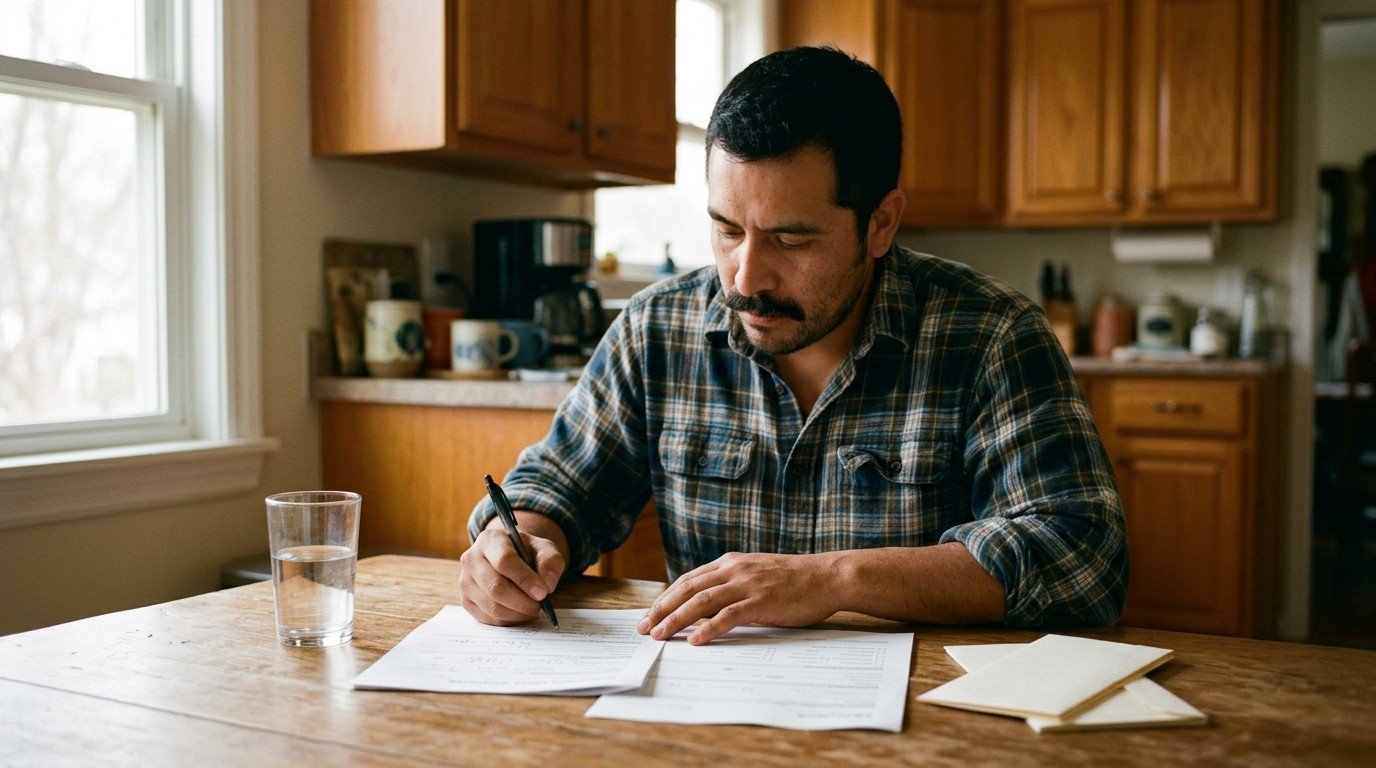
Two items on that list surprise people. The fingerprint requirement applies to every initial applicant and the statute is explicit that “The cost for the fingerprint processing shall be borne by the person subject to the background screening.” And a criminal record is not an automatic bar. The board must weigh the severity of the crime, its relation to contracting, the time since, and rehabilitation. The statute’s own wording is narrower than that list: section 489.111(3)(a) allows a refusal only where there is a substantial connection to a contractor’s duties, proved by clear and convincing evidence, as the section on what a conviction or an unpaid lien does to the application sets out beside the five year rule for specialty trades.
Everything in that table applies to an active license. The July 2024 edition of the DBPR application form for a certified residential contractor, the edition rule 61-35.010 adopts, also offers an inactive license, and its credit section carries the instruction “Do not complete this section if you selected Inactive”. An inactive license lets you hold the certification without contracting on it.
Certified license requirements checklist
Tick each item as you gather it. Each one links the rule it comes from. Ticking every box does not mean an application will be approved; the board decides that.
General information from the rule text, not a ruling on your eligibility.
How much experience does Florida require, and what counts?
Section 489.111(2)(c) gives six routes. The three most people use are: four years of active experience as a skilled worker or foreman, at least one of them as a foreman; a bachelor’s degree in the right field plus one year of proven experience; or a mix of foreman years, skilled worker years and college credits that adds up to four. The statute adds that “a minimum of 2,000 person-hours shall be used in determining full-time equivalency”, and that junior and community college courses count as accredited.
The board’s rule 61G4-15.001 then narrows what counts. The experience must be “lawfully acquired” under a contractor who was “properly licensed in the applied for category” or one that covers its full scope. Experience from another state is accepted if it fits the Florida definitions. If that experience came with a license from another state, Florida has four endorsement routes, and the comparison of the NASCLA, reciprocity and ten year endorsement routes quotes each one from section 489.115(3). Work done under an exemption in section 489.103 “will not be accepted”. So years spent on small jobs that needed no license do not build toward one. Electrical applicants face a different board with its own version of this test, including a rule that 40 percent of their experience be 3 phase work, set out in the guide to Florida electrical contractor and journeyman licensing.
| License class | What the experience must involve | Degree fields accepted |
|---|---|---|
| General and building | Commercial construction, in 4 or more of 6 areas; general also needs 1 year on structures of 4 or more stories | Civil engineering, building construction, architecture |
| Residential | One and two family dwellings and townhouses up to three stories, in 3 or more of 5 areas | Civil engineering, building construction, architecture |
| Sheet metal, air conditioning A and B, mechanical | Proven experience in the category | Mechanical engineering |
| Plumbing | Proven experience in the category | Mechanical or sanitary engineering |
| Pool classes | Proven experience in the category; servicing has a 1 year plus 60 hour course route | Building construction or civil engineering |
| Underground utility | Proven experience in the category | Building construction, civil or mechanical engineering |
One shortcut is written into section 489.113(1): an applicant with a bachelor’s degree in building construction, or a related degree the board approves, and “a grade point average of 3.0 or higher” is “only required to take and pass the business and finance portion of the examination.” The statute does not limit that shortcut to one class.
What credit score does the board require?
Rule 61G4-15.006, last amended on 5 May 2024, gives the board two money grounds for refusing an applicant. The first is financial responsibility: a current credit report that does not disclose “any unsatisfied judgments or liens against the applicant”. That reaches back to any business you previously qualified as primary qualifier, so an old company’s unpaid judgment follows you.
The second is financial stability, and the rule is short: “proof of a credit score, FICO derived, of 660 or higher.” If you cannot show that, you “shall meet the financial stability requirement by completion of a 14-hour financial responsibility course approved by the Board.” That is the whole alternative. The rule names no bond, no cash deposit and no net worth figure.

The form adds that the report must include “a public records statement that records have been checked at local, state, and federal levels”. Any lien or judgment it shows needs proof of satisfaction.
The statute behind the rule, section 489.115(7), does allow more. It says the board’s guidelines “may include minimum requirements for net worth, cash, and bonding” of no more than $20,000 for Division I and $10,000 for Division II. May is doing the work in that sentence. The rule in force today uses none of it, which is where several popular guides go wrong.
How much insurance does each license class need?
Rule 61G4-15.003 requires a signed affidavit that you “obtained and will maintain public liability and property damage insurance” for the life of an active license. Failing to keep it continuously is itself a violation. The amounts come from the table printed in the rule. For the air conditioning and mechanical classes they are $100,000 and $25,000, which the article on the HVAC license in Florida sets beside each class’s scope limit.
| License class | Public liability | Property damage |
|---|---|---|
| General contractor | $300,000 | $50,000 |
| Building contractor | $300,000 | $50,000 |
| Residential contractor | $100,000 | $25,000 |
| Sheet metal, air conditioning, roofing, mechanical | $100,000 | $25,000 |
| Pool, plumbing, underground utility, solar | $100,000 | $25,000 |
| Pollutant storage and specialty contractors | $100,000 | $25,000 |
You do not send a certificate with the application. The board runs random audits “by zip code area”, and a selected licensee has “thirty days” from the mailing of the request to produce proof. The certificate must name the exact business you qualify, show the policy number and dates, and list the DBPR’s Construction Industry Licensing Board as certificate holder. Because the board holds only your affidavit, none of this cover shows on the public record, which is why a Florida contractor license lookup leaves insurance for customers to check themselves.
Workers’ compensation is separate. Section 489.114 makes evidence of coverage a condition of issue and renewal, and sets a $500 administrative fine where coverage lapses. A business officer who is exempt files that exemption under section 440.05; the application asks you to attest you will obtain it “within 30 days after your license is issued”. Coverage is not only a licensed contractor’s concern: painting, tile and trim carpentry need no license yet sit among the construction class codes, as the workers’ compensation rules for unlicensed handyman trades set out. The renewal itself also needs 14 hours of continuing education every two years, set out topic by topic from rule 61G4-18.001 on the page on Florida contractor continuing education.

What does a certified license cost to apply for?
Rule 61G4-12.009 sets the application and examination fee for certification at “three hundred thirty-five dollars ($335.00)”, nonrefundable. It is paid in pieces: $135 to the exam development vendor when you schedule, $80 for each test administered, and $40 for processing after you pass. For fee purposes the contract administration and project management tests count as one test.
| Item | Amount in the rule | Rule paragraph |
|---|---|---|
| Application and examination, first attempt | $335 | (1)(a) |
| Retake fee per scheduling | $135, plus $80 per test | (1)(b) |
| Initial certification fee | $200, or $100 in the second year of a biennium | (4)(a) |
| Business organization application | $50 | (10)(a) |
| Registration application (local license route) | $100 | (2) |
| Biennial renewal, active | $200 | (3)(a) |
The $335 is not the whole bill. Paragraph (4)(a) of the same rule, read again on 3 November 2026, adds an initial certification fee of “two hundred dollars ($200.00)”, or “one hundred dollars ($100.00)” when it is paid “within the second year of a biennium”. Section 455.2281 of the Florida Statutes then adds “a special fee of $5 per licensee” at initial licensure to pay for action against unlicensed activity. So a certified license passed at the first sitting costs $540 in state fees, or $440 in the second year of the cycle, before fingerprinting and insurance. The adopted July 2024 edition of form CILB 5-C, read on 3 November 2026, asks for $245 or $145 with the application: the $200 or $100, the $40 processing fee that is already part of the $335, and the $5. An older copy of the form on the DBPR site, read through an archived capture on 7 October 2026, still carried a notice that fees were “reduced by 50%” for Fiscal Years 2023/2024 and 2024/2025. Both years have ended and the adopted edition carries no such notice, so pay what the current form says rather than a figure from a blog post, this one included. Form 5-A, with the same arithmetic set out line by line, is read section by section in the guide to the Florida contractor license application form 5-A.
Fingerprinting is a separate cost, charged by the LiveScan vendor rather than set in the rule.
What happens when an application goes before the board?
Most write ups stop at the checklist. The board’s own minutes show what happens to applications that staff send to a board committee for review, and they are public. The table counts every application review session in the July 2025, August 2025 and September 2025 minutes, read through archived copies.
| Session | On agenda | Approved | Approved contingent | Continued | Withdrawn or pulled | Denied |
|---|---|---|---|---|---|---|
| July 2025, Division I | 28 | 11 | 1 | 4 | 7 | 5 |
| July 2025, Division II | 20 | 5 | 2 | 5 | 4 | 4 |
| August 2025, Division I | 22 | 10 | 0 | 3 | 8 | 1 |
| August 2025, Division II | 28 | 6 | 1 | 1 | 16 | 4 |
| September 2025, Division I | 20 | 13 | 1 | 2 | 3 | 2 |
| September 2025, Division II | 23 | 7 | 3 | 5 | 2 | 6 |
| Total | 141 | 52 | 8 | 20 | 40 | 22 |
Of 141 applications put before those six sessions, 22 were denied, about one in six. More than that, 40, were withdrawn or pulled before a vote, and another 20 were continued, some for as long as 180 days. One July 2025 applicant was approved for the residential license in place of the one applied for, recorded as a “downgrade to CRC”. The minutes do not give reasons for each denial, so they cannot tell you which requirement tripped anyone up.
Two caveats. These are only the files referred to the board, not every application DBPR handles, so the share denied says nothing about applications in general. And the September 2025 Division I figures add up to 21 against an agenda of 20 in the minutes themselves, in a copy still marked unapproved. What the record does show is that a referred file is no rubber stamp. The September 2026 meeting, counted the same way in what the Florida Construction Industry Licensing Board does with the files and cases on its agenda, put 157 applications before the members and denied 24 of them.
How long the wait lasts is set by a general statute, not by the board. Section 120.60(1), read on 3 November 2026, gives any Florida agency 30 days from receipt to “notify the applicant of any apparent errors or omissions”, and says an application “must be approved or denied within 90 days after receipt of a completed application”. That clock counts from a completed file, so an application still missing a credit report or proof that a lien is satisfied is not yet on it, and the 90 days is paused while a hearing is under way. An application left undecided past the deadline is “considered approved”, but the statute makes the applicant notify the agency clerk in writing before taking “any action based upon the default license”.
Where do popular guides disagree with the rule text?
Here is where the ranking pages and the rule text part company, quoted side by side.
- A bond in place of the credit score. One requirements guide updated in April 2026 says a score below 660 means you must “post a cash deposit or purchase a construction contractor surety bond in the amount of $5,000, $10,000, or $20,000”. Seminole State College’s licensure page says “You may purchase a surety bond if your credit score is lower.” Rule 61G4-15.006(2)(b) names only the 14 hour course.
- A net worth test. Indian River County’s contractor licensing FAQ tells applicants they need “proper showing of financial stability, including net worth requirements under Rule 61G4-15.005, FAC.” The flrules.org record for 61G4-15.005 shows that rule “Repealed 9-16-07”, nineteen years ago.
- The exam fee. The same April 2026 guide puts exam fees at “approximately $295”. The rule sets $335 for a first attempt. $295 matches a retake of both tests: $135 plus $80 twice.
- Four years, full stop. Most summaries stop at four years with one supervisory. The rule also wants that experience gained under a properly licensed contractor, and excludes exempt work.
Those pages are evidence of what people believe, not of what the rule says. If you are still working out which license your work needs, the routing table from your work to the statute paragraph that names your license is the step before this one.
Frequently asked questions
Can I get a Florida contractor license with bad credit?
A low score alone is not a bar. Rule 61G4-15.006 lets an applicant who cannot show a FICO score of 660 meet the financial stability test by completing a 14 hour board approved course. Unsatisfied judgments or liens are a separate ground and need proof they were satisfied.
Does a felony stop me getting a contractor license in Florida?
Not automatically. Section 489.115(6) lets the board weigh the crime’s severity, its relation to contracting and the time since, and says it may not deny licensure based solely on a felony conviction.
Do I need a high school diploma for a Florida contractor license?
Section 489.111(2) does not list one. The requirements are age 18, good moral character and one of the experience or education routes in paragraph (c).
Does experience from another state count in Florida?
Yes, if it fits. Rule 61G4-15.001(1)(b) accepts experience from outside jurisdictions so long as it complies with the definitions in section 489.105, and it must have been gained under a properly licensed contractor.
Do I need to send a certificate of insurance with my application?
No. You sign an affidavit. Rule 61G4-15.003 says a certificate is submitted only when the board requests it in an audit, within thirty days of the request.
How many continuing education hours does a Florida contractor need?
Section 489.115(4)(b) requires at least 14 classroom hours each two year renewal cycle, including workers’ compensation, business practices, workplace safety and one hour on laws and rules.
Finished the page? The same five questions from the top, to see what stuck.
Rules and fees change without notice. This page was checked against the sources linked above on the date shown. If you find something different, tell us in the comments.
Leave a Reply