
The Florida Construction Industry Licensing Board is the 18 seat body created by section 489.107 that votes on contractor applications placed before it, disciplines licensees and answers petitions. At its September 2026 meeting it reviewed 157 applications, approving 70 outright or on condition, and took final action in 25 disciplinary matters.
Listen to this article, about 19 minutes. A synthetic voice reads the article and announces each section title as it begins; tables are read row by row and the questions at the end are left out.
Recorded 10 November 2026 from the article as published that day. Press a chapter to jump there; the highlighted line is what is playing. A play button sits beside every section heading, and once you scroll past this player a bar at the bottom of the screen keeps the controls in reach. Tap or click any sentence to hear the reading start from there.
On this page: the board’s 18 seats from section 489.107 in one cited table, the four application review sessions of its September 2026 meeting counted from the minutes, what the 25 disciplinary matters and 8 informal hearings ended in, three applicants’ accounts, and why “less than half approved” misreads the agenda.
Think you already know this? Five questions, one minute.
Every answer is on this page. Answer from what you know now; the page fills in the rest.
-
1. Under section 489.107(5), how many Division I members make a quorum?
Subsection (5) says five members of Division I constitute a quorum, and five members of Division II constitute a quorum. Florida Statutes 489.107 Read the section
-
2. What is the most the board may fine a licensee under section 489.129(1)?
The board may impose an administrative fine not to exceed $10,000 per violation, so a case with several counts can total more. Florida Statutes 489.129 Read the section
-
3. Under rule 61G4-15.006, what can an applicant with a FICO score below 660 do?
Applicants unable to show a score of 660 or higher meet the financial stability requirement by completing a 14 hour course approved by the board. Rule 61G4-15.006 Read the section
-
4. Across the four September 2026 review sessions, how many of the 157 agenda applications were denied?
The minutes record 5, 4, 8 and 7 denials across the four sessions, 24 in all, while 34 were continued. CILB minutes, September 2026 Read the section
-
5. What does each summary in the board’s minutes actually count?
Each session summary opens with the applications on the agenda, so it cannot give a statewide approval rate. CILB minutes, September 2026 Read the section
Most guides describe the board in one paragraph and then move on to selling you something. This page reads the board the way it describes itself: in the statute that creates it and in the minutes it publishes after every meeting. Every rule below is quoted and linked, and was read on 14 October 2026. The numbers come from the board’s own September 2026 minutes, counted section by section. Nothing here rules on your application; only the board and the department do that, and this site is not connected to either.
Who sits on the Florida Construction Industry Licensing Board?
Section 489.107(1) creates the board “within the department”, meaning the Department of Business and Professional Regulation. “Members shall be appointed by the Governor, subject to confirmation by the Senate”, for 4 year terms, and “No member shall serve more than two consecutive 4-year terms or more than 11 years on the board.”
Subsection (2) says “The board shall consist of 18 members”, and it splits them into two divisions under subsection (4). Division I regulates general, building and residential contractors. Division II covers the trades in section 489.105(3)(d) to (p): roofing, sheet metal, air conditioning, mechanical, pool, plumbing, underground utility and the rest.
| Seat | Number | Division | Source |
|---|---|---|---|
| General contractors | 4 | I | 489.107(2)(a), (4)(a) |
| Building or residential contractors, at least one of each | 3 | I | 489.107(2)(b) |
| Roofing, sheet metal, air conditioning, mechanical, pool, plumbing, underground utility | 1 each, 7 in all | II | 489.107(2)(c) to (i) |
| Consumer members | 2 | One in each | 489.107(2)(j) |
| Building officials of a city or county | 2 | One in each | 489.107(2)(k) |
Every contractor member must hold a certificate in the category they represent and have been in the construction business “for a period of not less than 5 consecutive years before the date of appointment.” Under subsection (5), “Five members of Division I constitute a quorum, and five members of Division II constitute a quorum”, and neither division may act on the other’s licensees, except to borrow members for a disciplinary vote when it cannot reach a quorum.
Seats on paper and seats filled are not the same thing. The September 2026 minutes list 14 members, and the chair reported writing to the Governor’s appointments unit “about getting additional board members”. The minutes are marked unapproved, so treat them as the draft record until the board adopts them.
What does the board actually decide?
The department’s construction industry page gives the short version: “The board meets regularly to consider applications for licensure, to review disciplinary cases, and to conduct informal hearings relating to licensure and discipline.” Its board information page adds that the board meets about eleven times a year for three days, with eight to twelve hours of reading before each meeting. Recent meetings have moved around the state, from St. Petersburg in June 2026 to Melbourne in September.
Five kinds of decision fill its agenda:
- Applications for a state certificate or registration, reviewed separately by Division I and Division II.
- Additional business entities. Under section 489.119(6), a qualifier who wants to qualify another company must “present evidence of his or her ability to supervise the construction activities of each such organization”, and “Approval of each business organization is discretionary with the board.”
- Discipline. Section 489.129(1) lets the board reprimand, put on probation, suspend or revoke, order restitution, require continuing education and “impose an administrative fine not to exceed $10,000 per violation”.
- Informal hearings, where an applicant or licensee answers a proposed denial or penalty in person.
- Petitions for declaratory statements, where someone asks the board how a rule applies to their own facts.
The fine cap is per violation, not per case, so one file with several counts can climb well past $10,000. That matters when you read the minutes below.
How does an application end up in front of the board?
The rules read today do not publish a list of which files staff clear alone and which go to the board’s agenda. They do set the grounds on which “the Board shall refuse to qualify an applicant”, and those are the issues that tend to put a file in front of the members.
Money comes first. Rule 61G4-15.006 requires a credit report that does “not disclose any unsatisfied judgments or liens against the applicant” and “a credit score, FICO derived, of 660 or higher”. An applicant below 660 meets the financial stability part by completing “a 14-hour financial responsibility course approved by the Board.” A lien against a business you used to qualify counts against you too.

Experience is the second. The board’s experience rule, quoted in full on the general contractor license page, asks for specific kinds of work, and the experience form is where most files stall. Criminal history and past discipline are the third, through the good moral character test and the grounds in section 489.129.
If the board proposes to deny you, you are not simply told no. Where the facts are not in dispute, section 120.57(2) requires the agency to give “a summary of the factual, legal, and policy grounds” and the option “to present to the agency or hearing officer written or oral evidence in opposition”. That is the informal hearing you see in the minutes. The full list of what every application needs is in Florida contractor license requirements, rule by rule.
If your application is placed on the board’s agenda
Each item comes from section 120.57(2), rule 61G4-15.006, rule 61G4-15.001 or what the September 2026 minutes record. The list prepares a file; it does not predict a vote, and the board decides every application.
Ticks are saved on this device only. Nothing here promises approval; the board decides each file.
What did the board handle at its September 2026 meeting?
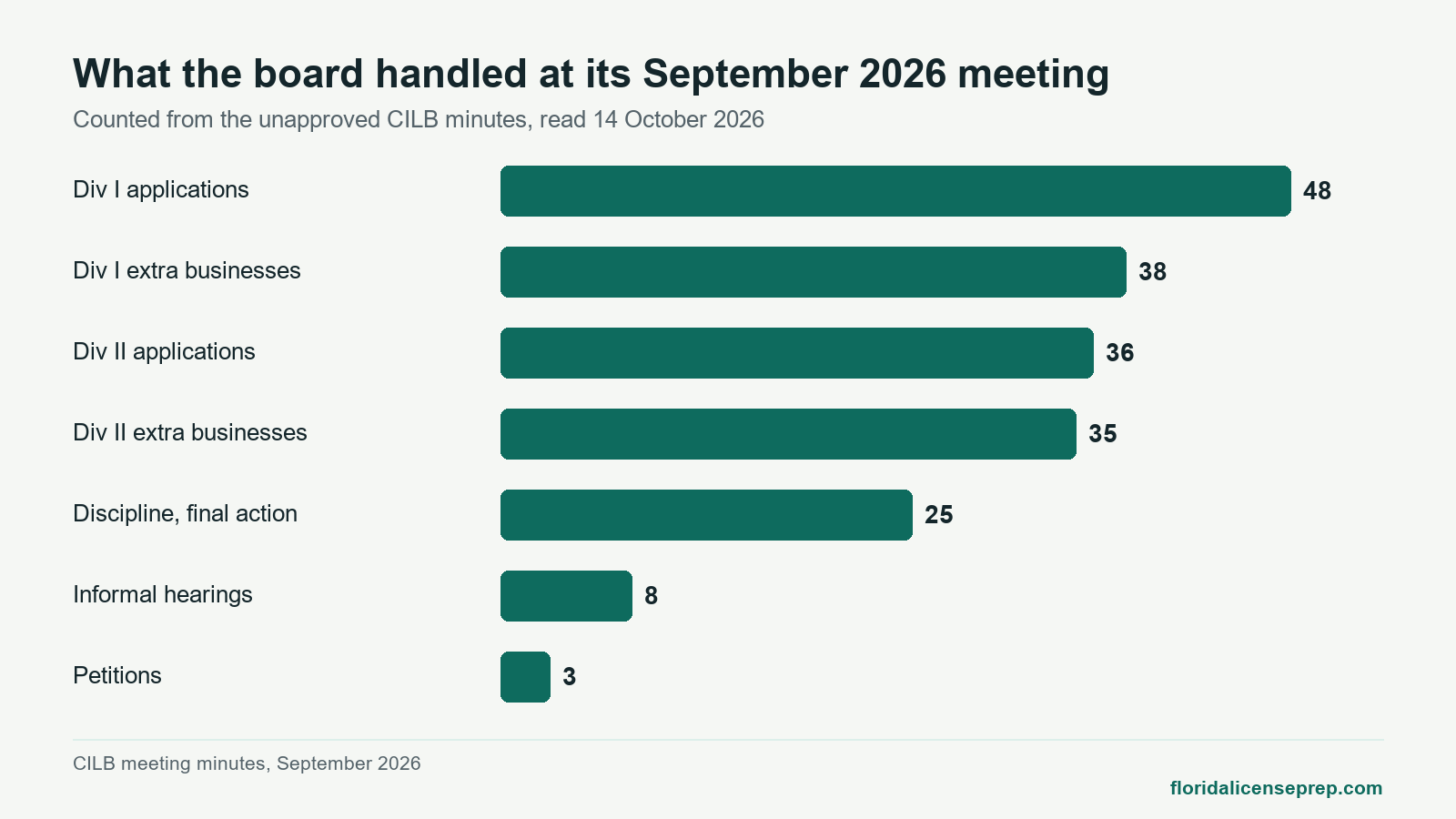
The board met on 3 September and 9 to 11 September 2026 at a hotel in Melbourne. The minutes were read on 14 October 2026 and each review session opens with one summary sentence, for example: “Of the 48 applications on the agenda, 25 were approved, 12 were continued, 3 were withdrawn, 3 were pulled and 5 were denied.” The table puts the four sessions side by side; every row adds up to its total.
| Session | On agenda | Approved | Contingent | Continued | Withdrawn | Pulled | Denied |
|---|---|---|---|---|---|---|---|
| Division I application review | 48 | 25 | 0 | 12 | 3 | 3 | 5 |
| Division I additional business entities | 38 | 12 | 4 | 10 | 4 | 4 | 4 |
| Division II application review | 36 | 20 | 0 | 2 | 5 | 1 | 8 |
| Division II additional business entities | 35 | 8 | 1 | 10 | 6 | 3 | 7 |
| All four sessions | 157 | 65 | 5 | 34 | 18 | 11 | 24 |

Discipline ran in three final action sessions with 25 matters between them: 6 in Division II, 10 heard jointly and 9 in Division I. Outcomes ranged from extra continuing education to revocation, and those extra hours sit on top of the 14 every licensee already owes each cycle, covered on the page on Florida contractor continuing education. Fines in the entries ran from $1,000 to $50,000. In case 2025079863, a general contractor license was revoked with a $17,500 fine and restitution in the amount set by the homeowners’ recovery fund. In case 2023038775, a building contractor got seven extra hours of continuing education and a $6,000 fine.
The board also held 8 informal hearings. In 2 it vacated an earlier denial and granted a license, one of them as a downgrade to a Class B air conditioning license, the narrower of the two classes described on the HVAC license page. In 4 it vacated the denial and let the applicant withdraw, so the file closes as a withdrawal rather than a denial. 1 denial was upheld and 1 hearing was continued to October. All 3 petitions for a declaratory statement got the same answer: the board voted not to provide one.
One more figure explains the pace. The prosecuting attorney reported “approximately 948 cases pending” in the department’s legal office. Complaints do not reach this table quickly.
What do applicants report about going before the board?
Five Reddit searches turned up three threads from the last year with accounts worth reading. They are what people report, not what the board decides, and the sample is small.
In a November 2025 r/GeneralContractor thread, a commenter who said they had passed all three exams and then gone before the board described it as “very particular about the type of experience”, meaning work on taller buildings and some new construction. Their advice to a high school student was to read rule 61G4-15.001, use the printable application rather than the online one, and sit in on a meeting where new applications are reviewed.
In a July 2026 thread, an applicant whose experience sat between the general and building license asked whether the board would offer the lower one. A reply said review takes about 4 to 5 weeks, that deficiency notices restart the clock, and that the board can downgrade an applicant but does not have to. Another user challenged that reply for repeatedly linking one paid application service. Two others reported doing it alone: one waited about six weeks in total, the other posted on 9 July 2026 that their license had been approved that day.
A September 2026 r/florida thread shows the other side of the board’s work: commenters pointing someone with a contractor problem to a complaint with the department and the board. Where the accounts agree with the record: the September minutes do show downgrades granted at hearing, and experience is where the forum stories concentrate. Where they do not: no rule requires an application service, and the board’s own process never mentions one.
Does the board really turn down more than half of applicants?
That claim circulates with a document attached, which makes it sound settled. In the July 2026 thread, the user promoting the application service linked the June 2026 minutes and quoted one session, 30 applications with 9 approved, 7 continued, 1 pulled, 6 withdrawn and 7 denied, under the line “less than half were approved”.
The arithmetic is right; the conclusion is not supported. Each minutes summary counts “applications on the agenda”, the files the board itself heard, and says nothing about how many applications the department received that month. The July 2026 poster approved in a matter of weeks never appears in any of these counts unless their file was one of those placed on the agenda. Continued and withdrawn are not denials either. In September, 24 of the 157 agenda applications were denied, about 15 percent, while 34 were simply continued for more information.
So the minutes are excellent evidence of what a file on the agenda faces, and no evidence at all of a statewide approval rate. When someone quotes one as the other, check what they are selling.
How does a complaint against a contractor reach the board?
Most of the 25 disciplinary matters in the September minutes started as somebody’s complaint, and the road from that complaint to a board vote is not in Chapter 489 at all. It is in section 455.225, the discipline statute the department uses for every profession it regulates, read in the 2026 edition on 10 November 2026. It says the department “shall cause to be investigated any complaint that is filed before it” when the complaint is in writing, signed and legally sufficient. “A complaint is legally sufficient if it contains ultimate facts that show that a violation of this chapter”, or of the contractor statute or the board’s rules, has happened. Facts, in other words, not adjectives. “The department may investigate an anonymous complaint if the complaint is in writing and is legally sufficient”, and the statute adds further conditions before it will.
The board does not see the file first. Under subsection (2) the investigators send their report to “the probable cause panel of the appropriate regulatory board”, a small group of members who decide whether the case goes on. Subsection (4) gives the panel 30 days after it receives the final report, by majority vote. The contractor, meanwhile, may answer in writing “within 20 days after service” of the complaint. For a first offense that “does not demonstrate a serious inability to practice the profession”, subsection (3) lets the department issue a notice of noncompliance instead, and discipline follows only if the licensee does not fix it within 15 days.
| Stage | What the statute says | Source |
|---|---|---|
| Complaint filed | Investigated if in writing and legally sufficient; an anonymous written complaint can be investigated too | 455.225(1)(a) |
| Licensee answers | A written response within 20 days after service | 455.225(1)(b) |
| First minor violation | A notice of noncompliance, with 15 days to correct it | 455.225(3) |
| Probable cause | Majority vote of a panel, within 30 days after it receives the final report | 455.225(4) |
| Public record | Confidential until 10 days after probable cause is found | 455.225(10) |
| Board final action | Reprimand, probation, suspension, revocation, restitution, fine up to $10,000 per violation | 489.129(1) |
| Homeowner repayment | Fund claim within 1 year after the action ends; $100,000 Division I or $30,000 Division II per claim for contracts on or after July 1, 2024 | 489.141, 489.143 |
One rule here surprises people. Subsection (10) keeps the complaint and the investigation “confidential and exempt from s. 119.07(1) until 10 days after probable cause has been found to exist”. So a clean record on the Florida contractor license lookup shows that no public discipline exists yet; it does not show that nobody has complained. With roughly 948 cases pending in the legal office at the September meeting, that gap can be long.
A fine is paid to the state, not to the homeowner. Getting money back runs through the Florida Homeowners’ Construction Recovery Fund in section 489.141. A claimant needs a final judgment from a Florida court, a restitution order from the board or an arbitration award, with a narrower route where a bankruptcy blocks the judgment, and the claim must be made “within 1 year after the conclusion of any civil, criminal, or administrative action.” The caps sit in section 489.143: for contracts signed on or after July 1, 2024, up to $100,000 for each Division I claim and $30,000 for each Division II claim, with $2 million and $600,000 caps on all claims against one licensee. Older contracts carry the older limits of $50,000 and $15,000 a claim. That is the fund case 2025079863 in the minutes pointed to when it set restitution. Work done by someone with no license at all is a different problem, covered on the page about unlicensed contracting in Florida. Whether a particular complaint is legally sufficient, or a particular claim payable, is for the department and the board to decide; this page does not rule on either.
Is the state board the same as a county licensing board?
No, and the shared name causes real confusion. Some counties run their own construction industry licensing boards for county level certification. Palm Beach County’s contractor FAQ says a county applicant’s criminal record “will be reviewed and considered for determination” by its own board of that name, and Charlotte County’s board meets every other month. A county card lets you work in that county; a state certificate from the state board works statewide. Which one your work needs is set out on the map of Florida contractor licenses, and the residential license page shows how a state certificate holder deals with local permit offices.
Frequently asked questions
Is the CILB part of the DBPR?
Yes. Section 489.107(1) creates the Construction Industry Licensing Board within the Department of Business and Professional Regulation. The department processes applications and prosecutes complaints; the board votes on the files and cases placed before it.
Can anyone attend a CILB meeting?
The board meets in public at hotels around the state, and its minutes are posted on the department’s site. Applicants and respondents on the agenda can attend in person or through a lawyer, as the September 2026 minutes record.
What happens if my application is continued?
A continuance puts the file on a later agenda, usually after 30 or 60 days in the September 2026 minutes. It is not a denial; the board normally wants more information before voting.
Can the board give me a lower license than the one I applied for?
It can, but it does not have to. The September 2026 minutes record a denial vacated at an informal hearing and a license granted as a downgrade to Class B air conditioning.
What is the largest fine the board can impose?
Section 489.129(1) allows an administrative fine not to exceed $10,000 per violation, and subsection (2) allows up to $5,000 more per violation against the business organization in some cases.
Do I need a credit score of 660 to get licensed?
Rule 61G4-15.006 asks for a FICO derived score of 660 or higher. An applicant below that can meet the financial stability requirement by completing a 14 hour financial responsibility course approved by the board.
Finished the page? The same five questions from the top, to see what stuck.
Rules and fees change without notice. This page was checked against the sources linked above on the date shown. If you find something different, tell us in the comments.
Leave a Reply