
A Pinellas County construction license now matters mainly for county certified contractors and journeymen. Since chapter 2024-294 took effect on 14 June 2024, the Pinellas County Construction Licensing Board no longer registers state certified contractors; they show their state license and insurance to each building department. The board was rewritten, not dissolved.
Listen to this article, about 23 minutes. A synthetic voice reads the article and announces each section title as it begins; tables are read row by row and the questions at the end are left out.
Recorded 19 November 2026 from the article as published that day. Press a chapter to jump there; the highlighted line is what is playing. A play button sits beside every section heading, and once you scroll past this player a bar at the bottom of the screen keeps the controls in reach. Tap or click any sentence to hear the reading start from there.
On this page: chapter 2024-294 quoted section by section, a dated timeline of how Pinellas contractor licensing changed, a side by side of state certified, county certified and journeyman rules, what three 2025 board minutes record, and three claims on other pages checked against the law.
Think you already know this? Five questions, one minute.
Every answer is on this page. Answer from what you know now; the page fills in the rest.
-
1. What did chapter 2024-294, Laws of Florida, do to the Pinellas County Construction Licensing Board?
The act recodifies the board’s special acts and says the PCCLB is created within the County of Pinellas, consisting of 15 members. Chapter 2024-294 Read the section
-
2. What does the PCCLB’s own site say state certified contractors must do to work in Pinellas County?
The board’s site says state certified contractors do not have to register with it, and must provide proof of state license and valid insurance to every building department. pcclb.com Read the section
-
3. Under section 7(2) of the 2024 act, what is the passing grade on a PCCLB certification exam?
Section 7(2)(b) says a passing grade on the examination is 70 percent, and 7(2)(a) makes it an open book exam. Chapter 2024-294 Read the section
-
4. Which of these job scopes does section 489.117(4)(a)1. name as one a local government may not license?
The statute’s list of job scopes that do not substantially correspond to a state category begins with painting, flooring and cabinetry. Section 489.117 Read the section
-
5. Under section 13(2) of the county act, contracting without being certified is what?
Section 13(2) says anyone who violates subsection (1) is guilty of a misdemeanor of the first degree, punishable under section 775.082 or 775.083. Chapter 2024-294 Read the section
If you heard the board was abolished, so did a few websites. The county drafted that bill in 2023; it is not the one that passed. Every rule below was read on 19 October 2026, and the county application, fee schedule and 2026 minutes on 16 November 2026, and each is linked where it lives. Nothing here rules on anyone’s eligibility, and this site has no connection to the board or the state.
Was the Pinellas County Construction Licensing Board dissolved?
No. It was re-created. The House staff final bill analysis of HB 1483, dated 3 July 2024, describes the board as “a dependent agency of the Pinellas County Board of County Commissioners” that “regulates certain construction and home improvement contractors practicing in all Pinellas County jurisdictions.” The law itself, chapter 2024-294, says in Section 3 of the new charter: “The PCCLB is created, within the County of Pinellas, consisting of 15 members.”
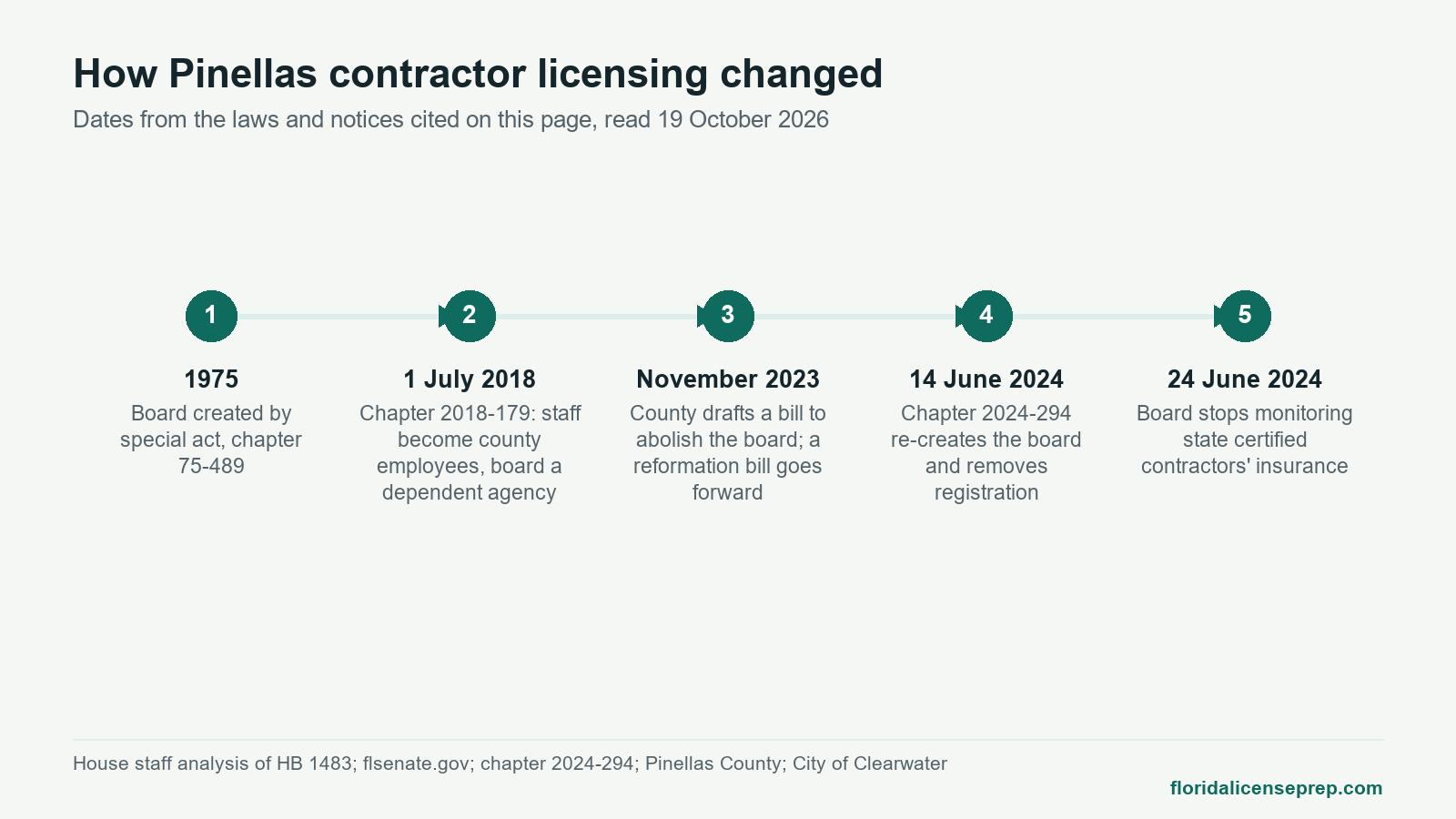
The confusion has two honest sources. First, a 2018 law, CS/CS/HB 1137 (chapter 2018-179, effective 1 July 2018), turned the board’s staff into county employees and made the board a dependent agency of the County Commission. That felt like an ending to people who remembered the old independent board. Second, in November 2023 the county put a draft local bill in front of its legislative delegation whose Section 2 reads: “The Pinellas County Construction Licensing Board is abolished.” A reformation bill went forward instead, and became law.
An exit stays on paper: the charter says the board “shall stand dissolved” if county voters approve a transfer of its authority by referendum. We found no record of one. For now, it meets, votes and licenses.
Do state certified contractors still register in Pinellas County?
Not with the board. The PCCLB’s own site, pcclb.com, says it in capitals: “State certified contractors DO NOT have to register or renew their registrations with PCCLB to work in Pinellas County.” Instead they must “provide proof of state license and valid insurance to every building department.” The broadest of those state certificates, and the four story experience year behind it, are set out in the rules for a general contractor license in Florida. That matches Section 7(8) of the 2024 act: a state certificateholder exhibits “evidence of holding a current state certificate” to the local building official with the usual permit fee, and “shall not be required to take an examination” for a county or city license.
Here is the snag. The county’s own Register a State Contractor’s License page, read the same morning, still says Pinellas “requires state-certified contractors to register their license with the county” and provide proof of insurance. Two county pages, two answers. The law and the board’s site agree with each other, and the staff analysis says the 2024 act removed “registration requirements for contractors, consistent with the prohibition of local contractor licensing that takes effect July 1, 2024.” Rechecked on 16 November 2026, it still says so, although the board’s May 2026 minutes record its fee schedule being amended because the PCCLB “no longer requires anything related to State contracts or registrations.” Our reading is that the services page was never updated. Call the department on (727) 582-3100 before you rely on either.

What changed in practice is who checks your insurance. A City of Clearwater permitting notice says that effective 24 June 2024 the board “will no longer monitor state-certified contractors’ insurance”, so Clearwater asks for certificates naming the city as holder. Expect each building department to want its own copy. For the state side, see what the Construction Industry Licensing Board actually does.
Which licenses does the Pinellas board still issue?
Two things: county certificates of competency for contractors, and journeyman certificates. Under Section 5 of chapter 2024-294, the board must make rules “governing the certification of those engaging in county-wide contracting” and “the county-wide certification of journeymen.” The county’s journeyman page says journeymen “must be certified by the Pinellas County Construction Licensing Board (PCCLB) to work in our county.”
| Question | State certified contractor | PCCLB certified contractor | PCCLB journeyman |
|---|---|---|---|
| Who issues it | DBPR, through the CILB | The PCCLB | The PCCLB |
| Where it works | Anywhere in Florida | Countywide in Pinellas, Section 7(7) | Pinellas; other Florida counties recognize some trades |
| Registers with the PCCLB | No, per pcclb.com | It is the PCCLB license | It is the PCCLB card |
| Exam | State exams | Open book, 70 percent to pass, Section 7(2) | Same standard, Section 7(3) |
| Insurance proof | To each building department | Before issue, Section 7(5) | Not stated |
| Expires | State cycle | 30 September each year, Section 10(1) | 30 September each year |
A whole industry sells fear of open book tests, so note the wording: Section 7(2)(a) says the county exam “shall be an open-book examination” prepared by “an independent testing agency.” Open book is not the same as easy. It does mean the book is allowed.
The insurance rule is stricter than it looks. Section 7(5) makes public liability and property damage insurance a prerequisite, “in amounts to be determined by the board”, and renewals run between 1 June and 30 September according to the county’s licensing department page. The board’s site warns of “non-negotiable late fees of up to $225.”
Working in Pinellas: what the rules on this page ask of you
Built from chapter 2024-294 and the board’s own site, read 19 October 2026. Tick what applies to you. It does not rule on your eligibility; the board and each building department do that.
General information from the law and county pages, not legal advice. Rules change; confirm with the Contractor Licensing Department on (727) 582-3100.
How do you get a Pinellas County certificate, and what does it cost?
Through the board, on paper, with a notary. The board’s contractor examination application, as served on 16 November 2026 with a server date of 6 November 2026, asks for a $250 application fee and says “ALL FEES ARE NON-REFUNDABLE.” Every applicant sits two exams, the trade exam and a business and law exam, graded separately, and must score at least 70 percent on each. The form says results arrive within 30 days and asks you, in capitals, not to call before then. The books on the reference list go into the room; class notes and scratch paper do not.
The $250 is not the whole bill. The board’s 2026-2027 fee schedule says its fees “do not include examination fees, training and course materials, or fees payable to a credit reporting agency.” The application adds three things on top: a personal credit report sent straight to the board by the agency, which “must include an official public records check for Pinellas County”; three character letters from business or professional people who are neither relatives nor former employers; and notarized experience forms. On the credit report, the form’s own FAQ answers the question everyone asks: “Is a certain credit score required for approval? No.” The board looks at liens, judgments and collections, and says it is “not concerned with medical bills or foreclosures on personal property.”
Experience is proved on Attachment B, a notarized statement from a contractor who certifies that they are the qualifier for the firm and hold a current certificate. Self employed applicants may send notarized letters from building officials, licensing agencies or the contractors they worked for. The years differ sharply by trade:
| Trade | Experience the county form asks for | Source |
|---|---|---|
| General | 4 years at supervisory level, one of them in high-rise construction, meaning buildings over three stories | Attachment B, p. 6 |
| Building | 4 years at supervisory level, one of them in building construction (3 stories, multi-family or non-residential) | Attachment B, p. 6 |
| Residential | 4 years at supervisory level in residential construction | Attachment B, p. 6 |
| Plumbing | 8 years full time in the trade, at least 4 of them at journeyman level | Attachment B, p. 6 |
| Mechanical or air conditioning | 8 years full time in the trade, at least 4 of them at journeyman level | Attachment B, p. 6 |
| Electrical | 6 years full time in the trade, at least 3 of them at journeyman level | Attachment B, p. 6 |
| Roofing, pools, underground utility | 4 years as a foreman or field supervisory employee | Attachment B, p. 6 |
| Irrigation, fence, garage door, demolition | 1 year as a foreman or supervisory employee | Attachment B, p. 7 |
General and building applicants must also show work in four or more of twelve areas the form lists, from sitework and footings to steel erection and framing; residential applicants need four of ten. For comparison, the state route through the CILB costs $540 in state fees for a certified license, as set out in the Florida contractor license requirements, and that license works in every county.
Then the calendar takes over. A county certificate expires on 30 September each year, and the fee schedule prices every month of lateness. Renewal is $150 for an active county certificate, $75 inactive and $35 for a journeyman card. An active certificate renewed after 30 September 2026 but before 31 October costs $250. After 31 October, which covers anyone renewing today, it costs $375, because a $125 reinstatement fee joins the $100 late fee. After 31 March 2027 it is $425.
The board’s home page warns of “non-negotiable late fees of up to $225.” That is the $100 late fee plus the $125 reinstatement fee in the winter window. After 31 March 2027 the schedule itself puts the same pair at $275, so $225 is not the ceiling. One line of the schedule also prints “after March 31, 2026 (to May 31, 2027)” where its own table says 2027; the table is the one that adds up.
The application is also older than the law it serves. Its checkbox list still offers a Painting Specialty license, though the board’s notice to new applicants says painting needed no license from 30 November 2023, and its experience pages still list cabinet, finish carpentry, tile and marble, flatwork and paving, which the same notice said would be valid “only until June 30, 2024.” The form’s letterhead gives a Largo address, while the notice gives 440 Court Street, Clearwater. Before paying $250, confirm with the department on (727) 582-3100 that the classification still exists and where the packet goes.
What changed for local specialty licenses, and when?
The board did not shrink by itself. The state cut the ground from under every local license whose work has no state equivalent. Section 489.117(4)(a)1. of the 2026 Florida Statutes now says a local government “may not require a person to obtain a license, issued by the local government or the state” for a job scope that does not substantially correspond to a state category, and lists examples including “painting; flooring; cabinetry”, “handyman services; plastering; pressure washing; stuccoing; caulking” and “canvas awning and ornamental iron installation.” Irrigation escaped that cut because the state keeps a voluntary irrigation category, and Pinellas class 37 sits beside three other counties’ cards in this county by county comparison of local irrigation licenses.
| Date | What happened | Source |
|---|---|---|
| 1975 | Board created by special act, chapter 75-489 | Staff analysis |
| 1 July 2018 | Staff become county employees; board becomes a dependent agency | Ch. 2018-179 |
| 2021 | Occupational licensing preempted to the state; local licenses limited | s. 163.211 history, ch. 2021-214 |
| November 2023 | County drafts a bill to abolish the board; reformation goes forward instead | Draft bill |
| 14 June 2024 | Ch. 2024-294 recodifies the board and removes registration | HB 1483 |
| 24 June 2024 | Board stops monitoring state certified contractors’ insurance | Clearwater |
| 1 July 2024 | Local licensing of non-matching job scopes ends | Staff analysis |
A few local licenses survive by name. Section 489.117(4)(a)3. lets a local government keep a license “for veneer, including aluminum or vinyl gutters, siding” and fence work if it imposed the requirement before 1 January 2021. Others are going. At the board’s September 2025 meeting a county staff member confirmed that “the State and the Pinellas County Board of County Commissioners eliminated the underpinning license”, the one that covered helical piling. The 2024 act itself warns that nothing in it prevents “the sunset of certain license categories as provided for in chapter 2023-271.” Volusia County took the same cutoff without a special act, keeping only an optional listing for state certified contractors, as set out in how Volusia County checks its licensed contractors. Irrigation stayed on a different footing: its scope matches a state certified specialty category, which is why the board kept class 37, as the irrigation certification page traces through the rule text. Miami-Dade shows the same squeeze on paper: its January 2026 application form strikes through 42 of the 101 categories it lists, as our count of the Miami-Dade certificate of competency categories sets out.

What happens if you contract in Pinellas without the right license?
Unlicensed contracting here is a crime first and a fine second. Section 13(2) of chapter 2024-294 makes it a misdemeanor of the first degree to “engage in the business or act in the capacity of a contractor” without being certified, punishable under section 775.082 or 775.083 of the Florida Statutes. The board’s site says “fines for unlicensed contracting start at $500.” For a certified contractor, Section 14(5) allows suspension, revocation, restitution and an administrative fine of up to $1,000, and Section 14(3) allows another $1,000 against the business organization.
The minor work exemption is smaller here than people expect. Section 16(9) of the county act exempts work “in which the aggregate contract price for labor, materials, and all other items is less than $500”, and not if the job is split to dodge the rule or if you advertise as a contractor. The state’s own figure in section 489.103(9) is $2,500, which is covered in what Florida’s $2,500 handyman rule actually covers. The county act does not apply to “any person who is certified under chapter 489”, but for anyone uncertified the safer figure is the lower one.
Checking a contractor takes two lookups: the board’s contractor search and the state’s DBPR license search. A reply in an r/StPetersburgFL thread in September 2024 gave exactly that advice about a flood remediation outfit that appeared in neither.
What do the board’s own minutes show happening to contractors?
The board publishes its minutes, and they are a better guide to how it behaves than any forum. We read five sets in full, from January, July and September 2025 and January and May 2026, plus two Reddit accounts. These are records of what happened to particular people, not rules, and we name nobody.
- In the 13 January 2025 minutes, the director said the board “is no longer the central repository for all contractors who are eligible to work in Pinellas County”, and that its power to sanction state certified contractors “is now limited to restricting them from pulling a permit.” The board voted to drop them from its partial payment plan for fines, and heard that complaints and citations had risen after two undercover sting operations.
- In the 14 July 2025 minutes, an irrigation specialty contractor whose license lapsed in 2010 after an accident asked to be reinstated without an exam. The vote was unanimous, and the acting chair noted the board had done the same before for similar reasons. In the 8 September 2025 minutes, a roofing contractor in good standing who had let the license lapse, and who told the board about medical issues, was reinstated the same way.
- Also in September 2025, a county certified contractor’s spouse told the board their liability policy renewed on 1 August, the filing was due with the board the same day, a faxing delay cost them a $150 fine, and there is no grace period. The insurance never lapsed, and the board voted to refund the $150.
- In a June 2025 r/Irrigation comment, a Pinellas irrigation contractor said the county licenses irrigation as a specialty trade and that a state certificate spares them separate county licenses in neighboring counties.
This fits the rule text. The board keeps a tight grip on its own certificates, with dates and late fees that bite even when the insurance never lapsed, and little hold over state certified contractors. The reinstatements show the softer side: Section 3(9) lets it “waive any examination requirements”, and it does so for lapses with no disciplinary history.
The 2026 minutes show a board doing less, by design. The meetings page lists the March, July and September 2026 board meetings as cancelled. At the 12 January 2026 meeting the board adopted a budget whose expenses exceed its revenue, and staff said the deficit had existed for at least five years. At the 11 May 2026 meeting staff proposed moving from bimonthly to quarterly meetings, said about 1,329 county licenses would be eligible for renewal with renewal rates near 90 percent the year before, and said the number of licenses had “declined as more contractors pursue State certification.” Investigators said new legal limits mainly bite on cases involving state licensed contractors and cities, so they were concentrating on unincorporated Pinellas.
Where do other pages get Pinellas licensing wrong?
The pages that rank for Pinellas licensing tend to be law firm explainers and older news stories, and each one froze at a different moment. Three gaps between those pages and the rule text, as read on 19 October 2026:
| What other pages say | What the rule text says | Source |
|---|---|---|
| A Tampa defense firm’s page, as indexed, says that on 1 July 2018 “the licensing board was abolished” | The 2018 law made it a dependent county agency; the 2024 law re-created it with 15 members | Firm page; Ch. 2024-294 |
| The county’s services page says state certified contractors must register | The board’s site says they “DO NOT have to register”; the 2024 act removed registration | County page; pcclb.com |
| The county’s licensing page says the board was “Established in 1973” | The staff analysis says it “was created by special act in 1975”, chapter 75-489 | County page; Staff analysis |
We could not explain the 1973 date. The first two gaps matter more: a state certificate goes, with insurance, to the building department; a county certificate is renewed with the board by 30 September. For which license covers which work, see the guide to the Florida contractor license types, and for a trade the county still tests in, the roofing license guide. For journeyman cards from other counties, the rule on journeyman reciprocity applies.
Frequently asked questions
Is the PCCLB part of Pinellas County government?
Yes. Chapter 2024-294 says board staff “are employees of Pinellas County” and the board “is a dependent agency of the Board of County Commissioners.”
Where is the Pinellas contractor licensing office?
The Contractor Licensing Department lists 440 Court Street, 1st Floor, Clearwater, FL 33756, and the phone number (727) 582-3100.
Can an out of state contractor work in Pinellas County?
Not without a Florida license. The board’s site says contractors “NOT licensed in the state of Florida CANNOT WORK in Pinellas County.”
Does a PCCLB certificate let me work in St. Petersburg or Clearwater?
Yes. Section 7(7) of the 2024 act says a holder only exhibits the certificate and pays the usual occupational license and permit fees, with no municipal exam.
Can the board reissue a lapsed license without an exam?
It can. Section 3(9) lets it waive exam requirements, though never the insurance. The 2025 minutes record two lapsed licenses reinstated this way.
Who sets technical amendments to the building code in Pinellas?
The PCCLB. Section 19 of the act makes it “the sole local governing body authorized to make technical amendments to the Florida Building Code” in the county.
Finished the page? The same five questions from the top, to see what stuck.
Rules and fees change without notice. This page was checked against the sources linked above on the date shown. If you find something different, tell us in the comments.
Leave a Reply