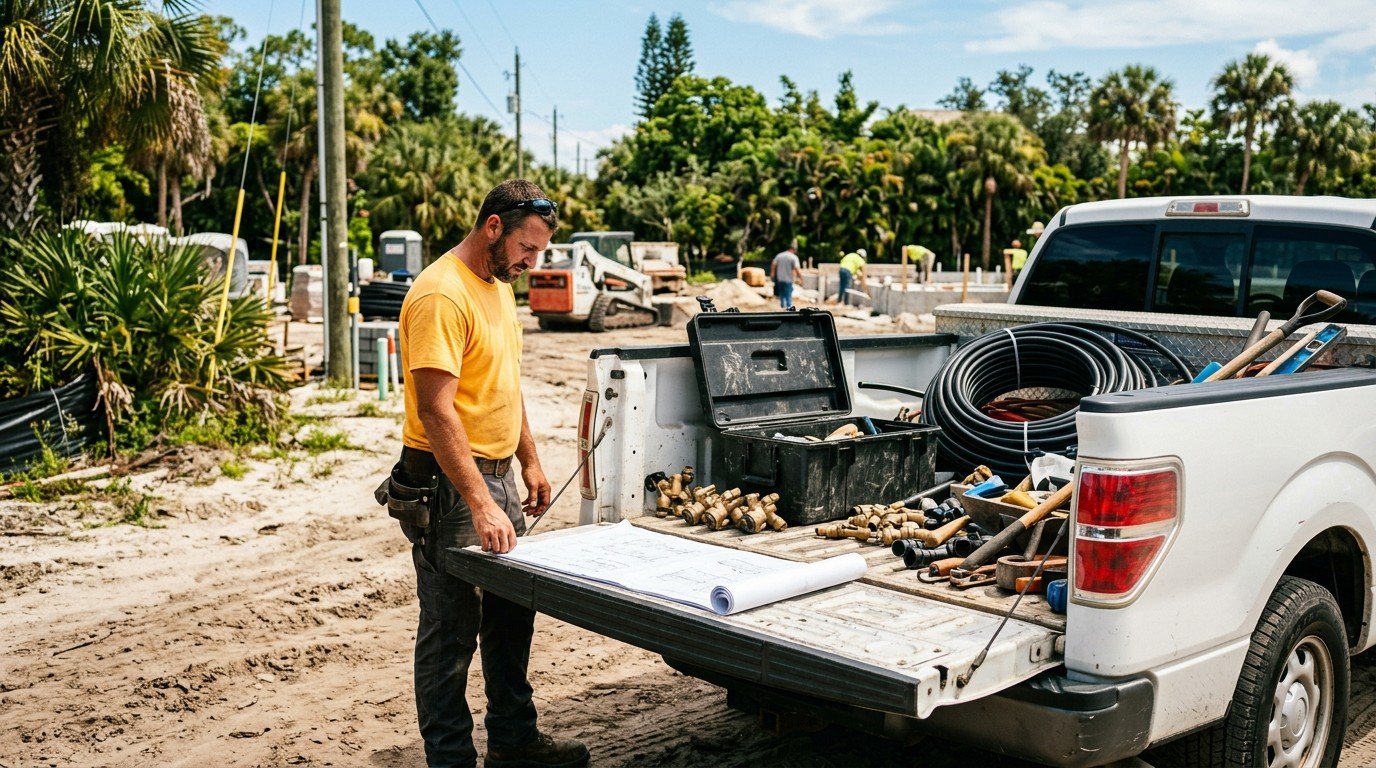
Irrigation certification Florida means three different papers. The state’s irrigation specialty contractor license is voluntary by statute: section 489.113(6)(a) says a board created category "does not create a mandatory licensing requirement". Counties such as Pinellas still require their own irrigation license. And the Irrigation Association’s Certified Irrigation Contractor is a private credential that licenses nothing.
Listen to this article, about 26 minutes. A synthetic voice reads the article and announces each section title as it begins; tables are read row by row and the questions at the end are left out.
Recorded 20 November 2026 from the article as published that day. Press a chapter to jump there; the highlighted line is what is playing. A play button sits beside every section heading, and once you scroll past this player a bar at the bottom of the screen keeps the controls in reach. Tap or click any sentence to hear the reading start from there.
On this page: rule 61G4-15.100(1)(q) quoted in full, the sentence in section 489.113(6)(a) that makes the state irrigation license voluntary, a table of five credentials with the rule behind each, two counties’ own requirements, and what a dozen r/Irrigation accounts from 2023 to 2026 reported.
Think you already know this? Five questions, one minute.
Every answer is on this page. Answer from what you know now; the page fills in the rest.
-
1. Under section 489.113(6)(a), what is a certified specialty contractor category such as irrigation?
Section 489.113(6)(a) says a category established by board rule exists as a voluntary statewide licensing category and does not create a mandatory licensing requirement. Read the section
-
2. Which of these does rule 61G4-15.100(1)(q) exclude from the irrigation specialty contractor’s scope?
Rule 61G4-15.100(1)(q) lists rain sensors and drip products inside the scope and says irrigation systems used for agricultural purposes shall not be included. Read the section
-
3. Why may a Florida county still license irrigation after the 2021 preemption of local occupational licensing?
Section 489.117(4)(a)1 bars local licenses only for job scopes that do not correspond to a state category or a certified specialty category; the Pinellas board’s notice kept irrigation on that ground. Read the section
-
4. Who issues the Certified Irrigation Contractor (CIC) credential?
The CIC is a private credential from the Irrigation Association; it appears nowhere in chapter 61G4-15 or Chapter 489 and pulls no permit. Read the section
-
5. How many questions does the DBPR irrigation trade exam carry, per the examinations at a glance sheet?
DBPR’s examinations at a glance sheet lists Irrigation at 80 questions in 5 hours and Business and Finance at 120 scored questions in 6.5 hours. Read the section
Is there a state irrigation license in Florida, and is it mandatory?
Yes to the first, no to the second. The Construction Industry Licensing Board’s rule 61G4-15.100(1)(q), effective 28 August 2024 and read on flrules.org on 22 October 2026, defines an "irrigation specialty contractor" as a contractor whose business "consists of the execution of contracts requiring the experience, financial means, knowledge, and skill to install, maintain, repair, alter, extend, manage, monitor, audit, or, if not prohibited by law, design irrigation systems". The board that writes that rule is the one this page on the Construction Industry Licensing Board describes.
The statute above the rule settles the mandatory question, and it does so in one sentence. Section 489.113(6)(a), read on the Senate’s site the same day and again in the 2026 edition on 19 November 2026, word for word unchanged: "a certified specialty contractor category established by board rule exists as a voluntary statewide licensing category and does not create a mandatory licensing requirement. Any mandatory statewide construction contracting licensure requirement may only be established through specific statutory provision." Paragraph (6)(b) then lists the twelve categories the Legislature ordered the board to create by 1 July 2025, from structural aluminum to structural carpentry. Irrigation is not among them. It is a category the board chose to keep, which is a different thing from one the state requires.
One piece of housekeeping trips older guides. The chapter 61G4-15 index shows the old irrigation rule, 61G4-15.035, as repealed on 5 May 2024, the day the consolidated rule took effect. A page that still cites 15.035 is quoting a rule number that no longer exists, even though the license it describes does.
What does the irrigation specialty contractor scope cover, and what is left out?
The scope paragraph is unusually concrete, which is a relief after the vagueness of the word "certification". Rule 61G4-15.100(1)(q) says an irrigation system "includes all: piping; fittings; sprinklers; drip irrigation products; valves; irrigation controllers; control wiring; rain sensors; water pumps, water conservation devices; water harvesting systems; irrigation main lines downstream of a utility potable water meter or utility alternative water supply distribution line and dedicated backflow prevention device; and associated components installed for the delivery and application of water for the purpose of irrigation", with "any excavation work incidental thereto".
Two things are written out of it in the same paragraph. "Irrigation systems used for agricultural purposes shall not be included within the scope of this rule", and the contractor "is precluded from conducting work on water wells or pumps per Florida Plumbing Code and Section 373.323(10), Florida Statutes". Farms and wells are somebody else’s paperwork.
Two more lines of Chapter 489 matter here. Section 489.105(3)(m) lists "irrigation systems" among the things a plumbing contractor may install, maintain and repair "without obtaining an additional local regulatory license, certificate, or registration", so a certified plumber already holds the whole irrigation scope; the plumbing license page covers what that license takes. And section 489.103(9) exempts work "of a casual, minor, or inconsequential nature" under $2,500 in total, unless the person "advertises that he or she is a contractor"; the same section’s paragraph (10) exempts work incidental to irrigation and drainage ditches and regularly constituted irrigation districts. The handyman page walks through the $2,500 line and the ways people cross it without noticing.
Which paper does your irrigation work point to?
Pick the line closest to the work. The answer names what the statute and the board’s rule define for it, with the section to read.
This chooser names what the statute and the rule define. It does not decide whether you qualify for any license; the DBPR and your county do that.
Can a county still require its own irrigation license?
Yes, and this is the point where forum certainty and the statute part company. In 2021 the Legislature preempted most local occupational licensing, and section 489.117(4)(a)1 now reads: "A local government, as defined in s. 163.211, may not require a person to obtain a license, issued by the local government or the state, for a job scope which does not substantially correspond to the job scope of one of the contractor categories defined in s. 489.105(3)(a)-(o) and (q) or authorized in s. 489.1455(1), or the job scope of one of the certified specialty contractor categories established pursuant to s. 489.113(6)." Irrigation is one of those certified specialty categories, so the preemption never reaches it. A county may license irrigation precisely because the state has a voluntary category for it.
Pinellas County’s licensing board wrote the plainest account of what that meant on the ground. Its notice updated 22 May 2024 lists seven local specialties eliminated on 1 July 2024, among them awning, cabinet, finish carpentry, flatwork masonry, non-electric sign, paving, and tile and marble, and then a table of classifications that "substantially correspond to State Specialty Contractor Category" and therefore continue. "Irrigation System Specialty Contractor", class code 37, established 9 July 1991, is in that second table. The board’s 2025 to 2026 renewal sheet puts irrigation licensees on 14 hours of continuing education. The Pinellas County page explains how that board differs from the rest of the state.
What the state license buys you locally is also in the statute. Section 489.113(4)(a): a certificate holder who wants to work anywhere in the state "shall be required only to exhibit to the local building official, tax collector, or other person in charge of the issuance of licenses and building permits in the area evidence of holding a current certificate and to pay the fee for the occupational license and building permit required of other persons". That is the sentence behind every "the state license exempts you from county licenses" line. The county still gets its business tax receipt and permit fee, and under paragraph (4)(b) a local board can limit a certified contractor’s permit privileges after a public hearing for fraud or a willful code violation.
| County | What its own pages say | Read on |
|---|---|---|
| Pinellas | Irrigation System Specialty Contractor, class 37, continues; renew by 30 September each year; 14 hours of CE for 2025 to 2026 (PCCLB notice) | 22 October 2026 |
| Sarasota | Improvements to a structure must be done by "a State of Florida or locally-registered Sarasota County contractor"; lawn irrigation tied to house plumbing needs a reduced pressure zone backflow preventer, and testers register with Public Utilities (licensing page and backflow contractor page) | 22 October 2026 |

How is a private irrigation certification different from the license?
The Irrigation Association’s Certified Irrigation Contractor is the credential most pages mean when they write "certification", and it is private. Its page, read on 22 October 2026, recommends about three years of field experience, or two plus a year of education, before a 150 question, three and a half hour multiple choice exam covering design, installation, scheduling, water management, maintenance, codes and business. The current page lists an exam fee of $250 for members and $495 for non-members, with a retake at $200 or $325 and an annual renewal of $75 or $125; an older registration form on the same site shows $350 and $595, so the fee is reported as, not settled. Holders submit 20 continuing education units every two years. What the CIC does not do is pull a permit, and nothing in chapter 61G4-15 or the DBPR forms mentions it. The association’s own Florida page describes the DBPR license as "a voluntary license that exempts the licensed contractor from local" licensing and says nothing about its certification being required anywhere.
The Florida Irrigation Society’s May 2025 article on local and state licenses is the most accurate trade page found for this article. It calls the state license voluntary, lists four years in the industry with at least one as a foreman, supervisor or business owner, two open book exams, issue typically 30 to 60 days after application, and 14 continuing education credits every two years. It cites no rule number.
| Credential | Issued by | Required? | What it lets you do | Source |
|---|---|---|---|---|
| Certified irrigation specialty contractor | DBPR, under the CILB | No: a "voluntary statewide licensing category" | Irrigation work anywhere in Florida on showing the certificate and paying local fees | ss. 489.113(4)(a) and (6)(a); rule 61G4-15.100(1)(q) |
| County irrigation license, for example Pinellas class 37 | The county licensing board | Yes, inside that county, for the work it defines, unless you hold the state certificate | Irrigation work in that county only | PCCLB notice, 22 May 2024; s. 489.117(4)(a)1 |
| Certified plumbing contractor | DBPR, under the CILB | Yes, for plumbing; irrigation is inside its scope | Irrigation systems "without obtaining an additional local regulatory license" | s. 489.105(3)(m) |
| Certified Irrigation Contractor (CIC) | Irrigation Association | No: a private credential | Nothing on its own at a permit counter; a credential for marketing and employment | IA CIC page |
| Backflow tester registration | The water utility, for example Sarasota Public Utilities | Yes, to test devices for that utility | Testing and certifying backflow assemblies, separate from installing the system | Sarasota contractor page |
What does the state license take in experience, exams and fees?
Two exams. DBPR’s examinations at a glance sheet, read on 22 October 2026 through an Internet Archive capture because the DBPR site refuses scripted reads, says "Division II contractors (all other specialties) must pass two examinations: Business and Finance and General Trade Knowledge", and its table gives Business and Finance 120 scored questions in 6.5 hours and Irrigation 80 questions in 5 hours, both daily computer based tests. Both are open book; the Business and Finance exam page goes through the part every certified contractor sits.

Experience and fees come from the irrigation application, form DBPR CILB 5-AC, the copy the board adopted into rule 61-35.010 with an effective date of June 2024, read in full on flrules.org on 19 November 2026 (the business version, CILB 6-AC, follows the same pattern). Its Section VI offers five methods, the plainest being “Four years experience as a worker or foreman of which at least one year must have been as a foreman”, with college credit able to replace up to three of those years, and “One year of experience is equal to 2000 hours.” The fee is $245 when filed “between May 1st of an EVEN year through August 31st of an ODD year” and $145 from 1 September of an odd year to 30 April of an even year. That $245 is the $40 processing fee and $200 initial certification fee in rule 61G4-12.009 plus the $5 in section 455.2281. Add the exam charges of $135 plus $80 for each of the two tests, $295, and the state’s share comes to $540 today and $440 from 1 September 2027. The form’s Part A then lists the experience it wants to see on every job: installing piping, solenoid valves, control wire and controllers, rain shut off devices, sprays and micro irrigation, each split into commercial and residential boxes, plus two wire or decoder controllers, trenching and compaction, cross connection control and locating underground utilities. An applicant with all of Part A “may have their experience approved by the Department”; one without it goes to the board for review. Fingerprints and a credit report with a FICO derived score are separate; a score under 660 means the 14 hour financial responsibility course. The application page works through the arithmetic behind $245 and $145.
Insurance is set by board rule rather than the form: rule 61G4-15.003 requires public liability and property damage cover, at $100,000 and $25,000 for every category except general and building contractors, which carry $300,000 and $50,000; residential contractors sit in the $100,000 row with the specialty classes. That cover never appears on the state record, a gap the guide to reading each field of a Florida contractor license lookup works through before a homeowner hands over a deposit. The license then renews on 31 August of even numbered years with 14 hours of continuing education, the same cycle the continuing education page describes. Nowhere in any of this is a weekend, whatever the banner says.

Can a county irrigation card holder skip the state exams?
Quite possibly, and it is the most useful line on the state form for anyone already holding a county card. Rule 61G4-16.009(5), last amended effective 26 August 2024 and read on Cornell’s copy of the Florida Administrative Code on 19 November 2026, says “Applicants for any speciality license are exempt from examination” when they meet four conditions. They held a valid local license or competency card in one of the specialty types on or after 30 June 2021. That card has not been disciplined in the last five years and is not pending discipline. They passed a written exam the board finds “substantially similar” to the state one, and a proctored exam from any of five named testing vendors counts as similar. And the application “is received by the Board no later than July 1, 2030.”
Here the form and the rule part company by two words. The adopted form 5-AC asks in Section VII: “As of June 30, 2021, did you hold a valid registered local license or competency card in any Florida Jurisdiction in the license category sought?” The rule says “On or after June 30, 2021”. A county card first issued in 2023 meets the rule’s wording and fails the form’s question. The form is dated June 2024; the rule was amended after it, in August 2024. The rule is the text the form exists to carry out, but how the board treats a post 2021 card is the board’s decision on the file, and this page does not rule on anyone’s eligibility.
Exempt applicants send one extra item, a copy of the local competency card, which the checklist says “Must match the license category sought”, with a copy of the scope of work if it does not. For a Pinellas class 37 or Palm Beach Irrigation Sprinkler holder, that is the difference between two open book exams and none. The same rule also sets a clock for everyone else: a candidate “must pass all tests within four years of the first attempt”, or every earlier score lapses.
Do Palm Beach, Hillsborough and Miami-Dade license irrigation too?
Three more counties were read for this page on 19 November 2026, and they give three different answers to the same question, which is about par for this subject.
Palm Beach licenses irrigation under its own special act. Its standards for certified categories, updated 1 July 2025, define “IRRIGATION SPRINKLER CONTRACTORS” as those qualified to “design, install, maintain, repair, alter or extend” the piping, heads, controls, pumps and chemical injectors “for irrigation of lawns and plant materials”. Electrical work stops at 98 volts. The county’s notice dated 2 February 2026 lists sixteen trades that no longer need a certificate, from acoustical ceilings to wood flooring. Irrigation is not one of them.
Hillsborough is the one that argues with itself. Its January 2026 comparison chart pairs a local Irrigation license with the state Irrigation category and, unlike carpentry or masonry, does not mark it “DBPR only”. Its apply page lists Irrigation among the local specialties it accepts, with a $50 fee to start, $230 on acceptance and $140 at issue. Yet the county’s own FAQ also says “Local specialty licenses are no longer available in Hillsborough County.” Both pages were live on 19 November 2026. The two that name irrigation say it is offered; anyone relying on that should confirm it with the county before paying.
Miami-Dade calls it something else again. Its plumbing trades page describes a Lawn Sprinkler contractor with a qualifying agent holding one year of experience in the trade, certified to “install, maintain, repair, alter or extend a lawn sprinkling system”, except that the work “shall not include the drilling of wells or the connecting of such systems to potable water”.
| County | Local irrigation credential | What its own page says | Source |
|---|---|---|---|
| Palm Beach | Irrigation Sprinkler certificate of competency, item 11 of the specialty trades | Piping, heads, controls, pumps and chemical injectors; electrical work limited to 98 volts; water from the discharge side of a backflow preventer a licensed plumber provided | County standards, updated 1 July 2025 |
| Hillsborough | Irrigation local specialty license, valid in the county only | $50 to start the application, $230 on acceptance, $140 at issue; renewal $140 every two years, late fee $70 a year | County apply page; FAQ |
| Miami-Dade | Lawn Sprinkler certificate of competency | Qualifying agent with one year in the trade; no wells, no connection to potable water, no agricultural systems | County plumbing trades page |
| Pinellas | Irrigation System Specialty Contractor, class 37 | Continued after 1 July 2024 because it matches a state specialty category | PCCLB notice, 22 May 2024 |
The table shows where the credentials stop agreeing: the point where the irrigation pipe meets drinking water. The state’s rule 61G4-15.100(1)(q) includes main lines downstream of a utility meter and a dedicated backflow prevention device. Palm Beach lets its irrigation contractor connect at the discharge side of a backflow preventer that a licensed plumber provided. Miami-Dade keeps the potable connection out of the lawn sprinkler scope altogether. The one person all three treat the same is the plumbing contractor, whose scope in section 489.105(3)(m) already includes irrigation systems.
What do people who went looking for this license report?
Five r/Irrigation threads from September 2023 to July 2026, about a dozen accounts in all, read through the Reddit route on 22 October 2026. They are testimony, paraphrased, not evidence.
In a September 2023 thread from Sarasota, a poster starting a company with a partner who had two years’ experience asked what licensing they needed. The top reply said a state issued contractor license is required and that it takes four years of verifiable work with one as a foreman. An August 2025 reply in the same thread said Florida does not require a state license for irrigation, only that certain counties and cities may. Both are half right, and the statute above is why.
A Pinellas based user flaired as a Florida licensed contractor gave the most consistent account across June 2025 and April 2025 comments: irrigation is regulated county by county, the populous counties require a specialty license, and they took the voluntary state license because it was cheaper than separate county ones for occasional work next door. Enforcement, in their words, is "spotty at best". In the same April 2025 thread, a user fifteen years into Florida irrigation work wrote that in most counties repair needs only a business license; the Pinellas user disagreed.
In April 2026 a South Florida maintenance and repair company said it wanted to move into permitted projects and was looking for a licensed irrigation qualifier, explicitly refusing any license renting arrangement; the one reply, in May 2026, came from a multi license holder offering a financially responsible officer agreement. And in July 2026 a poster from Lehigh Acres with just over two years, one as a supervisor, was told they needed two more years, a separate license for spraying chemicals, and that touching installs without an irrigation license was not acceptable.
Where the accounts agree with the rule text: the state license is voluntary, it works across counties, and the experience bar is four years. Where they do not: nobody cited a rule, the "required" claims were county rules wearing a state costume, and the repair question got opposite answers from people who had both done the work. One well read April 2026 licensing thread turned out to be about Texas and was left out.
Where do the ranking pages and the rule text disagree?
| Claim | Who says it | What the rule text says |
|---|---|---|
| "You need a state issued contractors license to do irrigation work in FL" | r/Irrigation, September 2023 | "a certified specialty contractor category established by board rule exists as a voluntary statewide licensing category", s. 489.113(6)(a) |
| Florida has "a voluntary license that exempts the licensed contractor from local" licensing | Irrigation Association Florida page | Close. The certificate holder is "required only to exhibit" the certificate and pay the occupational license and permit fees, s. 489.113(4)(a); paragraph (4)(b) lets a local board limit permit privileges after a hearing |
| The irrigation rule is 61G4-15.035 | Older DBPR material, as one guide notes | Repealed 5 May 2024; the category now sits in rule 61G4-15.100(1)(q) |
| Counties can no longer license trades after the 2021 preemption | Common reading of HB 735 | They can where the scope corresponds to a certified specialty category, s. 489.117(4)(a)1; Pinellas kept irrigation on exactly that ground |
| An irrigation "certification" lets you work | Pages that run the CIC and the license together | The CIC appears nowhere in chapter 61G4-15 or Chapter 489; only the license and the county card appear |
None of this makes the license pointless. It makes it a choice, and a choice is cheaper to make from the statute than from a banner.
Frequently asked questions
Does a certified irrigation specialty contractor also need a Pinellas County license?
No. Section 489.113(4)(a) says a certificate holder is required only to exhibit the current certificate and pay the local occupational license and permit fees. The Pinellas class 37 license is for contractors who do not hold the state certificate.
Can a landscaper repair sprinkler heads without any license?
It depends on the county. The state category is voluntary, so no state license is required by statute. A county that licenses irrigation can require its card for the work its ordinance defines, and the $2,500 exemption in section 489.103(9) does not apply to anyone who advertises as a contractor.
Does the irrigation specialty license cover well pumps?
No. Rule 61G4-15.100(1)(q) says the contractor is precluded from work on water wells or pumps per the Florida Plumbing Code and section 373.323(10). Water pumps inside the irrigation system itself are listed within the scope; the well and its pump are not.
Is the Irrigation Association’s CIC accepted instead of the state exams?
Nothing in chapter 61G4-15 or on the DBPR application forms mentions it. The forms require the Business and Finance exam and the irrigation trade exam, and the only exam exemption on the forms is for holders of a local competency card as of 30 June 2021 who passed a substantially similar exam.
How long does the state license take once the exams are passed?
The Florida Irrigation Society reports 30 to 60 days after a complete application. The statutory limit is section 120.60(1): 30 days for the agency to flag omissions and 90 days after a complete application to approve or deny.
Is the backflow preventer part of the irrigation contractor’s job?
Installing it is: the rule’s scope runs to the dedicated backflow prevention device downstream of the utility meter. Testing it is a separate registration with the water utility, and Sarasota County, for example, requires a reduced pressure zone device where lawn irrigation connects to house plumbing.
Finished the page? The same five questions from the top, to see what stuck.
Rules and fees change without notice. This page was checked against the sources linked above on the date shown. If you find something different, tell us in the comments.
Leave a Reply