There is no plumbing license Florida hands to every plumber. The state licenses plumbing contractors, the businesses that take the job: certified to work statewide, or registered where they hold a local certificate. Certification takes four years of experience and two exams, one still on paper. Journeyman plumber cards come from counties under section 489.1455.
Listen to this article, about 19 minutes. A synthetic voice reads the article and announces each section title as it begins; tables are read row by row and the questions at the end are left out.
Recorded 11 November 2026 from the article as published that day. Press a chapter to jump there; the highlighted line is what is playing. A play button sits beside every section heading, and once you scroll past this player a bar at the bottom of the screen keeps the controls in reach. Tap or click any sentence to hear the reading start from there.
On this page: the plumbing contractor definition quoted from section 489.105(3)(m), a rule cited table of the certification route, the paper exam’s format and content weights from DBPR’s own sheets, the $335 fee worked line by line, the exam dates the vendor listed as full on 9 October 2026, and what the board’s 2025 disciplinary records show.
Think you already know this? Five questions, one minute.
Every answer is on this page. Answer from what you know now; the page fills in the rest.
-
1. Which division does section 489.105(3) place the plumbing contractor in?
Division I is paragraphs (a) to (c). The plumbing contractor is paragraph (m), inside Division II’s paragraphs (d) to (q). Florida Statutes 489.105 Read the section
-
2. What does section 489.105(3)(m) say about drain cleaning?
The definition says a plumbing contractor may perform drain cleaning and clearing, but a mandatory licensing requirement is not established for those services. Florida Statutes 489.105 Read the section
-
3. What liability insurance does rule 61G4-15.003 set for a plumbing contractor?
The rule’s table puts plumbing with pool, underground utility and solar at $100,000 public liability and $25,000 property damage. Rule 61G4-15.003 Read the section
-
4. How is the morning session of the plumbing trade knowledge exam made up, according to DBPR’s content information?
The morning session has 45 equally weighted questions and 5 isometric drawings worth 10 points each; the afternoon has 65 questions. DBPR plumbing exam content information Read the section
-
5. Under section 489.1455, what must a county do about a journeyman plumber licensed by another Florida county?
Subsection (2) says counties and municipalities must recognize a person as a journeyman in the plumbing trade if another Florida county or city issued the license. Florida Statutes 489.1455 Read the section
That gap between what the phrase means and what the statute regulates is where most of the confusion starts. An employer asking for a licensed plumber usually means the person under the sink. Chapter 489 means the company signing the contract. Florida regulates that company at state level and leaves the worker, mostly, to the counties.
Plumbing sits with the Construction Industry Licensing Board, the same board as general and roofing contractors, unlike electrical work, which has its own board and its own state and county split. Every statute quoted below was read on 9 October 2026, and the fees and exam dates were checked again on 5 November 2026.
Does Florida license plumbers, or plumbing businesses?
Start with the definitions in section 489.105 of the Florida Statutes. A certified contractor is “any contractor who possesses a certificate of competency issued by the department”, and may work anywhere in the state. A registered contractor has met a county’s or city’s competency requirements and may contract only where that registration was issued. Section 489.105(3) then sorts the trades: Division I is paragraphs (a) to (c), the general, building and residential contractors. The plumbing contractor is paragraph (m), which puts plumbing in Division II with the other trades.
| Credential | Who issues it | Where it is valid | Can you contract with it? | Rule text |
|---|---|---|---|---|
| Certified plumbing contractor (CFC) | DBPR, on CILB approval | Statewide | Yes | 489.105(3)(m) and (8) |
| Registered plumbing contractor | DBPR registers a local certificate | Only the jurisdictions registered | Yes, there only | 489.105(10) |
| Local master or contractor certificate | County or city board | That county or city | Only once registered with the state | 489.105(10) |
| Journeyman plumber | County or city, if it chooses to | Every Florida county must recognize it | No; you work for a contractor | 489.1455 |
The certified license is not rare. DBPR’s public licensee records, in the copy captured on 10 August 2026, held 8,440 active records coded CFC, the fifth most common certified construction license. If you are still working out which board your trade belongs to, the overview of which Florida contractor license covers which kind of work sorts that out.
What work does a Florida plumbing contractor license cover?
Paragraph (m) defines the plumbing contractor as one “whose services are unlimited in the plumbing trade”, and it is generous. Without “an additional local regulatory license, certificate, or registration”, a plumbing contractor may work on drainage, water and sewer plants, venting, water supply, septic tanks, wells, swimming pool piping, irrigation and solar water heating, including “water, natural gas, liquefied petroleum gas and related venting”. Every pool license stops short of sewer and potable water connections, so that tie in is where a pool job passes to the plumber, as the scopes of the three Florida pool contractor licenses show line by line. That one word, irrigation, is also why a plumber never needs the separate credential on the irrigation certification page, which the statute treats as a voluntary category. The mains in the street are a different trade: the underground utility and excavation license and where its scope stops covers sewer, water and storm systems up to the meter.
It keeps going. The scope includes “oxygen line piping, nitrous oxide piping, and all related medical gas systems”, fire standpipes and sprinklers “if authorized by law”, fuel oil and gasoline piping short of bulk storage plants, and pneumatic control piping. Anything that belongs to another trade must be subcontracted to a contractor qualified in that field.
Two sentences in the same paragraph matter to anyone wondering what needs no license at all. A plumbing contractor may do drain cleaning and rainwater catchment systems, “however, a mandatory licensing requirement is not established for the performance of these specific services.” And licensed liquefied petroleum gas dealers and installers under chapter 527, along with gas utility employees, do not need a plumbing license “when disconnecting and reconnecting water lines” while servicing or replacing an existing water heater.
What does the state want before it certifies a plumbing contractor?
The eligibility test is section 489.111(2): at least 18, of good moral character, and one of several experience or education routes. The usual one is four years of active experience as a skilled worker or foreman, at least one of them as a foreman. The board’s rule 61G4-15.001 accepts mechanical or sanitary engineering degrees for plumbing, counts only experience that was lawfully acquired under a properly licensed contractor, and refuses work done under an exemption. A bachelor’s degree in building construction with a 3.0 grade point average lets an applicant skip straight to the business and finance exam under section 489.113(1).
Here is the full route as the rules set it out. The rules were read on 7 October 2026 and checked against the statute on 9 October.
| Requirement | What the rule says | Source |
|---|---|---|
| Age and character | 18 or older, of good moral character | 489.111(2)(a) and (b) |
| Experience | 4 years, at least 1 as a foreman, or a degree or credit route | 489.111(2)(c) |
| Degree fields for plumbing | Mechanical or sanitary engineering | 61G4-15.001 |
| Credit | No unsatisfied judgments or liens; FICO 660, or a 14 hour course | 61G4-15.006 |
| Liability insurance | $100,000 public liability, $25,000 property damage | 61G4-15.003 |
| Workers’ compensation | Coverage or an exemption before the license issues | 489.114 |
| Exams | Plumbing trade knowledge plus Business and Finance | DBPR exam sheet |
Insurance is an affidavit, not a certificate you mail in. The board audits at random and gives a selected licensee thirty days to produce proof, so keep the policy current from the first day.
Certified plumbing contractor: what the rules ask for
Tick each item as you gather it. This lists what the statute and rules name; it is not a ruling on your eligibility and it does not predict an exam result.
Check the current DBPR application before filing; forms and fee notices change.
Why is the plumbing exam different from every other trade exam?
DBPR’s Examinations at a Glance sheet, updated June 2024, says Division II contractors “must pass two examinations: Business and Finance and General Trade Knowledge.” Business and Finance is 120 scored questions over 6.5 hours, on a computer, any day. Nearly every trade exam on that sheet runs the same way. One line does not: plumbing is the only exam listed as paper and pencil. The business paper’s book list changes in 2027 as well: from 1 March 2027 it is marked against the 2026 edition of Chapter 455, and the Business and Finance exam’s rules on books, tabs and fees sets the 2026 and 2027 reference lists side by side.
The plumbing examination content information explains the format. The morning session has 45 questions and 5 isometric drawings, each “worth 10 points”. The afternoon session has 65 questions, and the two scores are combined. Each session runs 4 hours 30 minutes. Hand drawn piping isometrics are the reason a machine cannot mark this one.
| Content area | Share of the exam |
|---|---|
| Drainage | 20% |
| Water distribution | 20% |
| Medical gas piping | 20% |
| Natural gas piping | 15% |
| Industrial piping | 10% |
| Swimming pools, wells and irrigation | 5% |
| Solar | 5% |
| Fire protection | 5% |
Medical gas carries the same weight as drainage. Anyone who has spent four years on homes may never have touched an oxygen line, and the outline will test it anyway. DBPR’s examination page says “All examinations are open book and consist of multiple-choice questions”, and the drawings are the plumbing exception to the second half of that.

The schedule is the part that catches people out. DBPR’s construction examinations page, in the copy captured on 4 October 2026, which was still the latest archived copy on 5 November, listed plumbing dates at the Osceola Heritage Park exhibition building in Kissimmee: 12 to 13 October and 8 to 9 December 2026. Professional Testing’s registration page, read again on 5 November 2026, says the events for “December 9, 2026 and February 2, 2027 are currently at full capacity.” The next open date is still 14 April 2027, with a registration deadline of 14 March 2027, and a new date has appeared after it: 3 June 2027, deadline 2 May 2027. The same page also still carries an older block of 2026 dates that does not mark them full, so trust the newer list and confirm with the vendor before you plan around a seat. An applicant who is ready today waits about five months to sit the trade exam.
How much does a Florida plumbing contractor license cost?
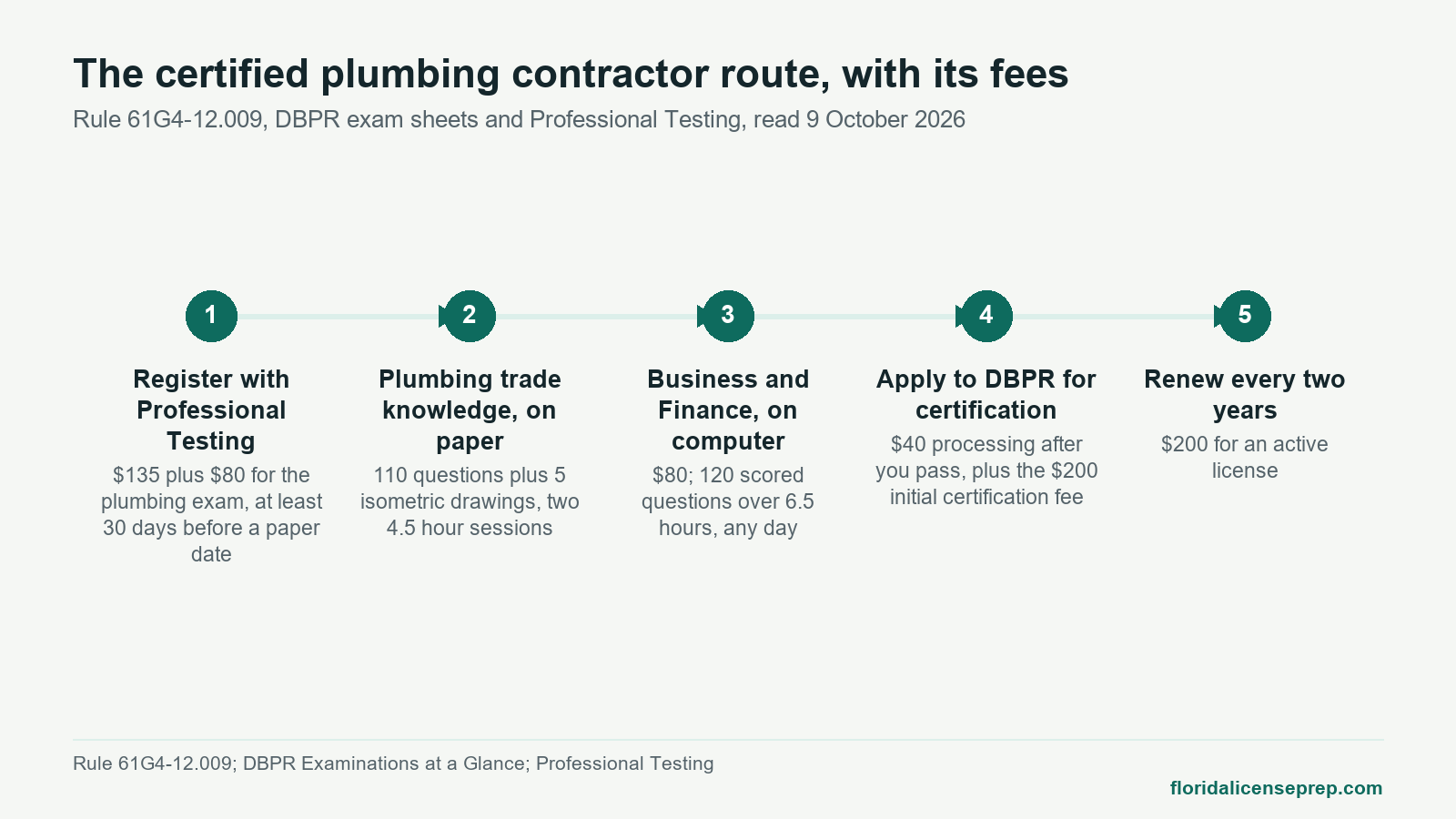
Rule 61G4-12.009 sets the application and examination fee at $335, nonrefundable, paid in pieces. For plumbing the arithmetic works out exactly.
| Item | When you pay | Amount |
|---|---|---|
| Exam development fee, to Professional Testing | When you register | $135 |
| Plumbing trade knowledge administration | When you register | $80 |
| Business and Finance administration | When you schedule | $80 |
| Application processing | After you pass | $40 |
| First attempt total | $335 | |
| Initial certification fee | When the license issues | $200, or $100 in a biennium’s second year |
| Business organization application | If you qualify a company | $50 |
| Biennial renewal, active | Every two years | $200 |
So a first time pass costs $295 in exam charges, all paid before you sit. The last $40 of the rule’s $335 is application processing, and it travels with two other charges: the $200 certification fee and a surcharge that section 455.2281 adds “upon initial licensure and each subsequent renewal”, described there as “a special fee of $5 per licensee” to fund the fight against unlicensed activity. The adopted application, form DBPR CILB 5-M, effective July 2024 and incorporated in rule 61-35.010, prints that bundle as one number: $245 for applications made between 1 May of an even year and 31 August of an odd year, and $145 from 1 September of an odd year to 30 April of an even year. Read on 5 November 2026, that puts an applicant today at $540 paid to the state and its vendor in total, dropping to $440 for applications made from 1 September 2027. Rule 61G4-12.009 itself was last amended on 30 October 2017. Fingerprints, the credit report, the insurance premium and any code books all come on top. More of the money side is in the rule by rule account of Florida contractor license requirements.
Where do journeyman plumber cards come from?
Section 489.1455 says counties and cities “are authorized to issue journeyman licenses in the plumbing, pipe fitting, mechanical, or HVAC trades”. Authorized, not required. The statute’s standard is a score of at least 75 percent on an approved proctored exam, a registered apprenticeship “or has at least 12,000 hours of on-the-job training”, and Florida Building Commission coursework. Subsection (2) helps anyone who moves: counties “must recognize a person as a journeyman” licensed by another Florida county or city. The electrical trade runs on an identical rule in section 489.5335, and the guide to how Florida counties issue and recognize electrical journeyman cards tests what that recognition does and does not cover. Above the journeyman sit the state contractor licenses, and for air conditioning the choice between them turns on one number, as the guide to Florida HVAC license classes and the 25 ton line explains.
Hillsborough County’s journeyman page states it plainly: “There is no State of Florida requirement for anyone to hold a Journeyman Certificate of Competency”, and the holder “must always work under the supervision of a properly licensed Electrical/Plumbing Contractor.” Its fees, read on 8 October 2026, were $50 to apply, $100 on acceptance and a $70 one time registration fee. Local master and journeyman plumber exams are often given by a separate testing vendor such as Prov, which on 5 November 2026 had taken down the county bulletins it used to post, so the per test fee is whatever your county and its vendor charge today. Ask your county which vendor it uses before you pay anyone.

What do the board’s disciplinary records show for plumbing licenses?
Discipline is public. We read the final orders listed in the board’s July, August and September 2025 minutes and counted every case that named a CFC license, citing them here by case number.
Of roughly 115 disciplinary cases across those three months, 9 named at least one plumbing license, belonging to 7 licensees; one licensee holding plumbing, roofing and general licenses appeared in all three months and voluntarily relinquished them, with restitution in amounts set by the Florida Homeowners’ Construction Recovery Fund. The rest ended in fines from $2,000 to $10,000, often with seven extra hours of continuing education on Chapter 489. Case 2025009737 brought three years of probation and a $4,000 fine; case 2024004832 brought two years of probation and a $10,000 fine.
The minutes record outcomes, not the violation behind each one, and several of these licensees hold other licenses too. So read this as what the board does, not as a rate for plumbers.
Where do popular guides get Florida plumbing licensing wrong?
The weekend licensing adverts are easy to dismiss, since even the degree route still asks for a year of proven experience. The ranking guides deserve closer reading, because their errors are smaller and more expensive.
- A diploma requirement. Jobber’s Florida plumbing page, last updated in 2024, lists “Obtain a high school diploma or GED.” Section 489.111(2) asks for age, character and experience or education routes. It does not mention a diploma.
- The only exempt work. The same page lists three things you may do without a license: an above ground pool, a faucet water filter, and irrigation behind a backflow preventer. The statute also exempts drain cleaning and rainwater catchment in 489.105(3)(m), and section 489.103(9) exempts casual or minor work under $2,500, unless it is part of a larger job or you advertise as a contractor. County permit rules still apply.
- The total exam cost. Housecall Pro’s Florida guide gives “Total exam cost: $295”. That matches the three charges paid before the exams, but rule 61G4-12.009 sets the fee at $335, and the last $40 falls due after you pass.
- Where the exam is held. Professional Testing says plumbing is given “in Orlando only”, while DBPR’s own page lists Kissimmee. Kissimmee sits in the Orlando area, so the gap is small, but go by your admission letter rather than either web page.
If your work is framing rather than pipe, the general contractor license rules are the Division I route, with three exams instead of two.
Frequently asked questions
Can I do plumbing on my own house in Florida without a license?
Section 489.103(7) lets owners act as their own contractor on a one or two family home built or improved for their own use and not offered for sale or lease. The local building department still issues the permit.
Is a Florida plumbing license good in other states?
Not automatically. A Florida certificate covers Florida. Other states set their own rules, so check with the licensing board in the state where the work is.
Do I need a separate license to install gas lines as a plumber?
Not for the work in the definition. Section 489.105(3)(m) includes natural gas and liquefied petroleum gas lines and venting in the plumbing contractor’s scope, with no extra local license needed.
Can a plumbing contractor install fire sprinklers in Florida?
Only where the law allows it. Section 489.105(3)(m) includes fire line standpipes and fire sprinklers “if authorized by law”, so check the fire code rules that apply before quoting the job.
How long is a Florida plumbing contractor license valid?
Certified licenses renew every two years. Rule 61G4-12.009 sets the biennial renewal fee for an active license at $200.
How many questions are on the Florida plumbing contractor exams?
DBPR’s exam sheet lists 110 scored trade questions, 45 in the morning and 65 in the afternoon, plus 5 isometric drawings in the morning. Business and Finance adds 120 scored questions over 6.5 hours.
Finished the page? The same five questions from the top, to see what stuck.
Rules and fees change without notice. This page was checked against the sources linked above on the date shown. If you find something different, tell us in the comments.
Leave a Reply