
The NASCLA exam is a national, open book trade test: 115 scored questions in 330 minutes, $130 at PSI. Florida accepts it only through certification by endorsement, and only for the general, building and residential licenses. You still pass Florida’s Business and Finance test, prove a Florida Building Code exam, and meet the full experience rule.
Listen to this article, about 24 minutes. A synthetic voice reads the article and announces each section title as it begins; tables are read row by row and the questions at the end are left out.
Recorded 21 November 2026 from the article as published that day. Press a chapter to jump there; the highlighted line is what is playing. A play button sits beside every section heading, and once you scroll past this player a bar at the bottom of the screen keeps the controls in reach. Tap or click any sentence to hear the reading start from there.
On this page: the three conditions of rule 61G4-15.004 quoted word for word, a side by side of the NASCLA exam and Florida’s own papers from each bulletin, the endorsement form’s NASCLA checklist, and three dated accounts from people on this route.
Think you already know this? Five questions, one minute.
Every answer is on this page. Answer from what you know now; the page fills in the rest.
-
1. How many scored questions does NASCLA’s bulletin list for the commercial general building exam?
The NASCLA candidate bulletin lists 115 questions, a passing score of 81 and 330 minutes, with 10 pretest questions added on top. Read the section
-
2. Which Florida licenses does rule 61G4-15.004 cover?
Rule 61G4-15.004 applies to a certified general contractor, certified building contractor, or certified residential contractor applying by endorsement. Read the section
-
3. Under the rule, which Florida exam must a NASCLA candidate still pass?
Rule 61G4-15.004(2) requires the candidate to take and pass, or show they passed, the Business and Finance examination; NASCLA stands in for the trade papers. Read the section
-
4. How long is Florida’s GC Contract Administration paper, per the DBPR booklet?
The DBPR Candidate Information Booklet lists GC Contract Administration at 60 scored questions in 4.5 hours; 6.5 hours is Business and Finance. Read the section
-
5. What is the application fee printed on the CILB 10 endorsement form?
The CILB 10 form, effective June 2024, sets the endorsement application fee at $350. $130 is NASCLA’s PSI exam fee and $335 is the Florida exam route fee. Read the section
Search for this exam and you mostly find people selling a course for it, which is how an open book test acquires the reputation of a bar exam. What decides whether it counts in Florida is one short board rule, one statute subsection and a 28 page form. This page quotes those, read on 30 October 2026 and read again on 21 November 2026, beside NASCLA’s own PSI bulletin. The copy PSI served on 21 November is headed “Updated 4/15/2026”, and its fee, question count, pass mark and time all match the copy read in October. DBPR documents were read through Internet Archive captures; the links go to the live copies.
What is the NASCLA exam, according to its own bulletin?
NASCLA is the National Association of State Contractors Licensing Agencies, a body of state licensing boards. Its candidate information bulletin calls the program “a streamlined test taking option for the trade portion of the contractor examination”, for contractors who want licenses in several states. Note the word trade. The bulletin says candidates still follow each state’s application, “in addition to taking a business and law examination”.
The bulletin sets the exam out in one line: 115 questions, a minimum passing score of 81, and 330 minutes. On top of the 115 come 10 unscored “pretest” questions, with their time already added to the clock. It is computer based, delivered by PSI, and “OPEN BOOK”, with a physical blueprint packet handed out at the test center. The biggest content areas are procurement and contracting requirements at 31 items, general requirements at 25 and site construction at 15.
You cannot simply book it. Since 1 November 2016 a candidate must be approved by NASCLA first; PSI then sends the booking details. The examination fee is $130, valid for a year, and approval gives you one year and “a maximum limit of three (3) times” to sit it. Fail three times and you reapply once that year runs out.
Does Florida accept the NASCLA exam, and for which licenses?
Yes, but by a side door. Florida does not let you swap NASCLA into an ordinary exam application. It accepts NASCLA under certification by endorsement. Section 489.115(3)(a) lets the board certify an applicant who has “passed a national, regional, state, or United States territorial licensing examination that is substantially equivalent to the examination required by this part” and has satisfied section 489.111.
The board then defined substantially equivalent for NASCLA in rule 61G4-15.004, amended effective 10 March 2019. It applies to “a certified general contractor, certified building contractor, or certified residential contractor” and nobody else. Those are the three Division I licenses, explained on their own pages for the general contractor, the building contractor and the residential contractor. A roofer, a pool contractor or a plumber gets nothing from this rule.
The board’s minutes for 12 to 15 June 2018 show where it came from: the Endorsement Committee voted unanimously to require NASCLA candidates to pass Florida Business and Finance and “a Departmental examination related to the Florida Building Code”, and sent draft wording for the rule onward. The 2019 amendment is that wording.
Which Florida exams does NASCLA replace, and which stay?
Rule 61G4-15.004 treats a candidate as having passed an equivalent exam by completing three items. First, “evidence of successfully passing the 2009-2018 or like version” of NASCLA’s commercial general building exam. Second, “Take and successfully pass or provide evidence of having passed The Business and Finance examination”. Third, “verification of having taken and passed any proctored examination covering the Florida Building Code administered by or through the Department”.
So the swap is narrow. NASCLA stands in for the two Florida trade papers, Contract Administration and Project Management, which the DBPR Candidate Information Booklet requires of every Division I candidate. It does not stand in for Business and Finance, the paper every trade shares and which has its own rules on books and tabs. And it adds a third condition the ordinary route does not list separately: a proctored Florida Building Code exam given by or through DBPR.

Which exam satisfies that third item? Neither the rule nor the form names one; the form only asks you to “attest to having passed an examination covering the Florida Building Code”. An earlier version of this page said nothing fills that gap. Something does, partly: DBPR’s construction FAQ, in the copy captured on 4 October 2026, says “you may wish to take an exam offered by an approved CE provider in lieu of taking the Florida trade exams.” That sits awkwardly beside the rule, which asks for an exam “administered by or through the Department”. The FAQ reads as DBPR accepting a proctored exam from a board approved continuing education provider, but it says “may wish to”, not “must”, and it names no provider and no price. Before you pay anyone, ask DBPR’s Customer Contact Center, 850-487-1395 on the form, whether the specific exam you are buying will be accepted.
| Requirement | Florida exam route (GC, BC, RC) | NASCLA endorsement route | Source |
|---|---|---|---|
| Trade knowledge | Florida Contract Administration and Project Management | NASCLA commercial general building exam | 61G4-15.004(1) |
| Business and Finance | Required | Required | 61G4-15.004(2) |
| Florida Building Code exam | Not a separate item | Proctored exam “by or through the Department” | 61G4-15.004(3) |
| Experience | 489.111 methods | Same methods, Section IV of the form | CILB 10, Section IV |
| Application form | DBPR CILB 5-A and related | DBPR CILB 10, Option A | CILB 10, page 1 |
| Fee to DBPR | $335 application and exam fee | $350 endorsement application fee | 61G4-12.009(1)(a); CILB 10 |
A correction to the fee row above, made on 21 November 2026. The $335 in rule 61G4-12.009(1)(a) is only the exam side of the Florida route: $135 when you schedule, $80 “for each test administered” with Contract Administration and Project Management “considered one test”, and $40 for processing once you pass. The license application adds the $200 initial certification fee and a $5 fee under section 455.2281, so the Florida route costs $540 in all, worked through in the cost section below. The endorsement $350 comes from form CILB 10 itself. The fee rule, last amended on 30 October 2017, lists no endorsement fee at all, so the form’s figure is the one DBPR asks for.
Which papers does each route sit?
Pick a license and a route to see the exams the rule text names. This does not decide whether you qualify; DBPR and the board do that.
Rule text read 30 October 2026. Confirm which code exam DBPR accepts by calling 850-487-1395 before you pay for anything.
How does the NASCLA exam compare with Florida’s own papers?
Florida figures below come from the DBPR booklet, effective July 2024, and NASCLA figures from its PSI bulletin, read again on 21 November 2026 with the same numbers. The table’s source cell keeps the October reading.
| Paper | Scored questions | Time | Correct answers to pass | Source |
|---|---|---|---|---|
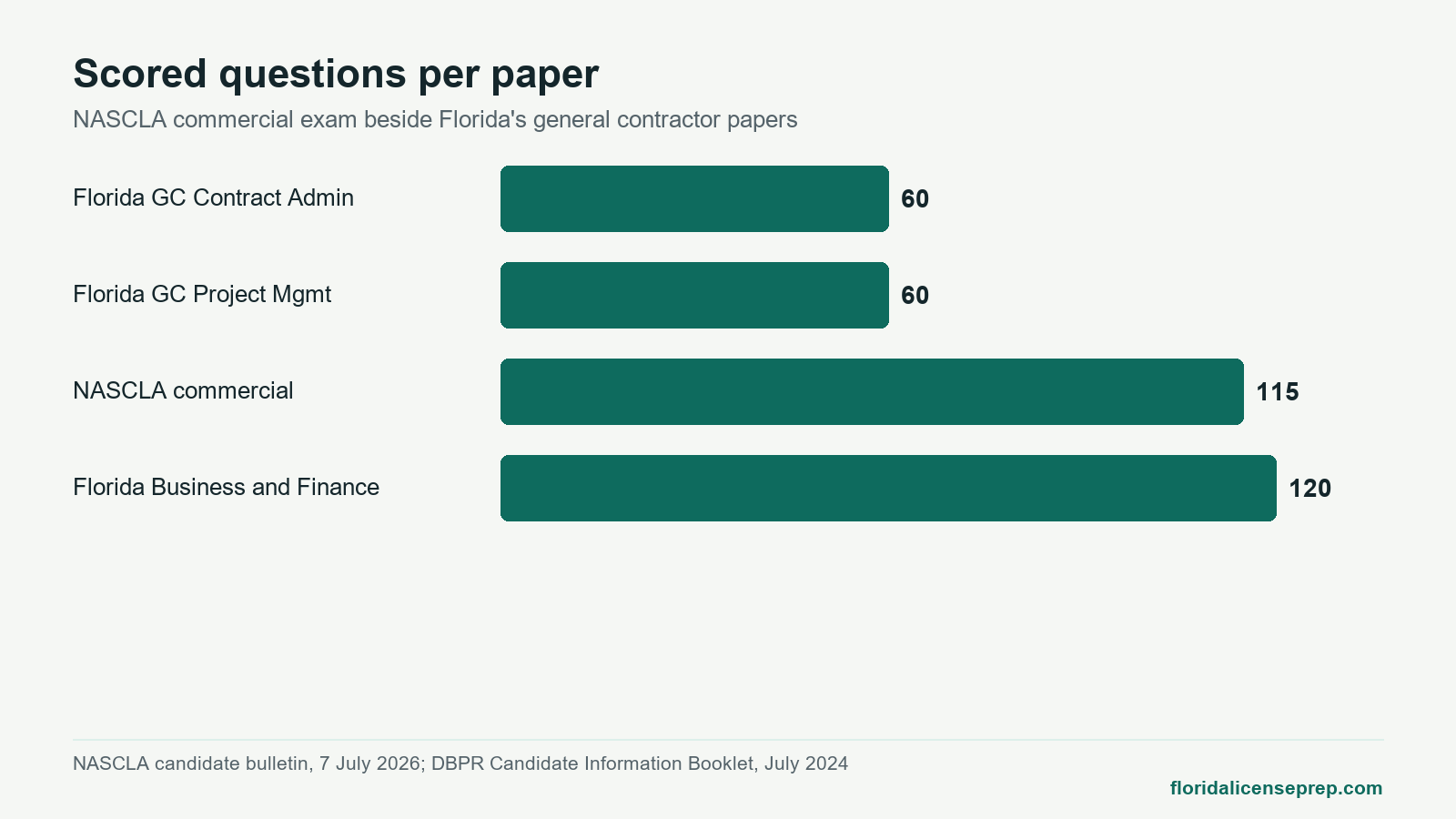
| NASCLA commercial general building | 115, plus 10 pretest | 330 minutes (5.5 hours) | 81 | NASCLA bulletin, 7 Jul 2026 |
| Florida Business and Finance | 120 | 6.5 hours | 84 | DBPR CIB |
| Florida GC Contract Administration | 60 | 4.5 hours | 42 | DBPR CIB |
| Florida GC Project Management | 60 | 4.5 hours | 42 | DBPR CIB |
| Florida BC Contract Administration or Project Management | 50 each | 4.5 hours each | 35 | DBPR CIB |
So a general contractor candidate on the NASCLA route trades 120 scored trade questions over nine hours for 115 over five and a half. Both pass lines sit near 70 percent: 81 of 115 is 70.4. Retakes differ too. Under 61G4-16.009 you resit only the Florida papers you failed, all within four years; NASCLA allows three attempts per year of approval. The Florida general contractor exam page has the books and content weights for the state papers.
What does the endorsement application ask a NASCLA candidate for?
The adopted form is DBPR CILB 10, effective June 2024, the edition rule 61-35.010 incorporates. It says “all NASCLA endorsement applicants must select Option A” and that the NASCLA option “is only available to applicants applying for licensure as a Certified General Contractor, a Certified Building Contractor, or a Certified Residential Contractor.” The other state score report and the examination questionnaire are both marked “not required for NASCLA endorsement”.
Everything else stays. The fee is $350. You submit electronic fingerprints and a credit report with a FICO derived score; below 660 the form asks for a 14 hour financial responsibility course. You need the board approved 2 hour Florida Building Code course with wind mitigation. Section III asks about insurance, and for general and building contractors the minimum printed is $300,000 public liability and $50,000 property damage. Section IV asks for your experience, with one of five methods, such as “Four years experience as a worker or foreman of which at least one year must have been as a foreman.” The license requirements page walks through those methods rule by rule.
Approval is not a rubber stamp. DBPR’s construction FAQ says the board has given the department “limited authority to approve NASCLA endorsement applications, however, your application may still be referred to the Board for further review”.

CILB 10 items for a NASCLA applicant
What the June 2024 form asks a NASCLA applicant to send, item by item.
Taken from form DBPR CILB 10, effective June 2024, as incorporated by rule 61-35.010. Ticking these does not mean an application will be approved.
Is NASCLA the only way to endorse into Florida?
No. Section 489.115(3), read in the 2026 edition on 21 November 2026, gives the board four doors into certification by endorsement, and NASCLA fits through only the first. Each one asks something different of your home state record.
| Door | What the statute says | Form | Who it is built for |
|---|---|---|---|
| (3)(a) Equivalent exam | “passed a national, regional, state, or United States territorial licensing examination that is substantially equivalent” | CILB 10, Option A | NASCLA candidates, and holders of another state’s exam, which the FAQ calls “very stringent and rarely” approved |
| (3)(b) Equivalent criteria | a license issued where “the criteria for issuance of such license were substantially equivalent to Florida’s current certification criteria” | CILB 10, Option B | Licensees who can show their state’s statutes and rules match Florida’s |
| (3)(c) Reciprocal agreement | a license from a state that “has entered into a reciprocal agreement with the board” | CILB 32 | Louisiana, North Carolina and Mississippi, general, building and residential licenses only |
| (3)(d) Ten years licensed | “held a valid, current license … for at least 10 years before the date of application” for the same or similar license | CILB 10, Option C | Long standing out of state licensees whose license is active or was active within 2 years |
Two lines in the statute apply whichever door you use. “Division I contractors and roofing contractors must complete a 2-hour course on the Florida Building Code which includes information on wind mitigation techniques.” And the board “may consider an applicant’s technical competence” on wind mitigation and water intrusion, which is one reason a file gets referred to the board rather than approved by staff.
DBPR’s reciprocity sheet, in the copy captured on 14 August 2026, adds a detail for anyone licensed in one of those three states: you can apply for reciprocity on a license “granted by taking the NASCLA exam, but the transcript must be released to CILB.” So a Mississippi general contractor who sat NASCLA has two doors, not one, and the forms ask for different things. Read both before choosing.
What does the NASCLA route cost next to Florida’s exam route?
Here are the published fees, added up, as read on 21 November 2026. Only charges set by a rule, an adopted form or the testing vendor’s bulletin are counted. The code exam and the 2 hour course are sold by private providers at their own prices, so they stay blank rather than guessed.
| Charge | Florida exam route (GC, BC, RC) | NASCLA endorsement route | Source |
|---|---|---|---|
| NASCLA exam at PSI | None | $130 | NASCLA bulletin |
| Scheduling charge for the Florida tests | $135 | $135, for Business and Finance only | 61G4-12.009(1)(a) |
| Administration, per test | $160 ($80 Business and Finance, $80 for Contract Administration and Project Management as one test) | $80, Business and Finance | 61G4-12.009(1)(a) |
| Application and license fee | $245 on form 5-A ($40 processing, $200 initial certification, $5 under s. 455.2281) | $350 on CILB 10 | Rule 61-35.010 forms; CILB 10 |
| Florida Building Code exam | Not a separate item | Provider’s price | DBPR FAQ |
| 2 hour code and wind mitigation course | Not required by s. 489.115(3), which governs endorsement | Provider’s price | s. 489.115(3) |
| Total of published fees | $540 | $695, plus the two provider charges | Sum of the rows above |
So the NASCLA route costs at least $155 more in fixed fees before you buy the course and the code exam. The rule writes no separate line for a candidate who sits Business and Finance alone; read literally, that candidate pays the $135 scheduling charge and one $80 administration charge, which is the figure used here. On the Florida route, the form 5-A fee falls to $145 from 1 September 2027, because rule 61G4-12.009(4)(a) halves the initial certification fee to $100 in the second year of a biennium.
Retakes are priced differently too. A failed Florida paper costs $135 plus $80 a test under 61G4-12.009(1)(b). NASCLA’s bulletin says its $130 fee “is valid for one year from the date of payment” and caps you at three sittings in that year. What the extra money buys is portability: the same pass counts with the other agencies on NASCLA’s list, which is the whole reason the exam exists. The Florida paper fees and books are on the Florida general contractor exam page.
What do people who took the NASCLA route report?
Three Reddit threads from the last year speak to this route, read through the fleet’s Reddit reader on 30 October 2026, with about a dozen comments under them. They are what people report, not evidence of what DBPR will do with your file.
- In a December 2025 r/GeneralContractor post, a candidate with no general contracting experience said they failed the first attempt because their books were not tabbed, then passed after three to four months of study. They counted 125 questions, which matches the bulletin’s 115 scored plus 10 pretest. Commenters were wary: one pointed out the account was an hour old and suspected an advert for the course it praised.
- In a July 2026 thread from an Alabama business owner planning a move to Pensacola, one commenter said NASCLA “won’t work in Florida”. Another corrected them, and the first conceded Florida accepts the exam but the experience rule still applies. That correction is the rule text in miniature.
- In an October 2026 post, a first time Florida applicant who passed Business and Finance and then NASCLA said applications on this route usually get called to a board hearing, where those who turned up were asked a few questions about their experience and approved. Nobody had replied when it was read.
A fourth account, read on 21 November 2026, covers the exam itself. In a June 2026 r/GeneralContractor post, a project manager with three years in warehouse racking work said they studied for 11 weeks, about three hours each weekday, brought all 24 reference books, and met roughly 18 math questions where practice tests had prepared them for 7 or 8. They passed, credited a paid course and admitted it was expensive. The post says nothing about Florida’s paperwork, which is rather the point: the exam is the part people write up.
The pattern is thin but matches the documents: people talk about the exam, while the experience proof decides the file, and a board referral is what the FAQ warns of. One commenter cut against the study stories, saying a pre-tabbed set of books was enough. Nothing here shows how often DBPR approves these files; the board’s 2026 minutes were not readable on the day.
Where do the prep pages and the rule text disagree?
Most of the confusion is honest: Florida’s own documents disagree, and prep pages inherit whichever one they read.
- Which NASCLA edition counts. Rule 61G4-15.004 says “the 2009-2018 or like version”. DBPR’s reciprocity sheet says “The NASCLA General Contractors Exam (2009 forward)”. A 2026 sitting is only covered if it is a like version, which the rule does not define.
- Which licenses. The same sheet calls NASCLA “substantially similar to all Florida Division 1 license trade knowledge exams (GC, BC, RC and related specialties).” The rule and the form stop at GC, BC and RC.
- When it started. Prep pages give dates from November 2010 to 1 March 2019. The rule’s history shows the NASCLA wording took effect on 10 March 2019.
- What it replaces. A Florida prep school’s guide says NASCLA “replaces the two Florida-specific trade exams”. True as far as it goes, but it happens inside an endorsement file, and it adds a Florida Building Code exam the guide leaves out.
- Attest or verify. The form asks you to attest to a code exam; the rule asks for verification. Keep the score report either way.
None of this makes NASCLA a bad choice. If you hold, or will want, licenses in other participating states, NASCLA’s list of participating agencies is the reason the exam exists. If Florida is the only state you will ever work in, the plain exam route through the form 5-A application asks for fewer moving parts.
Frequently asked questions
How much does the NASCLA exam cost?
NASCLA’s July 2026 bulletin sets the PSI examination fee at $130, valid for one year from payment, after NASCLA approves your application. Florida then charges $350 for the CILB 10 endorsement application, and Business and Finance is paid separately.
How many times can you take the NASCLA exam?
Three times within the one year of eligibility that starts on NASCLA’s approval date, according to its candidate bulletin. After a third failure you reapply once that year has expired.
Can NASCLA be used for a Florida roofing or pool license?
No. Rule 61G4-15.004 applies only to certified general, building and residential contractors, and the CILB 10 form says the NASCLA option is available only for those three categories.
Do you need a license from another state to use NASCLA in Florida?
Rule 61G4-15.004 does not say so, but the CILB 10 form introduces endorsement as being for people licensed in another state. One 2026 Reddit account describes a first time Florida licensure this way. Confirm with DBPR before relying on it.
Does passing NASCLA reduce the experience requirement?
No. NASCLA applicants complete Section IV of the CILB 10 form and must meet one of the same experience methods, such as four years as a worker or foreman with at least one as a foreman.
Can you bring books into the NASCLA exam?
Yes. The bulletin says the exam is open book and lists the permitted references, including the International Building Code and OSHA’s 29 CFR Part 1926, plus a blueprint packet handed out at the test center.
Finished the page? The same five questions from the top, to see what stuck.
Rules and fees change without notice. This page was checked against the sources linked above on the date shown. If you find something different, tell us in the comments.
Leave a Reply